

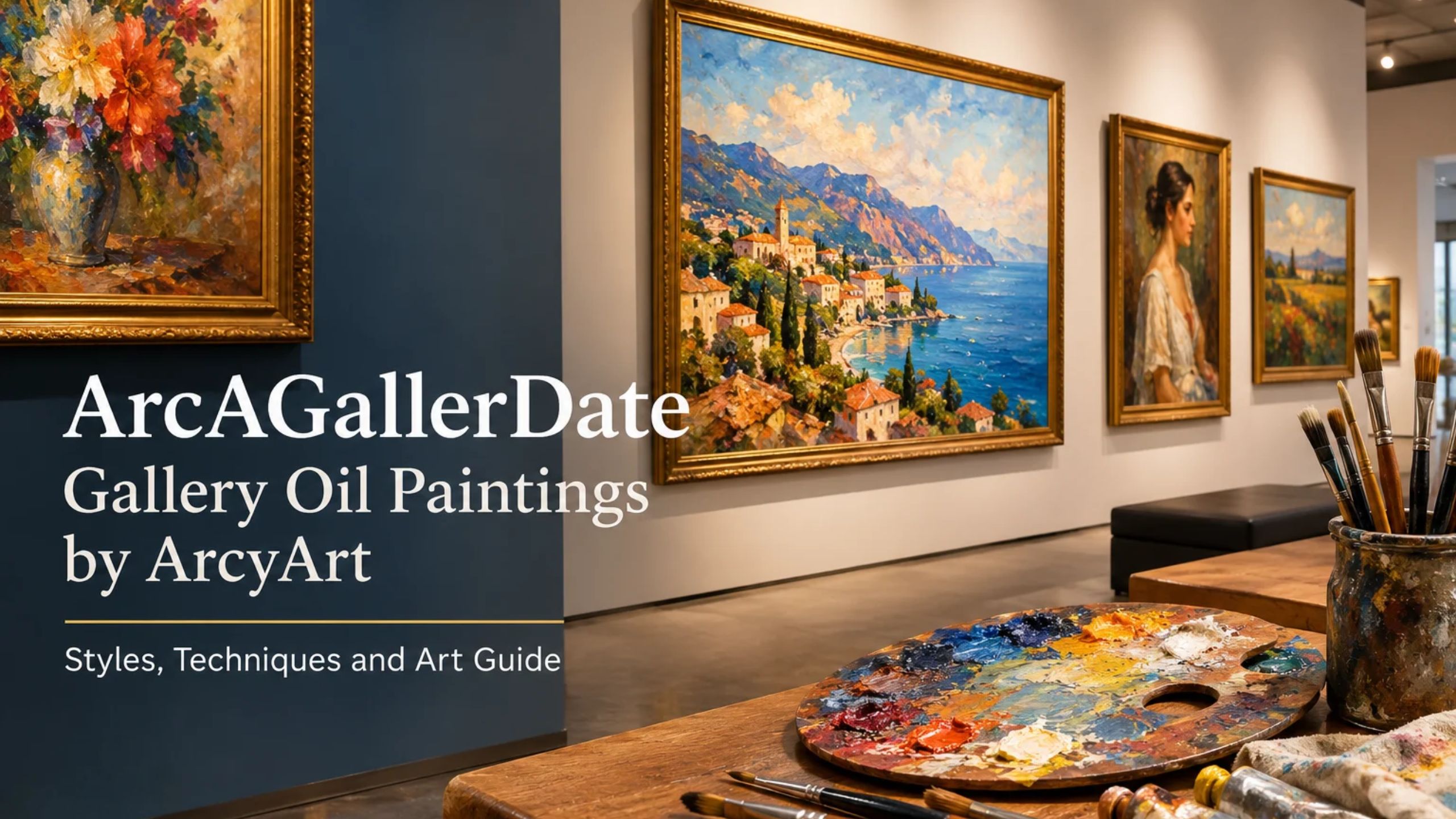
Art can change the way you see a room, a landscape, or even an everyday object. Oil paintings are especially interesting because artists can use color, texture, light and layered brushwork to create depth and visual impact.
If you are exploring ArcAGallerDate Gallery Oil Paintings by ArcyArt, it helps to look beyond the title and understand the artwork itself. This guide explains how to explore painting styles, recognize common oil techniques, evaluate artwork information and make informed choices. Specific details about individual ArcyArt paintings should be checked against reliable artist or gallery records.
What Are ArcAGallerDate Gallery Oil Paintings by ArcyArt?
ArcAGallerDate Gallery Oil Paintings by ArcyArt refers to a topic centered on oil paintings associated with the ArcAGallerDate name and ArcyArt. To understand a particular work, examine its subject, composition, painting medium and documented artist information. Verify titles, materials, dimensions and availability through reliable records rather than assuming every online description is accurate.
What Are ArcAGallerDate Gallery Oil Paintings by ArcyArt?
Oil paintings are artworks created using pigments mixed with a drying oil, commonly linseed oil. Artists use this medium to build color, adjust details and create different surface effects, from smooth transitions to thick, visible brushstrokes.
The phrase ArcAGallerDate Gallery Oil Paintings by ArcyArt identifies the subject of this guide, but the exact relationship between the gallery name, the artist and any specific collection should be established through reliable documentation.
When exploring the collection, look for these details:
- Artist name: Confirm who created the artwork.
- Artwork title: Check whether the title appears in a reliable catalog or artist statement.
- Medium: Establish whether the piece is oil on canvas, oil on panel or a mixed-media work.
- Date: Look for a documented creation year.
- Dimensions: Check the height, width and, where relevant, depth.
- Provenance: Review any available records of ownership and exhibition history.
These details help you understand what you are looking at and distinguish documented facts from interpretation.
Why Artwork Details Matter
A painting’s appearance can tell you a great deal about its composition and visual style, but appearance alone cannot confirm its creator, date or authenticity.
For example, a textured surface may suggest the use of thick paint, but it does not conclusively establish which materials or tools the artist used. Reliable identification may require documentation or examination by a qualified specialist. The National Gallery of Art explains how technical examination can help conservators investigate materials, attribution and an artwork’s history.
Exploring Oil Painting Styles and Subjects
Oil painting supports a wide range of subjects and artistic approaches. Understanding these categories helps you describe what you see without assuming that every style belongs to the ArcyArt collection.
1. Landscape and cityscape paintings
Landscape paintings focus on natural scenery, such as mountains, coastlines, forests and rivers. Cityscapes explore buildings, streets and urban environments.
Look at the arrangement of light and shadow, the depth between foreground and background, and how the artist uses color to create atmosphere.
2. Portraits and still-life paintings
Portraits focus on people and their expressions, poses or surroundings. Still-life paintings arrange objects such as flowers, fruit, books or household items.
Pay attention to the focal point, the balance between objects and the way highlights and shadows suggest form.
3. Abstract and contemporary paintings
Abstract art may emphasize shapes, colors, lines and textures rather than depicting recognizable objects. Contemporary art describes work connected to the present era; it is not a single painting style.
Consider how the colors interact, where your eye travels and whether repeated shapes or contrasts create a visual rhythm.
These categories provide a useful framework for exploring paintings. To say that a specific ArcyArt work belongs to one of them, however, you should identify the actual artwork and examine its documented or visible characteristics.
Oil Painting Techniques and Materials
The medium and technique influence how a painting looks, feels and ages. Learning a few basic terms can help you understand an artwork’s surface and the choices an artist may have made.
Brushwork, texture and impasto
Brushwork refers to the marks made by a brush or another painting tool. Smooth, blended strokes can create a soft appearance, while visible, energetic strokes may make a painting feel more immediate.
Impasto is a technique in which paint is applied thickly enough to create a raised surface. The ridges can catch light and make the texture more noticeable.
A close-up photograph can reveal visible texture, but it cannot always establish the precise medium or technique. Check the artwork’s technical description when available.
Glazing, underpainting and layered color
Oil painting can involve several different approaches to layering.
- Glazing: Applying a thin, transparent or translucent layer over a suitably prepared and dried layer to influence color and depth.
- Underpainting: Establishing an initial layer that helps organize values, composition or color relationships.
- Layered color: Building up paint in stages to develop form, atmosphere and detail.
These techniques are not interchangeable. Nor should they be attributed to an individual artist without supporting evidence.
Oil on canvas versus other surfaces
Canvas is a common support for oil paintings, but artists also work on prepared wood panels and other suitable surfaces.
| Feature | Oil on canvas | Oil on panel |
| Support | Fabric stretched over a frame or otherwise mounted | Rigid wooden or engineered panel |
| Surface behavior | May flex slightly with the support | Generally more rigid |
| Visual result | Depends on preparation, texture and technique | Also depends on preparation, texture and technique |
| Care needs | Sensitive to environmental changes and physical damage | Sensitive to environmental changes and physical damage |
Neither support automatically makes a painting more valuable or better made. The artist’s materials, preparation, execution and the work’s condition all matter.
How to Evaluate an ArcyArt Oil Painting
Whether you are studying a painting for personal interest or considering a purchase, a systematic review helps you make better judgments.
1. Confirm the artist and artwork title
Look for a consistent artist name, a documented title and a reliable source connecting the two. If similarly named artists appear in search results, do not assume they are the same person.
2. Review the medium, date and dimensions
Check whether the painting is identified as oil on canvas, oil on panel or mixed media. Compare the stated dimensions with the actual listing and request clarification if details conflict.
3. Examine the visible condition
Look for cracks, flaking paint, discoloration, tears, warping or damage to the frame. High-quality photographs can help, but they are not a substitute for a professional condition assessment when one is needed.
4. Check provenance and supporting records
Provenance is the documented history of an artwork’s ownership. Depending on the piece, useful evidence may include invoices, exhibition records, previous collection documentation or a credible certificate of authenticity.
5. Verify the seller’s terms
If a work is offered for sale, review the seller’s identity, total price, shipping arrangements, insurance, return policy and any applicable import charges.
How can you tell whether an oil painting is authentic?
Authenticity should be assessed using multiple forms of evidence, not a signature or photograph alone. Depending on the work, an expert may consider provenance, stylistic comparisons, technical examination and records of previous ownership or exhibitions.
The National Gallery of Art describes the role of technical examination in investigating attribution, materials and painting history.
For an ArcyArt painting, begin with the relevant artist or gallery records. If the identity or history remains uncertain, seek an independent opinion from a qualified art professional.
How to Choose an Oil Painting for Your Space
The right painting is one that works with your space, your preferences and your budget. You do not need to follow a particular decorating trend to choose artwork that feels right for you.
Consider size and wall placement
Measure the wall before selecting a painting. Think about the furniture below it, the surrounding space and the distance from which people will view the work.
A large painting can become the main visual focus in a room, while a smaller piece may work well in a reading corner, hallway or grouped arrangement.
Think about color and lighting
Look at the dominant colors in the painting and compare them with your room’s existing colors. A contrasting artwork can create a focal point, while related tones may produce a calmer effect.
Lighting matters, too. Avoid placing valuable paintings where they receive prolonged direct sunlight, and consider how glare affects the way you see the surface.
Check framing, delivery and returns
Before buying, find out whether the price includes a frame, whether the artwork needs special packing and how delivery damage is handled. Confirm the return terms in writing rather than relying on assumptions.
Practical tip: Save a photograph of the painting alongside its confirmed dimensions and place it next to a photograph of the intended wall. This simple comparison can help you judge scale before committing.
What Makes Oil Paintings Different From Acrylic Paintings?
Oil and acrylic paints can both produce detailed, colorful and expressive artwork. The main differences involve their binders, drying behavior and how artists work with them.
| Feature | Oil paint | Acrylic paint |
| Binder | Drying oil, commonly linseed oil | Acrylic polymer dispersion |
| Drying behavior | Often dries slowly, allowing extended blending | Usually dries faster, although conditions and formulations vary |
| Layering | Supports gradual blending and many layered techniques | Supports layering, including relatively quick successive applications |
| Surface effects | Can produce smooth blends or thick impasto | Can produce smooth surfaces or thick textures |
| Care and preservation | Requires appropriate handling and conservation | Also requires appropriate handling and conservation |
Neither medium is inherently superior. The result depends on the artist’s methods, materials and intentions.
If a particular ArcyArt painting is described as an oil painting, check its listing or supporting documentation rather than trying to establish its medium from an online photograph alone.
An Original Framework for Understanding a Painting: Observe, Verify, Interpret
A useful way to explore ArcAGallerDate Gallery Oil Paintings by ArcyArt is to separate what you can see from what you know and what you feel.
This three-part method helps readers appreciate artwork without confusing visual impressions with documented facts.
1. Observe
Record the visible details. Is the composition balanced or asymmetrical? Which colors dominate? Where are the strongest contrasts? Can you see brushstrokes or raised paint?
2. Verify
Check the artist, title, date, medium and dimensions against reliable records. Look for documented statements before attributing a specific meaning or technique to the artist.
3. Interpret
Consider the mood, associations and ideas the painting brings to mind. Your interpretation can be meaningful even when it differs from another viewer’s response.
For example, imagine a painting with a dark blue background, a bright central shape and thick visible strokes. You can observe the contrast and texture directly. You can verify its medium through documentation. You may then interpret the contrast as dramatic or energetic—but that interpretation is yours unless the artist has documented the same intention.
This distinction makes art appreciation more thoughtful and helps keep descriptions accurate.
Caring for Oil Paintings
Oil paintings can remain in good condition for many years, but their preservation depends on the materials, the environment and how they are handled.
The National Gallery identifies environmental factors such as excessive light and unsuitable moisture levels as risks to paintings.
Use these basic precautions:
- Avoid prolonged direct sunlight. Strong light can contribute to changes in sensitive painting materials.
- Keep the environment reasonably stable. Avoid locations with persistent dampness or frequent, extreme environmental changes.
- Handle paintings carefully. Avoid touching the painted surface, and support the frame or structure appropriately when moving the work.
- Avoid household cleaning products. Solvents, water and cleaning agents can damage paint or varnish.
- Consult a conservator for damage. Flaking paint, active cracks, mold or significant discoloration should be assessed by a qualified professional.
These are general preventive-care principles, not a substitute for advice tailored to a particular artwork. The safest treatment depends on the painting’s actual materials and condition.
For additional guidance, consult the National Gallery’s painting-care resource and the National Gallery of Art’s painting conservation information.
Conclusion
In conclusion, exploring gallery oil paintings by ArcyArt offers a valuable way to discover different artistic styles, painting techniques, and creative ideas. Whether you appreciate classic masterpieces or modern oil paintings, understanding the colors, textures, and methods behind each artwork can deepen your appreciation of art and inspire your own creative journey.
FAQs
What is ArcAGallerDate Gallery Oil Paintings by ArcyArt?
ArcAGallerDate Gallery Oil Paintings by ArcyArt is the subject of a collection-focused art guide exploring oil painting, artistic styles and artwork evaluation. To identify the exact collection and its individual works, consult reliable artist or gallery documentation.
What types of oil paintings are associated with ArcyArt?
The supplied topic concerns oil paintings, but the specific subjects and styles should be confirmed from actual collection records. Landscapes, portraits, still life and abstract art are common oil-painting categories, not verified descriptions of every ArcyArt work.
How can you identify an oil painting?
Start with the artwork’s catalog description or documentation. Visible brushwork and texture can provide clues, but photographs alone may not reliably establish the medium; expert examination may be needed when identification matters.
What makes oil paintings different from acrylic paintings?
Oil paint uses a drying-oil binder and generally dries more slowly than acrylic paint. This can give artists more time for blending and layering, although the finished appearance depends on the materials and techniques used.
How can you verify an ArcyArt painting’s authenticity?
Check the artist’s identity, provenance, artwork records and any supporting documentation. A signature or certificate alone may not settle the question, so consider an independent expert assessment if significant uncertainty remains.
How should you care for an oil painting?
Protect it from prolonged direct sunlight, damp conditions, physical damage and unstable environmental conditions. Avoid cleaning the painted surface yourself, and consult a qualified painting conservator if you notice cracking, flaking or other deterioration.
How do you choose an oil painting for your home?
Consider the painting’s dimensions, colors, subject, viewing distance and relationship to the room. If buying online, also check the seller, condition, framing, shipping arrangements and return policy.
What makes an oil painting valuable?
Value can depend on the artist’s established market, provenance, condition, rarity, historical importance and buyer demand. No single feature guarantees a high price, and future appreciation cannot be assured.
