

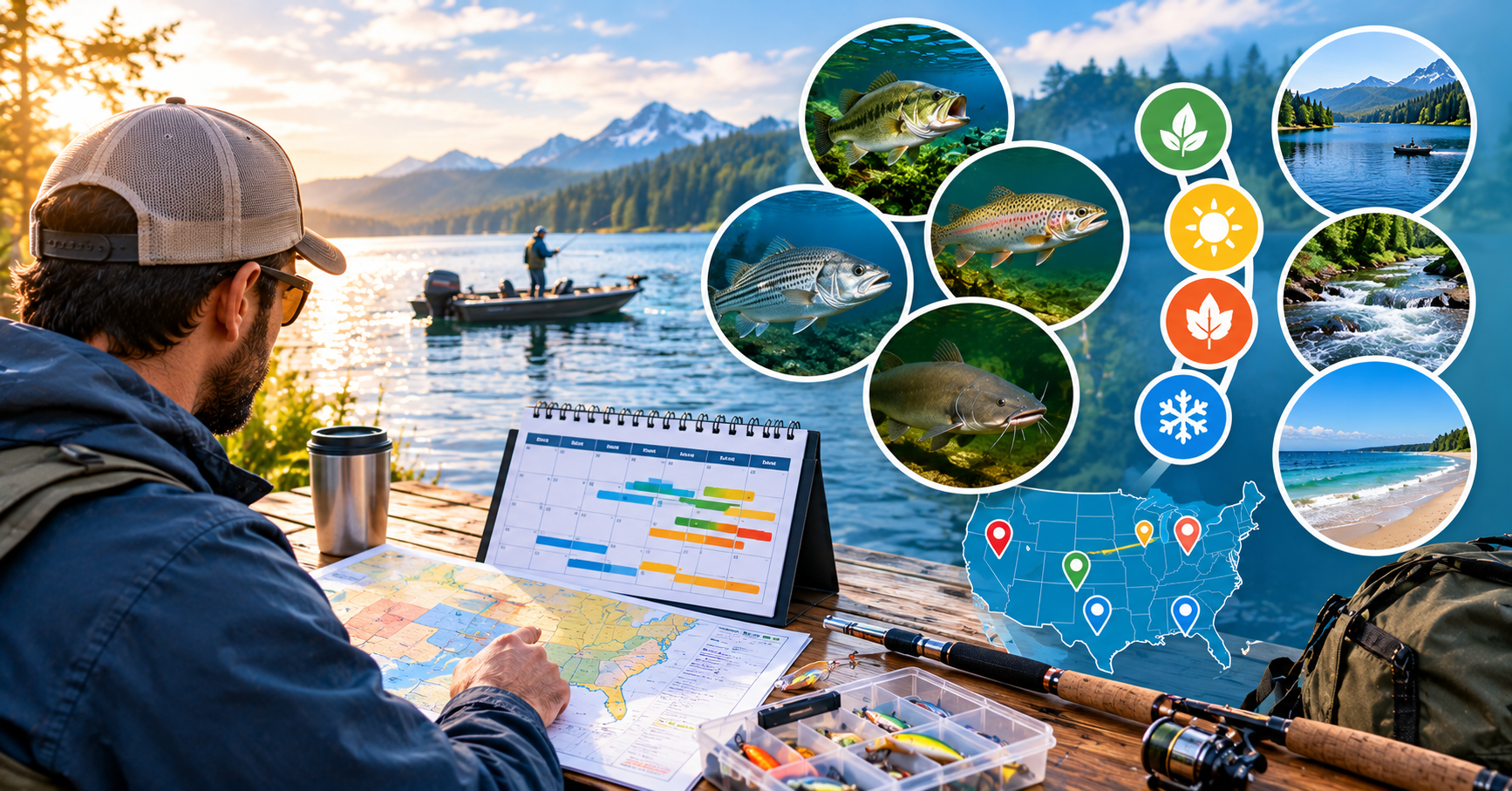
Fishing season depends on your state, the species and the type of water. Many freshwater seasons open in spring. Wisconsin’s general opener is traditionally the first Saturday in May. Trout often open earlier, and some fish, like bass in Pennsylvania, are open all year with limits on keeping them. Always confirm with your state wildlife agency before you go.
Why There’s No Single Fishing Season Date
Think of a fishing season as a three-part lock. You need all three pieces to open it.
A fishing season is the legal period when you may fish for a certain species in a certain place. It is set by the state, not by the calendar.
The three pieces:
- State. Each state agency writes its own rules.
- Species. Trout, bass and walleye can all have different dates in the same state.
- Water type. Streams, lakes and ponds can follow different calendars, and border waters can follow special rules.
Here’s the proof. In Wisconsin, trout in streams opened April 4, 2026, but trout in lakes and ponds opened May 2, 2026, according to the Wisconsin DNR. Same state, same fish, two dates.
Fishing Season Dates by State: 2026–27 Snapshot
Here are the headline dates from four state agencies, pulled from their official pages on October 2, 2026. Dates change, so use this table to orient yourself and your state’s regulations to confirm.
| State | General / opener | Trout | Bass | Walleye |
| Pennsylvania | Species-based; no single opener | Regular season: first Saturday in April through Labor Day. Extended season on stocked waters: Jan 1–Feb 15 and the day after Labor Day–Dec 31 | Open year-round; no harvest from the second Saturday in April to the second Saturday in June | Jan 1–Mar 14; first Saturday in May–Dec 31 |
| Wisconsin | General inland: May 2, 2026–Mar 7, 2027 | Streams: Apr 4–Oct 15, 2026. Lakes and ponds: May 2–Oct 15, 2026 | Northern zone: largemouth harvest from May 2, smallmouth from June 20, 2026. Southern zone: both from May 2, 2026 | May 2, 2026–Mar 7, 2027 |
| Minnesota | 2026 opener: May 9. 2027 opener: May 15 | Stream trout opener: Apr 11, 2026 and Apr 10, 2027 | Covered by the general opener (check regulations for specifics) | Covered by the general opener (check regulations for specifics) |
| New Hampshire | “All other waters”: no closed season | Rivers and streams: Jan 1–Oct 15. Trout ponds: 4th Saturday in April–Oct 15 | Catch-and-release May 15–June 15; most waters otherwise open | Check the NH Freshwater Fishing Digest |
Sources: Pennsylvania Fish and Boat Commission, Wisconsin DNR, Minnesota DNR, New Hampshire Fish and Game.
Pennsylvania
Pennsylvania splits its year by species. Trout has a regular season (8 a.m. on the first Saturday in April to midnight on Labor Day) and an extended season on stocked waters. Walleye and sauger are closed from mid-March until the first Saturday in May. Muskellunge, pickerel and pike are open year-round.
Wisconsin
Wisconsin lists its dates as a window. The 2026–27 general inland season runs from May 2, 2026 through March 7, 2027. Muskellunge harvest is shorter: May 2 through December 31, 2026. Wisconsin also runs an early catch-and-release trout season from January 3 to April 3, 2026.
Minnesota
Minnesota is the easiest to plan around. Its page lists openers years ahead, with the 2027 fishing opener on May 15 and the muskellunge opener on June 5, 2027. Fishing licenses run from March 1 to the last day of February.
New Hampshire
New Hampshire is the “open nearly all year” example. For waters not listed as trout ponds or rivers, there is no closed season. The state posts exceptions per species, such as lake trout (January 1 to September 30, with ice fishing only January 1 to March 31).
California
California’s inland fishing page doesn’t list season dates at all. It points anglers to the freshwater sport fishing regulations, license page and fish planting schedule. If you fish California, start with the regulations, not the hub page.
When Is Trout Season? When Is Bass Season? When Is Walleye Season?
When is trout season?
Trout season in most northern states opens in early spring. In Pennsylvania the regular season opens the first Saturday in April. In Wisconsin it’s April 4, 2026 for streams, and in Minnesota stream trout opened April 11, 2026. New Hampshire rivers and streams are open January 1 through October 15.
When is bass season?
Bass seasons often include a special window to protect spawning fish. Pennsylvania bass are open year-round, but the second Saturday in April to the second Saturday in June is catch-and-release only. During that window, anglers must release bass immediately and cannot cast into spawning beds. New Hampshire sets catch-and-release from May 15 to June 15. Wisconsin delays smallmouth harvest in its northern zone until June 20, 2026.
When is walleye season?
Walleye seasons usually open in late spring and close in winter or early spring. Wisconsin’s runs May 2, 2026 through March 7, 2027. Pennsylvania’s has two parts: January 1 to March 14 and the first Saturday in May to December 31.
| Species | PA | WI | NH |
| Trout (streams) | First Saturday in April–Labor Day (regular) | Apr 4–Oct 15, 2026 | Jan 1–Oct 15 |
| Bass | Year-round; no-harvest mid-April to mid-June | Zone-based opener from May 2 / June 20 | Mostly open; C&R May 15–June 15 |
| Walleye | Jan 1–Mar 14; first Saturday in May–Dec 31 | May 2, 2026–Mar 7, 2027 | See NH digest |
Which Fish Can You Catch Year-Round?
Some species have no closed season at all. The answer is still “it depends,” but here are verified examples:
- Pennsylvania: muskellunge, pickerel and pike are open year-round. So is bass, though with that spring no-harvest window.
- New Hampshire: “All other waters” have no closed season.
- Wisconsin: The state keeps a “year-round fishing waters” page, because some waters are exceptions to the general calendar.
Open year-round doesn’t mean no limits. Size limits, daily limits and special rules can still apply.
What a Closed Season Really Means (Even for Catch-and-Release)
Here’s a rule many anglers get wrong. A closed season usually means you can’t fish for that species at all. That includes catch-and-release.
Wisconsin DNR says it plainly: for listed species, it is illegal to fish for them during the closed season, including catch-and-release fishing. Species not listed on its seasons page have no open season.
The exception is when a rule is explicitly built around release. Pennsylvania’s bass no-harvest period, for example, is open for fishing but requires you to return bass to the water. Read each rule carefully. “Closed” and “catch-and-release only” are different.
Free Fishing Days, Youth Days and License Years
These dates are easy to miss and worth putting on your calendar.
- Pennsylvania Fish-for-Free Days (2026): May 24 and July 4. No license is required, and trout/salmon and Lake Erie permits aren’t either. All other regulations still apply.
- Pennsylvania Mentored Youth Day: the last Saturday in March, a week before trout season opens.
- Wisconsin Free Fishing Weekends: June 6–7, 2026 and January 16–17, 2027.
- Minnesota Free Fishing Weekends (2027): January 16–18 (ice fishing), May 8–9 (Take a Mom Fishing Weekend) and June 4–6 (Take a Kid Fishing Weekend).
- Minnesota license year: March 1 through the last day of February. Don’t buy early and assume it covers the next opener.
Ice Fishing and Winter Seasons
Winter isn’t off-season everywhere. Some states open earlier than you’d expect.
- Wisconsin allows early catch-and-release inland trout fishing from January 3 to April 3, 2026.
- New Hampshire limits some lake trout and salmon waters to ice fishing only from January 1 to March 31.
- Minnesota runs a “Take a Kid Ice Fishing Weekend” each January (January 16–18, 2027).
Safe ice is your responsibility, not a regulation. Check your agency’s ice safety guidance before you walk out.
Freshwater vs. Saltwater Seasons
Saltwater works under a different system. Here’s the short version.
Where you fish matters. According to NOAA Fisheries, state waters generally cover 0 to 3 nautical miles offshore, and anglers there should contact their state fish and wildlife agency. Federal waters typically span 3 to 200 nautical miles. In the Gulf, state waters extend further off Texas and Florida’s Gulf coast (9 nautical miles, per one third-party summary), so state-water seasons can differ from federal ones.
In practice, that means:
- Check both. Federal rules apply offshore, while state rules apply close to shore.
- Expect differences. Red snapper seasons in Texas state waters, for example, can run longer than the federal season on the same coast.
- Know your license. NOAA notes that a state saltwater fishing license or registration is needed for most recreational anglers.
If you’re fishing salt, start at NOAA Fisheries’ regional pages and your state marine agency.
Why Seasons Exist: Spawning and Conservation
Seasons aren’t random. They exist to protect fish at their most vulnerable.
Pennsylvania’s bass rule shows the idea. During the no-harvest window, anglers must release bass right away and cannot cast into spawning beds. That protects fish while they’re nesting.
Wisconsin’s delayed smallmouth harvest in its northern zone works the same way: fish get time to spawn before they can be kept.
Want to add expert authority? Quote a state fisheries biologist here on why the dates were chosen. I haven’t invented one. This section is the best place to add a first-hand source.
How to Find Your Exact Fishing Season Dates in 5 Steps
- Pick your state agency. Search “[your state] fish and wildlife” or “[your state] DNR.” Look for a .gov address.
- Choose your species. Open the seasons page or the current regulations digest for that fish.
- Match your water. Find your lake, river or pond. Look for special rules by county or water body. Wisconsin, for example, notes that not all waters follow the general dates.
- Check for emergency changes. Wisconsin says temporary or emergency rules may change dates for a species or waterbody, and notices may be posted at boat landings. Check the agency’s news page too.
- Confirm your license. Make sure your license is current for the license year, and note any free-fishing days that could save you a purchase.
The Three-Question Season Check
Here’s a simple tool to use every time you plan a trip. Ask these in order:
- Where? (Which state, and which water?)
- What? (Which species?)
- When does it open and close? (Is there a no-harvest period, a closed period or a special rule?)
Working example: You want to fish for bass in Pennsylvania in May.
- Where? Pennsylvania, an inland lake.
- What? Largemouth bass.
- When? Bass is open year-round, but May falls in the no-harvest window. You can fish, but you must release every bass and avoid spawning beds.
Brand note: If you have your own anglers’ stories, guide interviews or local reports, add one here. First-hand experience is your biggest edge.
FAQs
When does fishing season start?
It depends on your state, species and water. Many freshwater seasons open in spring: Wisconsin’s general opener is traditionally the first Saturday in May, and Minnesota’s was May 9 in 2026. Some species, like Pennsylvania bass, are open year-round.
What month is fishing season?
There’s no single month. Trout often opens in April, general fishing in May, and some species run into winter. Check your state agency for your species.
Can you fish year-round?
In many places, yes, for certain species. Pennsylvania lists bass, muskellunge, pickerel and pike as open year-round, and New Hampshire has no closed season in “all other waters.” Other species have closed seasons.
Is there a closed season for fishing?
Yes, for many species. Wisconsin states that during a closed season it is illegal to fish for those species, including catch-and-release fishing.
When is trout season?
In the states covered here, stream trout opens in early to mid-April. Pennsylvania opens the first Saturday in April, Wisconsin on April 4, 2026 and Minnesota on April 11, 2026. New Hampshire rivers and streams run January 1 to October 15.
When is bass season?
It varies. Pennsylvania bass are open year-round with a no-harvest period from the second Saturday in April to the second Saturday in June. Wisconsin starts smallmouth harvest in the northern zone on June 20, 2026.
Do you need a license on a free fishing day?
Usually not. Pennsylvania’s Fish-for-Free Days (May 24 and July 4, 2026) require no license, but all other fishing regulations still apply.
When is the best month to fish?
The legal season and the best bite are different questions. This guide covers legal dates. For timing the bite, a local biologist, bait shop or the agency’s fishing report is your best source.
