

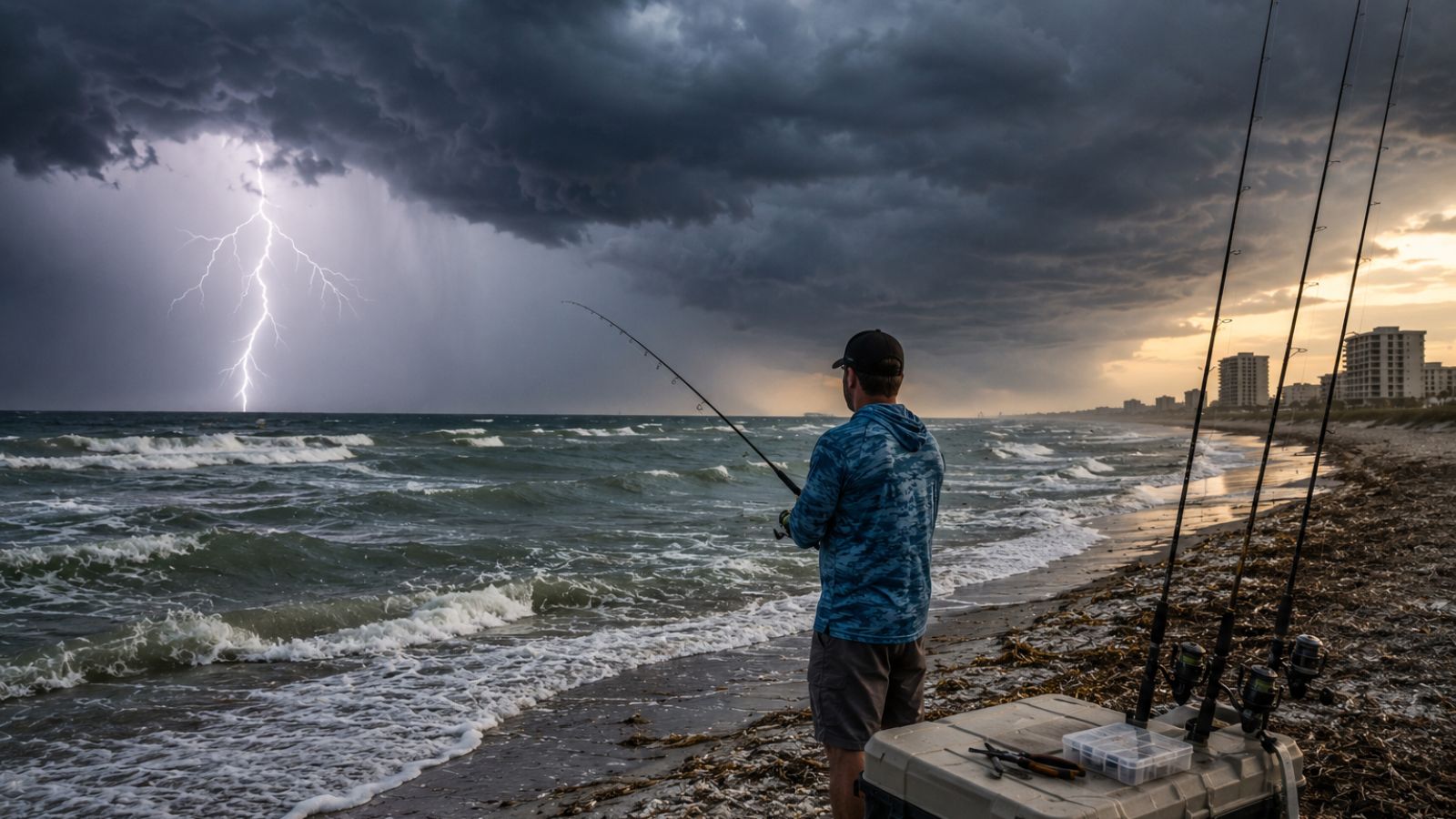
Fishing “thunder on the Gulf” means targeting the window of changing barometric pressure and bait activity that surrounds a coastal thunderstorm — the hour or two before it hits, and sometimes the calm right after. Falling pressure can trigger aggressive feeding in species like speckled trout, redfish, and tarpon, but the same storm brings real lightning and wind risk, so timing and safety matter as much as technique.
Why Fish Feed Differently Before a Storm
Anglers up and down the Gulf from Texas to the Florida Panhandle — have long noticed the same pattern: as a storm approaches and barometric pressure drops, fish activity often picks up before it falls off once the storm is directly overhead.
The working theory is straightforward: falling pressure changes water density near the surface, which affects baitfish behavior. Baitfish get pushed shallower or bunch up, and predator species like trout, redfish, and jack crevalle key in on that easy meal while conditions still allow them to feed comfortably. Once the storm hits in full — heavy wind, hard rain, wave chop — most species pull back, hunker down, or move to deeper, calmer water.
That gives you a real but narrow window: roughly 30–90 minutes before the leading edge of a storm arrives.
Reading the Signs Before You Cast
You don’t need a meteorology degree — just pay attention to a few reliable cues:
- Darkening skies to the west or south — the Gulf’s prevailing storm direction in summer
- A sudden drop in wind, or a shift in wind direction — often the calm before the front
- Baitfish schooling tighter near the surface or flipping/nervous water
- Increased bird activity — diving gulls or terns often mean bait is being pushed up
- A noticeable temperature drop in the air
If you see two or more of these at once, you’re likely in that pre-storm feeding window.
Techniques That Work in Changing Conditions
Before the storm arrives: Topwater lures — poppers, walking baits (think “walk-the-dog” style plugs) — can be deadly in the last hour before a storm, especially in low light. Fish are often feeding near the surface and reactive strikes go up.
As wind and chop build: Switch to something with more visible profile and vibration — a paddle-tail soft plastic on a jighead, or a spinnerbait-style lure — since visibility drops in choppy, murky water.
Once the storm is active: This isn’t fishing time. Get off the water. If you’re still fishing as thunder starts, you’ve misjudged your window — more on that below.
After the storm passes: Many Gulf anglers find a second, shorter window right after a storm clears — water is freshly oxygenated, and fish that held tight during the worst of it start feeding again. Deeper structure — channel edges, dock pilings, jetty bases — tends to hold fish that have retreated from open, choppy water.
Where to Fish It Along the Gulf Coast
Storm-window fishing works best in areas with a mix of accessible shallows and nearby deep refuge, so fish (and you) have somewhere to go when conditions shift fast:
- Grass flats and back bays — good for the pre-storm topwater bite on trout and redfish
- Jetties and passes — current and structure concentrate baitfish and give you a fast retreat option
- Nearshore reefs — for anglers with a boat, but only if you’re confident you can outrun the front
Shore and pier anglers have an advantage here: no boat to secure, no open-water exposure, and a straight shot to your vehicle when the sky turns.
Safety Comes First — Every Time
This is the part that gets skipped in a lot of “storm fishing” content, and it shouldn’t be.
- Lightning is the real threat, not wind or rain. Water and open boats are exactly where you don’t want to be when lightning starts. If you hear thunder, you’re already close enough to be at risk — the “30-30 rule” (seek shelter if less than 30 seconds between lightning and thunder, wait 30 minutes after the last strike before resuming) is a good baseline.
- Set a hard turnaround time, not a “just one more cast” mentality. Storms on the Gulf can move faster than they look on radar.
- Check a real-time marine forecast (NOAA’s National Weather Service marine forecasts are the standard) before you head out, and keep a way to check radar while you’re on the water.
- Boaters: know your route back before you need it, keep required safety gear (PFDs, VHF radio, navigation lights) checked and accessible, and don’t wait until the storm is visible to start heading in.
- Everyone: if in doubt, sit it out. No fish is worth the risk.
A Few Gear Notes
- Braided line handles the increased wind and current of pre-storm conditions better than mono — less stretch, more sensitivity to detect strikes in choppy water.
- Polarized sunglasses help you read the water and spot bait activity even as light gets flat and gray.
- A dry bag for your phone/electronics is non-negotiable if you’re fishing storm-adjacent conditions at all.
FAQ
Is it actually safe to fish before a thunderstorm?
It can be, if you leave the water well before the storm arrives and you’re monitoring conditions closely. The danger isn’t the pre-storm window itself — it’s misjudging how fast the storm is moving and staying out too long.
What fish are most active before a Gulf storm?
Speckled trout, redfish, and tarpon are the species most commonly reported as more aggressive during falling-pressure conditions, though results vary by location and season.
Do I need a boat to fish this window?
No — piers, jetties, and surf access points work well, and they come with the added safety benefit of a fast, dry retreat when the storm actually hits.
How do I know when to stop fishing and leave?
Use the 30-30 rule: if you can count less than 30 seconds between seeing lightning and hearing thunder, get off the water immediately, and don’t return until 30 minutes after the last strike.
What’s the best lure for pre-storm topwater fishing?
Walking-style topwater plugs and poppers tend to draw aggressive reaction strikes in the low light and surface activity that often precede a storm.
