

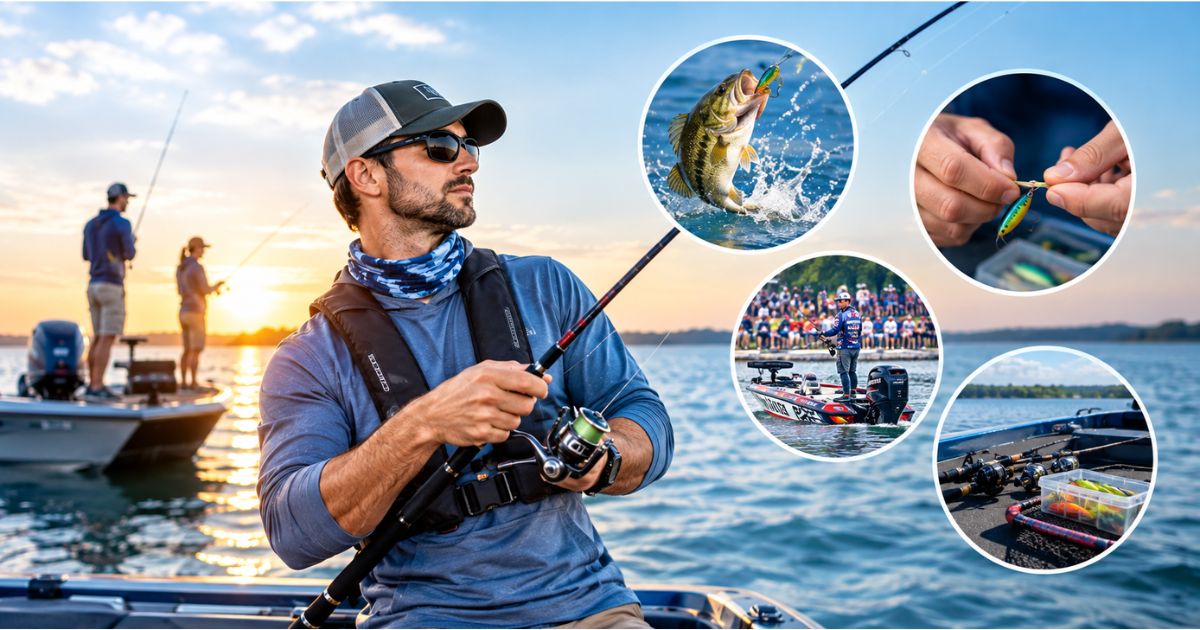
Is Fishing a Sport? Yes by every standard definition, fishing is a sport. It requires skill, physical exertion, and structured competition, and it’s governed by real rules through organizations like B.A.S.S. and the Confédération Internationale de la Pêche Sportive (CIPS). The catch is that not all fishing is competitive. A relaxed afternoon on the bank is closer to a hobby, while tournament fishing checks every box a “sport” needs to check.
You’ve probably heard someone say fishing isn’t a “real” sport because “anyone can do it” or because “you’re just sitting there.” Fair question. Let’s actually test it against the real criteria instead of just arguing about it.
What Actually Makes Something a “Sport”?
A sport is generally defined as an activity that requires physical exertion and skill, is governed by a set of rules, and involves competition between individuals or teams.
That’s four separate boxes to check:
- Physical exertion; does your body have to work?
- Skill; does it take real, learnable technique?
- Competition; do people compete against each other, not just the activity itself?
- Rules; is there a structure that governs how it’s played?
Chess checks skill and competition but barely touches physical exertion. Running checks exertion but has almost no skill ceiling. A real sport usually needs to clear all four and that’s exactly the test fishing has to pass.
Applying the Criteria to Fishing, Point by Point
Physical exertion: Fighting a large fish on a rod and reel works your forearms, shoulders, back, and core, sometimes for 15+ minutes straight. Add wading against a current, hiking to remote spots, or standing for hours in a boat, and the “no exertion” argument falls apart fast at least for anything beyond bank fishing with a bobber.
Skill: Casting accuracy, reading water and weather, matching lures or bait to fish behavior, and understanding a species’ seasonal patterns all take years to develop. This is the criterion fishing clears the most easily even skeptics rarely argue fishing takes zero skill.
Competition: Fishing tournaments pit individual anglers or teams against each other for the biggest or heaviest catch, on a set schedule, with a declared winner. That’s direct, structured competition not just “you versus the fish.”
Rules: Tournament fishing runs on strict rulebooks covering catch limits, boundaries, gear restrictions, and scoring. Recreational fishing runs on state and federal regulations (licenses, size limits, seasons). Either way, there are real rules: this isn’t a free-for-all.
“But You’re Just Sitting There” Debunking the Biggest Objection
This is the objection that actually drives most of the “is fishing a sport” searches, so it’s worth answering directly instead of dodging it.
The honest answer: it depends which kind of fishing you’re picturing. Sitting on a dock with a bobber and a soda is genuinely low-exertion nobody’s claiming that’s an athletic event. But that’s not what’s happening in a bass tournament or offshore trolling for tuna. Casting a spinnerbait for 8 hours straight, standing the whole time, works the same muscle groups repeatedly enough that tournament anglers regularly report sore shoulders and forearms the next day the same kind of overuse soreness you’d expect from a repetitive-motion sport like tennis or rowing, not from an afternoon of sitting still.
The “just sitting there” image describes one style of casual fishing. It doesn’t describe wade fishing, kayak fishing, fly fishing, or tournament bass fishing and lumping all of fishing into that one image is where the objection breaks down.
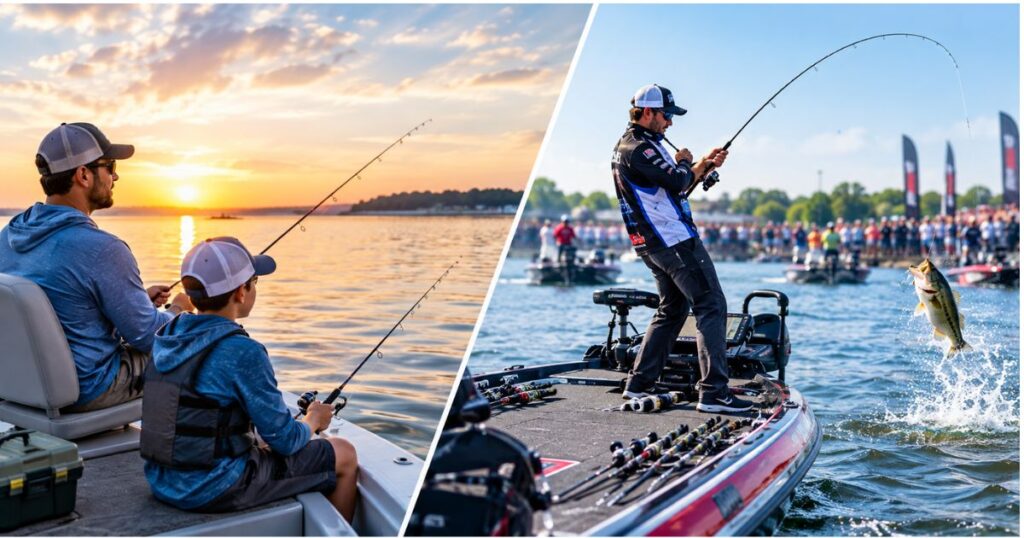
Recreational Fishing vs. Competitive Fishing Two Different Answers
| Recreational (casual) fishing | Competitive (tournament) fishing | |
| Physical exertion | Low to moderate | Moderate to high |
| Skill required | Basic to intermediate | Advanced, specialized |
| Structured competition | Rare (self-set goals) | Built-in, scored, ranked |
| Governed by formal rules | Regulations only (license, limits) | Full tournament rulebook |
| Closer to | A hobby | A sport |
This is really the core of the whole debate: people arguing “fishing isn’t a sport” are usually picturing recreational fishing, while people arguing “fishing is definitely a sport” are usually picturing the tournament version. Both are right about the version they’re picturing they’re just not picturing the same activity.
Is Fishing an Olympic Sport?
Not currently but it’s closer than most people realize. Fishing made a brief, unofficial appearance as a demonstration event at the 1900 Paris Olympics and hasn’t been back since.
CIPS, fishing’s international governing body, has been actively pursuing Olympic recognition for years. It applied for IOC consideration ahead of the 2020 Tokyo Games and was turned down, with the IOC citing the need for broader global participation beyond fishing’s Europe-heavy base. Since then, CIPS has been accepted by SportAccord and AIMS (associations that help federations build toward IOC status) and has since applied to ARISF the Association of Recognized International Sports Federations as the next formal step toward Olympic recognition.
So the accurate, current answer is: fishing isn’t an Olympic sport yet, but its governing body is actively working toward that recognition, and it has already cleared some of the preliminary steps.
The Money and the Numbers Behind Competitive Fishing
The scale of organized fishing in the U.S. keeps growing, and the money involved has grown right along with it:
- A record 57.9 million Americans age 6 and up went fishing in 2024 19% of the U.S. population according to the Recreational Boating & Fishing Foundation’s 2025 Special Report on Fishing.
- The Bassmaster Elite Series, professional bass fishing’s top tour, pays $100,000 to the winner of each individual tournament stop in its 2026 season.
- A newly announced 2026 event, The Champions Tournament, will pay out $1.25 million to first place the largest single cash prize in competitive fishing history, with $500,000 for second and $300,000 for third.
Numbers like that don’t attach themselves to hobbies. Sponsors, prize purses, and season-long ranking systems (like Bassmaster’s Angler of the Year points race) are sport infrastructure, the same kind of scaffolding that supports golf, tennis, or NASCAR.
What Anglers Themselves Actually Say
Dig into any long-running angler forum thread on this exact question, and the opinions split into three fairly consistent camps, not two:
- “It’s a sport, full stop” anglers who point to the skill, tournament structure, and physical toll of a full day fighting fish.
- “Fishing is a sport, but that doesn’t make every fisherman an athlete” a more nuanced camp that separates the activity (which they’ll call a sport) from the participant (who isn’t necessarily athletic, the same way not every weekend golfer is an “athlete”).
- “It’s a skill, not a sport” a smaller camp that compares fishing to poker: something that takes real skill and can be competitive, but that they don’t feel belongs in the same category as physically demanding sports.
That second camp is the one most “is fishing a sport” articles skip entirely but it might be the most accurate read: fishing clears the bar as a sport, while individual anglers vary widely in whether they’d call themselves athletes. Same distinction we’d make for a casual weekend golfer versus a PGA Tour pro.
FAQ
Is fishing considered a sport or a hobby?
Both, depending on context. Casual, low-effort fishing functions more like a hobby, while tournament and competitive fishing meets the standard criteria for a sport: exertion, skill, competition, and rules.
Why do some people say fishing isn’t a sport?
Mostly because they’re picturing relaxed, low-effort recreational fishing sitting with a line in the water rather than the physically demanding, competitive tournament version.
Is fishing an Olympic sport?
Not yet. It appeared once as an unofficial demonstration event in 1900. Its governing body, CIPS, has applied for formal Olympic recognition and is still working through the IOC’s approval process.
Are professional fishermen considered athletes?
Many are, especially top tournament anglers who train physically and compete under real athletic and mental strain. Casual anglers, like casual golfers, don’t necessarily qualify as athletes just because their activity is a sport.
What’s the biggest prize in competitive fishing?
As of 2026, the newly launched Champions Tournament offers a $1.25 million first-place prize, the largest in the sport’s history, ahead of the Bassmaster Classic’s $300,000 top prize.
