

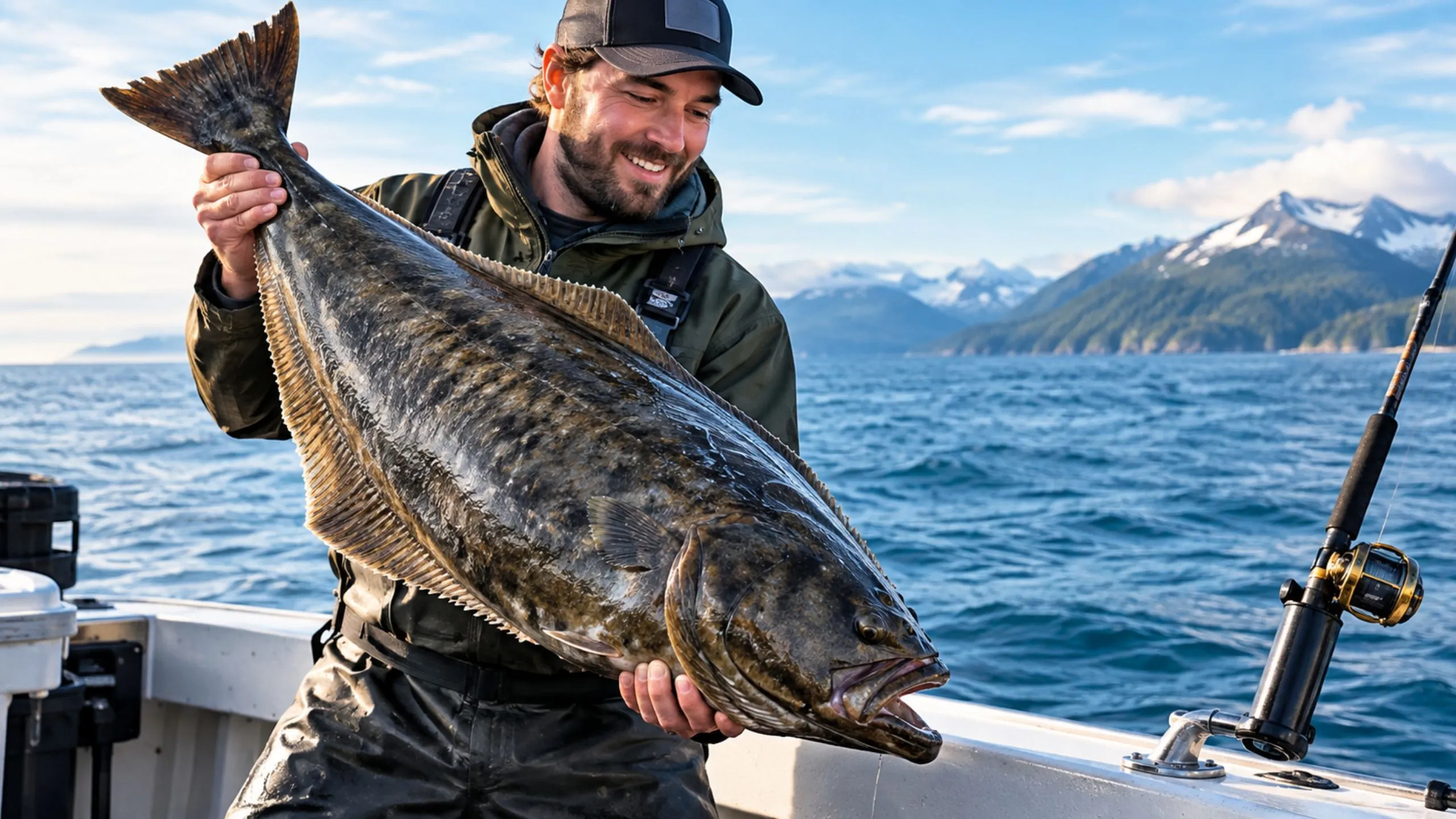
Halibut fishing isn’t a secret reserved for Alaska-bound trophy hunters. You can learn to catch halibut with basic gear, fundamental techniques, and the right knowledge. Halibut fishing combines patience, the right equipment, and an understanding of where these powerful fish live. Once you master the core techniques and match your location to the season, success becomes predictable not guaranteed, but genuinely probable.
Halibut fishing works best with heavy jigging rigs in deep water (200–300+ feet) or trolling near structures. Your best bet is jigging, dropping a weighted lure to the seafloor, lifting it hard, and holding on for aggressive strikes. Peak seasons vary by region: Alaska peaks spring through summer (May–August), while California fishes year-round with hot months from May through October. You’ll need a sturdy rod rated for heavy jigging (30–50-lb class minimum), a quality reel, a strong line, and local regulations knowledge.
What You Need to Know Before You Start
What Is Halibut? (And Why It Matters)
Halibut is a flatfish and one of the largest and most aggressive flatfish in North American waters. Two species matter to US anglers: Pacific halibut (found from California to Alaska) and Atlantic halibut (rare in recreational fishing, mostly East Coast). When people talk about halibut fishing in the USA, they mean Pacific halibut.
Here’s what makes halibut special: they’re bottom dwellers that live in deep, cold water. They’re aggressive hunters not picky eaters. A 50-pound halibut will strike a jigging lure with violent intent. That’s why halibut fishing feels so rewarding. You’re not finesse fishing; you’re targeting a fish that wants to eat what you’re offering.
Why halibut fishing is worth learning: Halibut provide consistent action, grow to impressive sizes (20–100+ lbs are real), and live in stunning locations. You don’t need elite skills or expensive travel. Many halibut are caught by beginners on their first outing.
Is Halibut Fishing Hard?
No, not in the way you might think. Halibut don’t require subtle presentations or tricky casting. They’re not shy. A beginning angler with basic gear and location knowledge catches halibut regularly.
What’s actually hard: Getting to halibut requires a boat (except a few rare shore-access spots). Finding their depth and location demands some planning. Weather can shut down fishing in coastal regions. And physically, jigging all day builds arm and back muscles fast.
But technique-wise? Halibut fishing is straightforward. Drop, jig, hold tight.
Regional Overview: Where Americans Fish Halibut
| Region | Main Locations | Access | Best for |
| Alaska | Bering Sea, Gulf of Alaska | Mostly charter; some DIY remote | Trophy size; peak experience |
| California | San Diego to Central Coast | Charters + DIY accessible | Year-round opportunity; easy access |
| Pacific Northwest | Washington, Oregon coasts | Limited; mostly charters | Shorter season; growing opportunity |
| Other | Gulf of Mexico (rare) | Very limited | Niche destination |
Alaska dominates halibut fishing for size and prestige. California dominates for accessibility and year-round seasons. The PNW sits in between. Pick based on your budget, time, and experience level.
Halibut Fishing Gear Setup (The Essentials)
Rod & Reel Basics
Halibut fishing demands heavy equipment because you’re fighting depth (300+ feet of line pressure) and weight (jigging lures + fish). Wimpy rods break. Light reels jam.
Rod Requirements:
- Power: Medium-heavy to heavy (rated for 30–50 lbs)
- Length: 5.5–6.5 feet (shorter is better for jigging; easier to pump in deep water)
- Action: Fast (bends near the tip; quick energy transfer for hook sets)
- Material: Fiberglass or composite (more forgiving than graphite in deep jigging)
Why this matters: A rod rated for 30-lb line gives you the leverage to set the hook hard at 250+ feet of depth. Lighter rods don’t generate enough energy. You’ll feel the difference on the first strike.
Reel Requirements:
- Type: Conventional (baitcasting) reel not spinning (you need the power)
- Capacity: 300+ yards of 30–50-lb braid
- Drag: Smooth and reliable (loads will be heavy)
- Speed: Medium retrieve (around 4:1 gear ratio; you want steady power, not speed)
Real-World Setup Example:
A beginner’s solid jigging combo: Penn Senator (or similar level-wind conventional reel) + heavy-action fiberglass rod + 40-lb braided line. Cost: ~$250–350. It’ll last years, hold up to hard use, and land every halibut you hook.
Line, Leader & Terminal Tackle
Main Line: 40–50-lb braided line is standard for halibut jigging.
- Why braid? Zero stretch. Crucial at 250+ feet deep you need direct contact to feel bites and set hooks.
- Why 40–50-lb? Matches your rod rating and handles the combined weight of lure + current + fish.
Leader: 50–80-lb fluorocarbon or monofilament, 3–4 feet long.
- Fluorocarbon is less visible (halibut can be line-shy in clear water).
- Connect your main line to your lure via a quality knot (Palomar or uni-knot).
Sinkers & Weights: This is critical. Your jigging lure needs weight to reach bottom in deep water and to maintain bottom contact against current.
- Deep water (200–400 feet): 8–16-oz jigging lures or pyramid sinkers
- Medium depth (100–200 feet): 4–8-oz lures
- Shallow depth (<100 feet): 2–4-oz lures
Why depth matters: Cold, deep water has currents. A light lure drifts uselessly. A heavy lure stays on bottom where the halibut hunts.
Lures & Bait
Jigging Lures (Most Effective for Beginners):
- Vertical jigging lures: Spoons (Hopkins, Crippled Herring style) and diamond jigs (shiny, flashy, basic shapes)
- Colors: Silver, white, chartreuse in clear water; darker colors (purple, black) in murky water
- Why they work: Visual flash + vibration + the jigging action mimics wounded baitfish
Live Bait (Also Very Effective):
- Herring: Pacific herring (10–14 inches) are halibut candy
- Mackerel: Jack mackerel, Pacific mackerel work well
- Rigging: Hook through the nose or back; keep them alive by oxygenating the bait tank
- Best used: Drifting near structure; less effective in super-deep water
Cut Bait (Budget Option):
- Cut herring or mackerel: cheaper, easier, still works
- Fish slower (less active, needs time to attract)
Beginner recommendation: Start with jigging lures (easier to control, no bait tank complexity, faster action). Once you nail jigging, experiment with live bait.
Budget Breakdown: Entry-Level to Serious Angler
| Tier | Rod & Reel | Line/Leader | Lures/Bait Setup | Safety Gear | Total |
| Entry-Level | $200–300 | $40–60 | $30–50 (lures) | $50–80 | $320–490 |
| Intermediate | $400–600 | $60–100 | $80–150 (lures + bait tank) | $100–150 | $640–1,000 |
| Serious | $800–1,200 | $100–200 | $200–400 (backups, premium) | $200–300 | $1,300–2,100 |
The Entry-Level Kit: You can fish successfully for ~$400. No frills; everything functional.
The Intermediate Kit: Better reliability, multiple lure types, bait capacity. Confidence builder. ~$800.
Safety gear includes: PFD (personal flotation device), first-aid kit, signaling device, sunscreen, polarized sunglasses. Don’t skip this. Ocean fishing demands respect.
The Best Halibut Fishing Techniques
Halibut don’t require fancy presentations. Three techniques work: jigging, trolling, and live-bait fishing. For beginners, jigging is the fastest skill to master.
Jigging (The Most Effective Method for Beginners)
Why it works: Jigging mimics a wounded baitfish struggling to escape. Halibut finds it irresistible. It’s also the most interactive technique where you’re in constant contact with the lure and the bottom.
Step-by-Step Jigging How-To:
Step 1: Establish Your Location
- Find a depth chart or GPS mark (150–400 feet over structured bottom is ideal)
- Use a fish finder if available; look for hard bottom (rocks, reefs)
- Halibut hang near structure: slopes, drop-offs, rocky outcrops
Step 2: Drop to Bottom
- Release line and drop your jigging lure straight down
- Maintain contact keep the line mostly vertical
- Feel when the lure touches bottom (slight slack in the line)
Step 3: The Jigging Motion
- Pump the rod upward sharply (2–3 feet) with a hard, quick motion
- Drop the rod back down, recovering line at the same time
- This creates an up-and-down, erratic lure action
- Repeat in steady rhythm: up-up-up, down-down-down (about 2-second cycles)
Step 4: Stay Alert
- Halibut hit hard. You’ll feel a solid tug or sudden weight
- Set the hook immediately with an upward rod jerk
- Reel steadily, keeping pressure on; halibut pull hard
Step 5: Work the Full Water Column
- If you’re not getting bites at bottom, jig higher (20–50 feet up from the seafloor)
- Some days, fish suspend slightly. Adjust depth accordingly
Depth & Conditions:
- Best depth for halibut: 200–350 feet in Alaska; 150–250 feet in California
- Current strength: Light current (less than 1 knot) is ideal. Strong currents make deep jigging exhausting
- Time on bottom: Spend 20–30 seconds per depth zone before moving up; then drop back and repeat
Jigging is tiring but addictive. You feel every bite. Beginners often catch halibut on their first drift because the technique is so direct.
Trolling
When to use trolling: When you want to cover more water or fish shallower depths (80–200 feet).
How it works:
- Motor slowly (1–3 knots) over likely halibut grounds
- Troll a large jigging spoon or swimsuit lure behind the boat
- Keep the lure at a depth where halibut are (use a fish finder to estimate)
- Halibut strike aggressively; the rod tip will telegraph the bite
Best for: Finding new spots, covering shallow-to-mid depth zones, less strenuous than jigging
Drawback: Less precise than jigging; fewer bites per outing, but more casual.
Regional suitability: California halibut respond well to trolling. Alaska jigging is more common.
Live Bait Fishing
When to use: When halibut are actively feeding or when you want a passive presentation.
How it works:
- Rig a live herring (10–14 inches) on a large circle hook (6/0–8/0)
- Add enough weight to reach bottom but keep the bait active (pyramid sinker or sliding weight)
- Lower to bottom slowly
- Hold the rod and wait live bait does the attracting for you
- When you feel steady pulling/shaking, set the hook with a firm upward jerk
Best bait species: Pacific herring (gold standard), mackerel, squid
Why it works: Live bait is a buffet. Halibut can’t resist it.
Best used: Drifting over known structure; slower, more meditative than jigging
Drawback: Requires a bait tank and live bait cost. Best with experienced help initially.
Bottom Fishing (Drift with Sinker)
When conditions demand it: In strong current or very deep water where jigging becomes impractical.
How it works: Drop a weighted rig with cut bait or a lure, let it sit on bottom, and wait for bites. Simple and passive good backup option when jigging is exhausting.
TECHNIQUE COMPARISON TABLE
| Technique | Best Depth | Effort Level | Bite Frequency | Best For Beginners? | Best Season |
| Jigging | 200–350 ft | High (active) | High | Yes (learns fast) | Spring–Fall |
| Trolling | 80–200 ft | Medium (steady) | Medium | Yes (passive alternative) | Summer |
| Live Bait | 150–300 ft | Low (patient) | Medium–High | Yes (with guidance) | Year-round |
| Bottom Drift | 300+ ft | Medium | Medium | Yes (backup option) | Anytime |
Halibut Fishing Season & Regional Guide
Halibut seasons shift dramatically by geography. Alaska’s halibut are catchable only in warmer months. California’s fish bite year-round. Matching season to region is the single biggest factor in your success rate.
Alaska The Benchmark
Bering Sea & Bristol Bay (Iconic Fishery):
- Best months: June–August (peak) | May, September (shoulder season)
- Why: Warmer water, migrating halibut, most accessible weather windows
- Typical fish size: 20–60 lbs average; 100+ lbs possible
- Depths: 150–300 feet
- Access: Virtually all charter-based (remote, few DIY options)
- NOAA Regulatory Limit: Current possession limit is 1 halibut per person per day (check NOAA Fisheries for current season dates)
Gulf of Alaska (Southeast & Central):
- Best months: May–September (varies by inlet)
- Key areas: Glacier Bay, Kodiak Island region, Inside Passage
- Typical sizes: 15–50 lbs (smaller than Bristol Bay, but accessible)
- Depths: 100–250 feet
- Mix of charter and remote DIY (float planes, guided hiking + fishing)
Beginner reality: Alaska charters are expensive ($2,000–4,000+ for a full day) but deliver results. Most charters target halibut specifically; guides know the fishing cold. First-timers commonly catch fish.
California Accessible Year-Round
San Diego to Southern California:
- Best months: January–June (winter/spring peak); possible year-round
- Why: Temperate water, stable weather, consistent halibut presence
- Typical fish size: 10–40 lbs average; 60+ lbs possible
- Depths: 150–250 feet offshore; shallower nearshore
- Access: Excellent. Charter boats depart daily. DIY boat ramps exist. Some access from party boats
- Regulations: California Department of Fish and Wildlife (CDFW) | Current limit varies; check CDFW for current rules
Central Coast (Monterey, Big Sur):
- Best months: March–May
- Access: Private charters mostly (more selective)
- Conditions: Colder water; bigger seas sometimes
- Why it’s special: Deep structure, pristine locations, fewer crowded boats
Year-round reality: California never fully closes. Winter is slower; summer is more active. You can chase halibut every month, a huge advantage for frequent anglers.
Pacific Northwest Growing Opportunity
Washington State Coastal Areas:
- Best months: April–September
- Access: Mix of charters and some public access
- Typical sizes: 15–35 lbs average
- Depths: 200–350 feet
- Regulations: Washington Department of Fish and Wildlife (WDFW) | Check current rules
Oregon Coast:
- Best months: May–August
- Access: Limited; mostly private charters
- Conditions: Variable weather; shorter reliable windows
- Typical sizes: Similar to Washington
DIY feasibility: More difficult than California; mostly charter-dependent. Fewer public launch options.
REGIONAL SEASON MATRIX
| Region | Peak Months | Secondary Months | Off-Season | Avg. Size | Weather Difficulty |
| Alaska (Bristol Bay) | June–Aug | May, Sept | Oct–Apr | 30–60 lbs | Challenging |
| Alaska (Gulf) | May–Sept | — | Oct–Apr | 15–50 lbs | Challenging |
| California | Jan–June | July–Sept | (Year-round) | 15–40 lbs | Easy–Moderate |
| Pacific NW | May–Aug | April, Sept | Oct–Mar | 15–35 lbs | Moderate–Challenging |
Beginner insight: If you’re new and want to maximize success, fish May–August in your closest region, or April–June in California. These are the sweet spots across all zones.
Regulations & Legal Requirements (Made Practical)
Halibut fishing is managed heavily. Regulations exist to prevent overfishing and ensure sustainability. You must follow them. Violations carry fines.
Fishing License Requirements
Federal Waters (3+ miles offshore):
- You need either a state fishing license or a federal saltwater license (NOAA Saltwater License)
- Some states bundle them; some don’t
State Waters (Inside 3 miles):
- Require your state’s fishing license
- California: CDFW Fishing License (resident/nonresident)
- Washington: WDFW Fishing License
- Alaska: Alaska Department of Fish and Game (ADF&G) License
Charter boats: Often include licensing for you (verify when booking). DIY anglers must buy their own.
Where to buy:
- Official state Fish & Wildlife websites
- Sporting goods stores (Cabela’s, Bass Pro, local tackle shops)
- Online (most states offer digital licenses)
Possession Limits & Size Regulations
NOAA Pacific Halibut Regulations (Federal, 2024):
- Possession limit: 1 halibut per person per day (varies by season and area; check NOAA Fisheries website for your specific zone)
- Minimum size: Generally 32 inches fork length (varies regionally; always verify)
- Closed seasons: Some areas close entirely Oct–Mar (check your region)
State-Specific Limits (Examples):
- California (CDFW): 1 halibut per person per day; 22-inch minimum (check current; varies by zone)
- Washington (WDFW): Varies by season and area; check their halibut opening announcements
- Alaska (ADF&G): Varies by region and season; some areas allow higher limits
Why these limits exist: Halibut populations are vulnerable to overfishing. These rules ensure the fishery survives for future generations.
Seasonal Closures
Many halibut zones close October–March to protect spawning populations. Always check your intended fishing area 2–3 weeks before your trip to confirm the season is open. A closed season means zero fish can be kept, no exceptions.
Check here:
- NOAA Fisheries (Pacific Halibut): https://www.fisheries.noaa.gov/species/pacific-halibut
- Your state’s Fish & Wildlife website
- Local charter companies (they stay current)
Sustainable Practices & Catch-and-Release
C&R best practices if you’re releasing halibut:
- Minimize air exposure (halibut can’t breathe air; keep wet)
- Use circle hooks (less gut-hooking; easier safe release)
- Cut the line rather than yanking the hook if deeply hooked (halibut will survive better)
- Return fish to water quickly every second in air stresses them
The bigger picture: Halibut biomass has recovered over the past 30 years because of strict management. Playing by the rules isn’t bureaucratic nonsense, it’s how we keep fishing good.
Common Mistakes & How to Avoid Them
Beginners make predictable errors. Here’s how to sidestep them.
Mistake 1: Wrong Depth (The Single Biggest Error)
The mistake: Fishing at 50 feet when halibut are at 200 feet.
Why it happens: New anglers underestimate how deep halibut live. They use depth charts wrong or ignore structure.
The fix: Always use a depth finder (fish finder) if available. Start by researching your specific location’s typical halibut depth. Drop your lure to the bottom, then jig. You’ll feel when you’ve reached bottom. Don’t guess.
Rule of thumb: If you’re not bumping bottom occasionally, you’re too shallow.
Mistake 2: Poor Jigging Rhythm
The mistake: Jigging too fast, too slow, or with inconsistent motion.
Why it matters: Halibut responds to rhythm. A smooth up-down jigging motion is way more effective than erratic yanking.
The fix: Use a steady 2-second cycle: Up hard (1 second), down controlled (1 second), repeat. Practice on a dock with a lure in the water so you feel the rhythm. Once it’s muscle memory, you’ll jig the same way every trip.
Mistake 3: Under-Weighted Tackle
The mistake: Using a 4-oz jigging lure in 300-foot deep water with strong current.
Why it fails: The lure drifts off bottom. You lose contact. No bites.
The fix: Match weight to depth and current. Deep water + current = heavy lure. Start with 12–16 oz for 250+ feet. If your lure isn’t touching the bottom regularly, go heavier.
Quick test: Drop to bottom and wait 5 seconds. If your line isn’t taut, increase weight.
Mistake 4: Ignoring Current & Structure
The mistake: Fishing random open water instead of targeting high-percentage zones.
Why it matters: Halibut aren’t evenly distributed. They stack on structure rocks, drop-offs, reefs, submerged canyons.
The fix: Study a depth chart before fishing. Mark GPS waypoints on structure. Drift through those zones, not random areas. Structure = halibut. Open bottom = wasted time.
Beginner shortcut: Fish with a guide or charter for your first trip. They know the structure is cold. You’ll learn the zones.
Mistake 5: Fishing the Wrong Season
The mistake: Planning an Alaska halibut trip in October, or expecting California bites in December (it still happens, but slower).
Why it fails: You show up to closed or slow seasons. Low catch rates. Frustration.
The fix: Match your trip to the peak season for your region. May–August works everywhere. Plan around that.
Beginner Skill Progression (Your First Year)
Halibut fishing has a learning curve, but it compresses fast. Here’s a realistic 12-month roadmap.
Months 1–2: Learn the Gear
- Buy or assemble your kit (rod, reel, line, basic lures)
- Practice casting and basic reel operation at home
- Study depth charts and fish finder use (YouTube tutorials)
- Take a charter trip with a guide (most important move here)
- Goal: Comfortable handling gear; understand what “bottom contact” feels like
Months 3–4: Master One Technique (Jigging)
- Focus exclusively on jigging (forget trolling and live bait for now)
- 4–6 fishing trips focused on depth and rhythm
- Keep a notebook: water temp, depth, lure color, bites
- Goal: Consistent hook sets; landing halibut reliably
Months 5–8: Build Regional Knowledge
- Fish multiple locations (different depths, structures, seasons)
- Learn how seasonal change affects bite patterns
- Experiment with lure colors and sizes (one variable at a time)
- Goal: Confident fishing in 2–3 different zones
Months 9–12: Refine & Specialize
- Try trolling and live bait (add to your toolkit, don’t replace jigging)
- Dive deeper into one region’s seasonal patterns
- Experiment with new lure brands or styles
- Consider a DIY trip (if you’re confident) vs. continued charters
- Goal: Catch fish consistently; know your “home” fishing zone inside-out
Realistic expectation: By month 4–5, you’ll catch halibut regularly. By month 12, you’ll be comfortable enough to plan DIY trips and teach others.
Charter vs. DIY What’s Right for You?
The Charter Advantage
When charters make sense:
- First trip. A guide handles navigation, depth, technique coaching, and safety. You focus on fishing. Catch rate: high.
- Alaska fishing. Most Bristol Bay and Gulf of Alaska fishing is charter-only (access, permits, expertise).
- Unfamiliar region. New coast, new structure? The charter captain knows the zone is cold.
Typical cost: $300–600 per person per day (California); $2,000–4,000 per day (Alaska, shared boat).
What you get: Boat, fuel, guide, often tackle (confirm). You focus on fishing.
The DIY Advantage
When DIY makes sense:
- You own/rent a boat. Capital already spent; just fuel and time.
- California or PNW. Access is real; structures are documented.
- Budget tight. Renting a boat + gas (~$200–400) beats a $600 charter by $200–200+.
- You’re experienced. Navigation, safety, technique confidence are high.
DIY costs: Boat rental ($200–400/day) + fuel ($100–200) + tackle + time to learn zones.
What you need: Boat license (captain or crew depending on state), safety gear, navigation skills, local knowledge, and a fishing buddy (never fish alone).
Decision Framework
Choose CHARTER if:
- It’s your first or second halibut trip
- You’re traveling to unfamiliar waters (Alaska, new coast)
- You want coaching (guides teach fast)
- Budget isn’t your only concern (time matters; charters maximize it)
Choose DIY if:
- You own/rent a boat easily
- You’ve fished your local zone 5+ times
- You’re confident with navigation and safety
- You want flexibility (fish when you want, not on charter schedule)
Hybrid approach (Smart for many): Take 2–3 charter trips to learn zones and technique. Then DIY with confidence.
Safety & Ethics
Halibut fishing means boat fishing in ocean conditions. It demands respect.
Boat Safety Fundamentals
- Wear a PFD (Personal Flotation Device). No exceptions. Ocean safety gear includes: USCG-approved PFD, signaling mirror, first-aid kit, fire extinguisher
- Check the weather before every trip. Coastal weather changes fast. If forecasts show 2+ foot swells or winds >15 knots, reschedule
- Tell someone where you’re going and when you’ll return. File a float plan (even informal)
- Operate the boat safely. Know your captain’s experience and qualifications. Charters handle this; DIY = your responsibility
Weather Awareness
- Halibut fishing happens in the open ocean. Conditions matter.
- Spring/summer (peak season) offers the best weather windows, but surprise storms still happen
- Afternoon conditions often deteriorate faster than morning (book early-morning departures)
- Hypothermia is a real risk in cold water. Layering and PFD save lives
Handling Fish Responsibly
- Large halibut are dangerous. A 50-pounder thrashing on deck can break bones. Keep hands and limbs clear.
- Use a gaff or net for safe landing. Don’t try to grab the fish
- Humanely dispatch fish if you’re keeping them (quick, sharp blow to the head; minimize suffering)
- Respect the fish. You’re taking a life. Do it cleanly
Catch-and-Release Best Practices
- Minimize air exposure (halibut are bottom-dwellers; they can’t breathe air)
- Use circle hooks (reduce internal injuries)
- Cut the line if deeply hooked (fish survive better)
- Return fish to water fast every second counts
- Measure before you release (confirm it meets regulations)
Respecting the Ecosystem
- Follow regulations. Limits and closures exist because halibut were overfished in the past
- Report unusual observations (dead fish, pollution, illegal fishing) to your state Fish & Wildlife agency
- Use lead-free tackle when possible (lead can poison seabirds if lost; alternatives exist)
Expert Tips for Maximizing Your Catch
Tip 1: Current Timing is Underrated
The insight: Halibut feed more aggressively during slack tide (when current is minimal).
Why: Strong current exhausts halibut. Slack tide = more aggressive feeding.
Apply it: Fish your best spot during slack periods (high slack and low slack). Skip or fish lighter during peak current times.
Tip 2: Structure Hunting Beats Random Drifting
The insight: 80% of halibut occupy 20% of the bottom.
Apply it: Use depth charts, fish finders, and online maps to locate structure (ridges, drop-offs, rocks). Mark waypoints. Fish those spots repeatedly.
Tip 3: Lure/Bait Selection by Season
- Spring (May): Silver and white lures (halibut transition into feeding mode; bright attracts)
- Summer (June–Aug): Mix bright (silver, chartreuse) with darker colors (purple, black); experiment
- Fall (Sept–Oct): Darker lures, live bait (fish are pre-spawn, less aggressive; needs buffet)
Tip 4: Jigging Cadence Adjustment
- Slow water (light current): Jig slower, longer pauses (2–3 second rhythm)
- Fast water (strong current): Jig faster, tighter motion (1–1.5 second rhythm)
Tip 5: Line Pressure Matters
- Maintain steady tension; never go slack (you won’t feel bites)
- When a halibut takes line, keep reeling, don’t go slack
- Tired arms? Shorter sessions + frequent breaks. Sloppy fishing loses fish
FAQs
What’s the best bait for halibut?
Pacific herring (10–14 inches) is the gold standard halibut hunt herring naturally. Mackerel is a strong second choice. Jigging lures work equally well for most situations and are less fussy (no bait tank).
How big do halibut get?
Pacific halibut range from 10 lbs to 300+ lbs (rare). Typical recreational catches are 15–60 lbs. A 50-pounder is considered excellent; a 100-pounder is a lifetime fish for most anglers.
Can you fish halibut year-round?
In California, yes (with seasonal peaks May–June). In Alaska and the Pacific Northwest, seasons close October–March in most zones. Always check your specific region’s NOAA season dates before booking.
Do you need a special license?
You need a fishing license (state or federal saltwater). Halibut-specific endorsements don’t usually exist, but you must follow halibut regulations (limits, size, seasonal closures). Charter boats often include licensing; verify when booking.
What’s the easiest technique for beginners?
Jigging is straightforward to learn (up-down rhythm) and highly effective. Live-bait fishing is even more passive if you prefer patience over active jig pumping. Avoid trolling until you’ve mastered jigging.
How deep do you fish for halibut?
Most productive depths are 150–350 feet (varies by region). Alaska often means 200–300 feet; California can be 150–250 feet. Always confirm depth for your specific location via depth charts or local guides.
What’s a realistic catch rate for beginners?
On a good charter day in peak season (May–August), a beginner catches 1–3 halibut. Solo DIY trips average lower (0–2) due to the learning curve. Bad weather or wrong season = 0 fish. Charters dramatically increase odds.
What rod weight do I need?
A minimum 30-lb class rod; 50-lb class is safer for heavy jigging. Light rods break under the strain of deep jigging and large fish.
Can you catch halibut from shore?
Rarely in the mainland USA. A handful of California jetties and piers have caught halibut, but it’s exceptional. Halibut fishing is essentially boat-dependent. Alaska has a few shore-accessible spots via float plane/hiking, but that’s specialized.
How much does a halibut fishing trip cost?
Charter: $300–600 per person (California); $2,000–4,000 per person (Alaska, if split multi-person boat). DIY: $200–400 boat rental + $100–200 fuel. Both include your own tackle and license.
