

Finding an artist online can be harder than it sounds. Names, portfolios, biographies, galleries, and social profiles are often spread across different websites.
Artist Directory ArcyArt provides a structured starting point for discovering artists, exploring their work, and learning about their artistic backgrounds. The directory includes artist profiles with information such as artwork, biographies, mediums, and contact details.
What Is the Artist Directory ArcyArt?
Artist Directory ArcyArt is an online artist directory that helps people discover and explore artists and their work. Its listings can provide access to artist names, artwork, biographies, artistic mediums, and contact or website information, making the directory useful as a starting point for art discovery and research.
What Is the Artist Directory ArcyArt?
An artist directory is essentially an organized collection of artist information. Instead of searching the entire web from scratch, you can begin with a collection of artist names and profiles.
ArcyArt describes its directory as a resource for exploring international artists. Its directory page highlights artist names, artwork images, biographies, and contact information, with alphabetical browsing by surname as one of its navigation methods.
That structure matters because discovering an artist is not only about seeing one painting. You often want to know who created it, what medium they use, what influences their work, and where you can learn more.
How ArcyArt Fits Into the Online Art World
The web contains several different types of art resources:
- Artist directories
- Museum collections
- Gallery websites
- Art marketplaces
- Artist websites
- Social platforms
- Art-history databases
Each serves a different purpose.
An artist directory is particularly useful at the discovery stage. You can find an artist first and then move to more detailed sources for additional research.
For example, an artist profile may introduce you to an artist’s work, while the artist’s own website can provide more current information about exhibitions, projects, commissions, or contact details.
Who Uses an Artist Directory?
An artist directory can serve very different audiences.
Art Enthusiasts
If you simply enjoy discovering new art, a directory gives you a starting point for exploring unfamiliar artists, styles, and mediums.
You do not need to know exactly what you are looking for. Browsing artist names or categories can lead you to artists you would not have found through a single keyword search.
Collectors
Collectors can use directories during the research and discovery stage.
A directory can help create an initial shortlist, after which the collector can investigate the artist’s current portfolio, exhibitions, representation, provenance, and other relevant information through primary sources.
Students
Students researching an artist can use a directory to identify names and gather initial biographical context.
However, a directory should generally be treated as a starting point, not the only source for an academic claim.
Researchers
Researchers may use artist listings to discover artists connected to particular mediums, locations, periods, or artistic practices.
Galleries and Curators
Professionals may use directories as one discovery channel when looking for artists whose work fits a particular exhibition, project, or curatorial theme.
Designers and Creative Professionals
A structured artist directory can also help creative professionals discover potential collaborators or artists whose visual approach fits a project.
How to Explore Artists Through ArcyArt
The most effective approach is to treat the directory as a discovery pathway, rather than simply scrolling through names.
1. Start With an Artist’s Name
If you already know an artist’s name, an alphabetical directory can be useful.
ArcyArt’s directory describes browsing artists by surname, allowing visitors to move through an alphabetical listing.
This is particularly useful when you are researching an artist you have already encountered elsewhere.
2. Explore by Artistic Medium
Medium tells you what type of material or artistic process an artist works with.
Examples include:
- Oil painting
- Acrylic painting
- Watercolor
- Photography
- Sculpture
- Mixed media
- Ceramics
- Illustration
- Digital art
- Textile art
Medium is one of the most useful ways to narrow a broad artist search.
Large art databases demonstrate how powerful this type of classification can be. Art UK, for example, organizes discovery around materials and techniques as well as styles, movements, genres, and nationalities.
3. Look at Style and Subject
Two artists can use the same medium but produce completely different kinds of work.
A painter might specialize in:
- Portraiture
- Landscapes
- Abstract art
- Still life
- Figurative work
- Contemporary subjects
So do not stop at “What medium does this artist use?”
Also ask:
“What kind of visual language does this artist use?”
4. Consider Location and Background
Geography can add important context.
An artist’s country, city, cultural background, and artistic environment may help you understand their work, but avoid assuming that geography automatically determines artistic style.
For international research, consider location as one discovery attribute among several, rather than the sole definition of an artist.
What Information Should You Look for in an Artist Profile?
A strong artist profile should help answer more than “Who is this person?”
It should give you enough information to decide whether you want to research the artist further.
Biography
A biography provides context.
Look for information about:
- Artistic background
- Education, where relevant
- Career development
- Influences
- Major activities
- Location
- Artistic interests
ArcyArt’s directory pages include biographical information alongside examples of an artist’s work.
Medium and Technique
Identify the materials and methods associated with the artist.
This can immediately tell you whether the artist is relevant to your research or project.
Portfolio and Representative Work
Look beyond one attractive image.
Try to identify:
- Recurring subjects
- Consistent techniques
- Color choices
- Composition
- Scale
- Development over time
- Different bodies of work
A portfolio gives you a better picture of an artist’s practice than a single artwork.
Exhibitions and Experience
When documented, exhibitions can provide useful context about an artist’s professional activity.
But always distinguish between information supplied by a directory and information independently confirmed by a gallery, museum, institution, or the artist.
Artist Website and Contact Information
An artist’s own website can be particularly valuable because it may contain newer information than an older directory entry.
ArcyArt artist pages can include website and contact details.
How to Evaluate an Artist Before You Contact or Follow Them
Discovering an artist is only the first step.
If an artist interests you, use a simple evaluation framework before making an important decision.
The PROFILE Framework
Here is a practical PROFILE framework for evaluating an artist:
| Letter | Criterion | What to Check |
| P | Portfolio | Quality, consistency, and range of work |
| R | Relevance | Whether the artist fits your purpose |
| O | Origin | Background and artistic context |
| F | Focus | Medium, subject, and artistic direction |
| I | Information | How complete and useful the profile is |
| L | Links | Website and professional sources |
| E | Evidence | Supporting information you can independently verify |
P Portfolio
Look at the body of work, not just the strongest image.
Ask whether the artist’s work shows a recognizable practice and whether it fits what you are looking for.
R Relevance
A highly respected artist may still be the wrong fit for your project.
Consider:
- Style
- Medium
- Subject
- Scale
- Location
- Budget, if applicable
O Origin
Understand the artist’s background and context.
This can help you interpret the work rather than judging it only by appearance.
F Focus
What does the artist actually specialize in?
An artist may work across several mediums, or may have a very specific focus.
I Information
A complete profile is easier to research.
Look for clear biographical information, artwork examples, medium information, and relevant professional details.
L Links
Follow links to the artist’s official website, gallery, institution, or other authoritative sources where available.
E Evidence
Do not treat a directory listing as automatic verification of every claim.
For important decisions, verify relevant information through primary sources.
This distinction is one of the most important parts of responsible online art research.
Artist Directory vs. Art Marketplace: What’s the Difference?
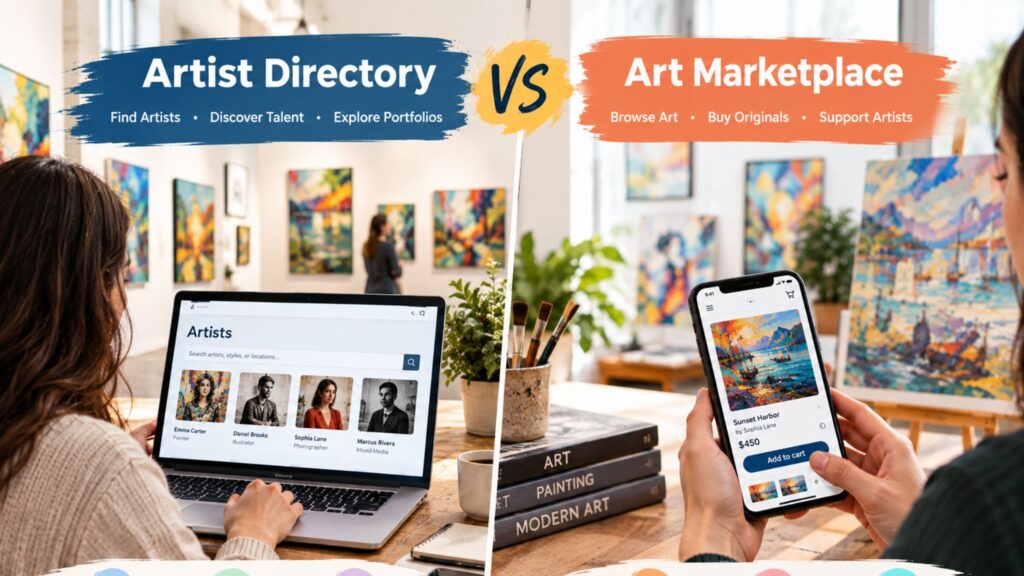
An artist directory and an art marketplace can overlap, but they are not necessarily the same thing.
| Feature | Artist Directory | Art Marketplace |
| Artist discovery | Usually central | Usually available |
| Artist biographies | Often important | Varies |
| Portfolio research | Common | Common |
| Artwork purchasing | May not be central | Usually central |
| Transactions | May be outside the directory | Usually supported |
| Research | Strong use case | Secondary use case |
| Artist comparison | Useful | Often product-focused |
| Commission discovery | May be possible | Often available |
The simplest distinction is purpose: an artist directory primarily helps you discover and research artists, while a marketplace generally puts more emphasis on transactions and buying artwork.
That distinction is important when evaluating what you want from a platform.
How Collectors and Art Researchers Can Use an Artist Directory
Build an Artist Shortlist
Instead of trying to make a decision immediately, create a shortlist.
For each artist, record:
- Name
- Medium
- Style
- Location
- Portfolio URL
- Official website
- Relevant exhibitions
- Why the artist interests you
This makes comparison much easier.
Compare Artistic Practices
Do not compare artists only by popularity.
Compare their:
- Medium
- Subject matter
- Technique
- Visual style
- Career focus
- Portfolio consistency
A structured comparison often reveals that two artists who initially looked similar are actually very different.
Research Before a Purchase
If you are considering artwork for a collection, use the directory as the beginning of your research.
Depending on the artwork and transaction, you may need to investigate:
- Artist identity
- Artwork title
- Medium
- Dimensions
- Date
- Edition information
- Provenance
- Ownership
- Condition
- Price
- Authenticity
- Shipping
- Insurance
The exact requirements depend on the artwork and transaction.
Follow Primary Sources
For important facts, move from the directory to the strongest available source.
For example:
Directory → Artist website → Gallery/institution → Museum or collection record
This creates a stronger research trail than relying on one page alone.
How Artists Can Benefit From Directory Visibility
Artist directories are not only useful for people searching for art.
They can also help artists present their work to a wider audience.
Build a Complete Artist Profile
An artist profile should make it easy for someone unfamiliar with your work to understand:
- Who you are
- What you create
- Which medium you use
- What your work looks like
- What themes you explore
- Where to learn more
Use Clear Portfolio Images
Your images are often the first thing a visitor notices.
Use representative work rather than uploading images that do not reflect your current artistic direction.
Explain Your Medium and Style
Do not assume visitors already understand your work.
A short, clear description can provide context around your materials, techniques, subjects, and creative approach.
Keep Professional Information Current
If your website, email, portfolio, or other professional details change, keeping directory information current makes it easier for interested people to continue their research.
Discovering Artists in the USA, France, Spain and Canada
International artist discovery works best when you combine geography with artistic attributes.
Instead of searching only for “artists in France,” for example, combine:
Country + medium + style + subject
You could structure research around:
- American painters
- French contemporary artists
- Spanish sculptors
- Canadian photographers
- Emerging artists by region
- Artists by medium and country
This approach gives you a more useful shortlist than geography alone.
USA
For American artist research, consider combining location with medium, movement, subject, or city.
France
French artist research can benefit from adding artistic period, movement, medium, or location to the search.
Spain
Spanish artists can similarly be explored through medium, region, movement, or historical period.
Canada
For Canadian artist discovery, consider combining country with province, city, medium, or artistic practice.
The key principle is simple:
Country tells you where to look; medium, style and subject tell you what to look for.
How ArcyArt Compares With Other Artist Directories
There is no single artist directory that is automatically best for every research task.
Different platforms organize information differently.
For example, Art UK provides structured discovery across styles and movements, materials and techniques, genres, and nationalities, alongside artist records connected with works in the UK’s national collection.
Other directories may emphasize different things, such as direct artist discovery, geographic categories, commissions, or marketplace functionality.
When comparing directories, examine:
| Factor | Why It Matters |
| Artist coverage | Determines the breadth of discovery |
| Search structure | Determines how easily you can find relevant artists |
| Medium categories | Helps narrow visual practices |
| Geographic information | Useful for regional research |
| Biographies | Adds context |
| Portfolio depth | Helps evaluate artistic practice |
| Primary-source links | Supports verification |
| Contact information | Helps with legitimate follow-up |
| Marketplace functions | Important if buying is your goal |
The best directory depends on what you are trying to accomplish.
Common Mistakes When Researching Artists Online
Judging an Artist From One Image
One artwork can be visually impressive without representing the artist’s broader practice.
Look at multiple works whenever possible.
Ignoring the Artist’s Biography
Artwork shows you what an artist makes.
Biography and artist statements can help explain why and how they make it.
Both can matter.
Confusing Discovery With Verification
Finding an artist in a directory does not mean every detail has been independently verified.
For important information, follow primary sources.
Assuming Directory Information Is Always Current
Online listings can become outdated.
Websites change. Artists move. Contact information changes. Portfolios develop.
Before making an important decision, check current information directly with the artist, gallery, institution, or other authoritative source.
Conclusion
Artist Directory ArcyArt is best approached as a starting point for structured artist discovery. Use it to find artists, explore their artwork and biographies, understand their medium and artistic direction, and build a shortlist for deeper research.
FAQs
What is the Artist Directory ArcyArt?
Artist Directory ArcyArt is an online resource for discovering and exploring artists. Its directory can provide artist names, artwork, biographies, medium information, and contact or website details, giving users a starting point for further research.
How do you use an artist directory?
Start with an artist name, medium, style, or location. Review profiles and portfolios, create a shortlist of relevant artists, and then follow official or authoritative sources when you need more detailed or current information.
What information should an artist profile include?
A useful profile can include the artist’s name, biography, medium, artistic focus, portfolio, exhibitions, website, and contact information. The more complete the profile, the easier it is for visitors to understand and research the artist.
Can collectors use artist directories for research?
Yes. Collectors can use directories to discover artists and build an initial shortlist. Before purchasing artwork, however, they should independently investigate important details such as authenticity, provenance, condition, ownership, and transaction terms where relevant.
How do I find artists by medium or style?
Use the directory or broader art resources to identify the medium or style you want, then narrow the results using artist names, locations, subjects, or movements. Structured art databases commonly use these attributes to support artist discovery.
Is an artist directory the same as an art marketplace?
No. An artist directory primarily organizes and presents information for discovery, while an art marketplace generally focuses more heavily on buying and selling. Some platforms can combine elements of both.
How do I research an artist before contacting them?
Start with the artist’s profile and portfolio, then check their official website and other authoritative sources. Compare biographical information, artistic practice, current work, and professional details before contacting them.
How can I find emerging artists?
Use artist directories, galleries, exhibitions, institutional collections, and other art resources. Search by medium, style, location, and artistic movement rather than relying on popularity alone.
