

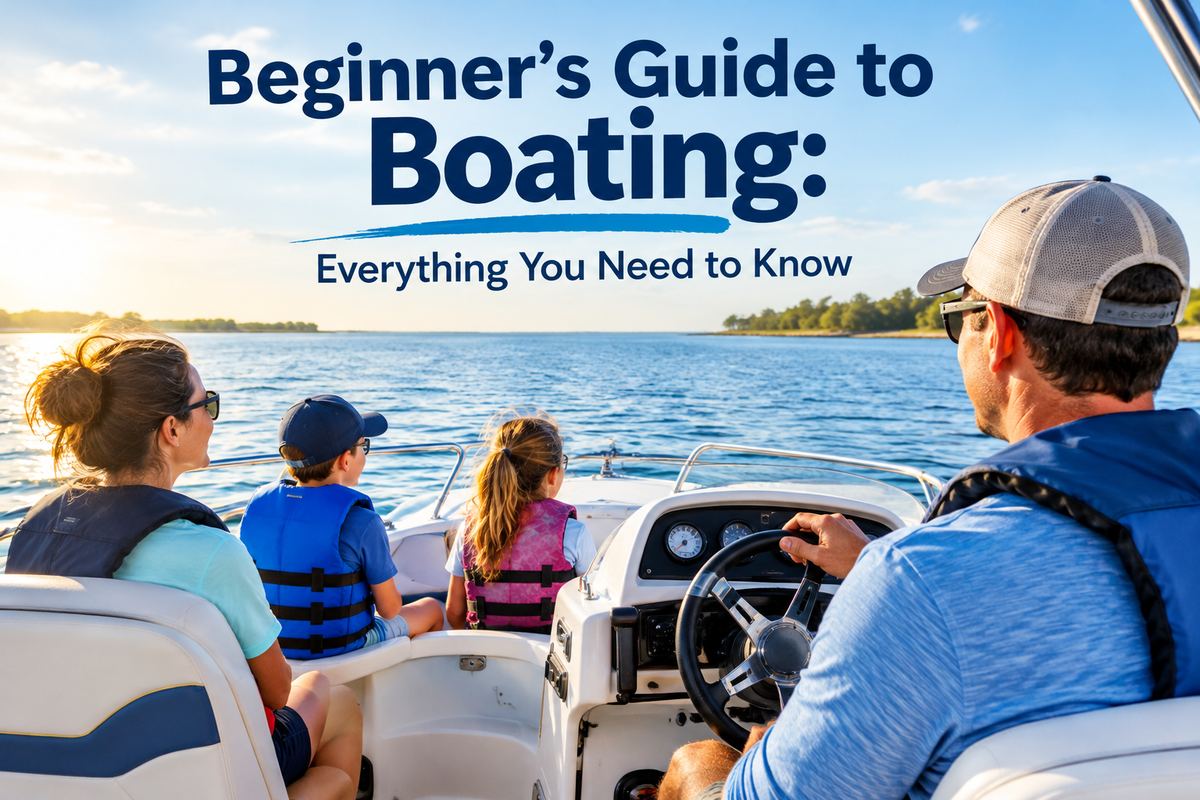
Getting started with boating is easier when you understand the basics, choose the right boat, and learn how to stay safe on the water. Whether you want to enjoy a peaceful lake trip, go fishing with friends, or eventually own a boat, the right preparation helps you build confidence and avoid common mistakes.
A beginner’s guide to boating starts with five essentials: learn basic boat terminology, understand safety equipment, check your state’s boating requirements, practise essential operating skills, and plan your first trip carefully. You do not need to own a boat to begin learning. A guided trip or qualified instructor can be a practical first step.
This guide explains everything you need to know to begin boating responsibly in the United States.
What Should a Beginner Know Before Boating?
Before your first boating trip, learn the boat’s basic controls, check the weather, understand applicable boating laws, and make sure the required safety equipment is aboard. Wear an appropriate life jacket, tell someone your trip plans, and never operate beyond your skill level. Beginners should start in suitable conditions and practise with an experienced operator or qualified instructor.
1. Understanding the Basics of Boating
Boating involves more than steering a vessel across the water. You need to understand how your boat moves, how to communicate with other boaters, and how to respond to changing conditions.
Learning a few essential concepts will make your first experience much easier.
Common Types of Recreational Boats
Different boats serve different purposes. Some are designed for relaxing with family, while others are built for fishing, water sports, or longer journeys.
| Boat type | Common uses | Beginner considerations |
| Pontoon boat | Family outings, relaxing, entertaining | Spacious and often stable in suitable conditions |
| Bowrider | Day trips, cruising, water sports | Versatile, but handling varies by model |
| Small fishing boat | Fishing on lakes and rivers | Practical for simple trips; capacity and stability matter |
| Jon boat | Fishing and shallow-water activities | Lightweight models may be suitable for sheltered waters |
| Center console | Fishing and coastal activities | Appropriate operation depends on size, equipment, and conditions |
| Sailboat | Recreational sailing and longer trips | Requires learning wind, sail handling, and navigation |
| Personal watercraft | Recreational riding | Requires specific safety knowledge and compliance with applicable rules |
Which boat is best for beginners? The best choice depends on where you plan to go, how many people will join you, and what you want to do. A small, manageable boat may be suitable for one person fishing on a sheltered lake, while a family may prefer a pontoon boat for relaxed outings.
Do not select a boat based on size or appearance alone. Consider its capacity, engine power, handling, storage, transportation, maintenance, and the conditions in which you will use it.
Basic Parts of a Boat
Knowing basic boat terminology helps you understand instructions from instructors, other boaters, and emergency personnel.
- Bow: The front of the boat.
- Stern: The back of the boat.
- Port: The left side when facing the bow.
- Starboard: The right side when facing the bow.
- Helm: The position from which the boat is steered and controlled.
- Hull: The main body of the boat.
- Deck: The surface you walk or stand on, where applicable.
- Draft: The depth of water a boat needs to float without its bottom touching the ground.
- Anchor: Equipment used to help hold a boat in position.
- PFD: A personal flotation device, commonly called a life jacket.
Remember that port and starboard never change according to which direction you are facing on the dock. They are defined from the perspective of someone facing the bow.
Boating on Lakes, Rivers, and Coastal Waters
The water you choose affects your preparation.
Lakes: Sheltered lakes can be suitable for learning, but wind can create waves, and conditions can change quickly. Watch for swimmers, other boats, shallow areas, and underwater obstacles.
Rivers: Currents, changing water levels, submerged objects, and narrow passages may make river boating more demanding. Learn the local hazards before travelling.
Coastal waters: Tides, currents, larger waves, marine traffic, and rapidly changing weather require additional knowledge. Beginners should seek appropriate instruction and avoid challenging conditions.
Start with a suitable location and conditions that match your experience. A calm-looking waterway does not automatically mean it is safe.
2. Choosing the Best Boat for Beginners
Buying a boat is not the only way to enjoy boating. Before spending money, decide how often you will go, which activities interest you, and whether you want to operate the vessel yourself.
How to Choose a Beginner-Friendly Boat
Ask yourself these five questions:
- Where will I use it? A boat for a sheltered lake may not be appropriate for open coastal water.
- What will I do? Fishing, family cruising, sailing, and water sports require different equipment and layouts.
- How many passengers will join me? Consider the vessel’s rated capacity and weight limits.
- How much experience do I have? Choose something you can learn to operate safely.
- What is my total budget? Include maintenance, fuel, insurance, storage, registration, and training where applicable.
A boat that is easy to handle, maintain, and transport can be more useful to a beginner than a larger vessel with more features.
Pontoon vs. Bowrider vs. Small Fishing Boat
A pontoon boat is often attractive to families because it provides an open layout and room for passengers. However, its performance in wind, waves, and currents depends on the specific boat and conditions.
A bowrider is versatile for day cruising and recreational activities. Its size, engine, and handling characteristics determine how suitable it is for a new operator.
A small fishing boat may be practical for someone who wants to spend time fishing rather than entertaining a large group. Lightweight boats still require careful attention to passenger placement, stability, capacity, and weather.
Compare boats by intended use rather than assuming one design is always the easiest or safest.
Should You Buy a New or Used Boat?
A new boat may offer modern features, a manufacturer’s warranty, and a known ownership history. However, it usually requires a larger initial investment.
A used boat may cost less upfront, but its condition matters. Before buying, consider an independent marine survey or qualified inspection appropriate to the vessel, inspect the engine and systems, check maintenance records, and verify ownership and registration documentation.
Do not purchase a boat until you understand its operating requirements and the full cost of keeping it ready for the water.
3. Boating Safety and Essential Equipment
Safety is the foundation of enjoyable boating. A trip can become dangerous when an operator ignores weather, overloads a vessel, lacks suitable equipment, or assumes experience is unnecessary.
The U.S. Coast Guard’s 2024 Recreational Boating Statistics report recorded 3,887 recreational boating incidents, 556 deaths, and 2,170 injuries. The report also highlights the importance of life-jacket use.
Official source: U.S. Coast Guard Boating Safety.
Essential Boat Safety Equipment
The exact equipment required depends on the vessel, its size, its use, the waterway, and applicable federal and state rules.
Before departure, verify that your boat carries the required equipment. Depending on the vessel and trip, this may include:
- Appropriate life jackets: Ensure the required number and types are aboard. They should fit their intended wearers and be readily accessible.
- Throwable flotation equipment: Some vessels must carry an approved throwable device.
- Fire extinguisher: Carry the type and quantity required for your vessel and its installed equipment.
- Sound-producing device: A horn, whistle, or other suitable device may be required.
- Navigation lights: Ensure the required lights work for operation during applicable low-visibility conditions or at night.
- Visual distress signals: Carry the required type when applicable to your vessel and operating area.
- Communication equipment: A suitable mobile phone or marine radio can help you seek assistance. Coverage and requirements vary.
- Anchor and appropriate line: Select equipment suitable for the vessel, bottom conditions, and expected environment.
- First-aid supplies: Keep an accessible kit suitable for the trip.
This list is a preparation guide, not a complete legal checklist for every boat. Verify requirements using the U.S. Coast Guard and your state boating authority.
Why Life Jackets Matter
A life jacket is not merely an item to keep in a storage compartment. It needs to be suitable for the wearer, correctly fitted, and immediately accessible.
Choose a Coast Guard-approved life jacket appropriate for the activity and conditions. Make sure children have properly fitted jackets and that everyone understands when and how to wear them.
Wearing a life jacket is especially important when conditions are unpredictable, when passengers are inexperienced, or when falling overboard could quickly become life-threatening.
Weather, Float Plans, and Emergency Preparation
Check the marine forecast before leaving and continue monitoring conditions during the trip.
The National Weather Service Marine Weather page provides official marine forecasts and warnings for US coastal waters, the Great Lakes, and other designated areas.
Pay attention to wind, wave conditions, thunderstorms, fog, and relevant marine warnings. Postpone the trip if conditions exceed your ability or the vessel’s limits.
A float plan tells a trusted person where you intend to go, who is aboard, what vessel you are using, and when you expect to return. Include a contact method and instructions for raising the alarm if you do not return as planned.
Also discuss emergencies with passengers before departure. Explain where safety equipment is located, how to call for help, and why everyone must follow the operator’s instructions.
Common Boating Safety Mistakes
Avoid these preventable mistakes:
- Leaving without checking the forecast.
- Operating beyond your experience or the boat’s limits.
- Ignoring passenger capacity and weight distribution.
- Consuming alcohol before or while operating the boat.
- Failing to brief passengers about safety.
- Assuming a phone will always have a signal.
- Ignoring navigation rules or restricted areas.
- Continuing a trip when weather or water conditions deteriorate.
A safe operator knows when to slow down, change the plan, return to shore, or cancel the outing entirely.
4. Do You Need a Boating License in the USA?
There is no single nationwide boating-license rule that applies identically to every recreational boater. Requirements can vary by state, operator age, vessel type, boating activity, and location.
Some states require approved boating education or a boating safety certificate for particular operators. Other requirements may apply to vessel registration, minimum operator age, or specific waterways.
How to Check Your State’s Boating Requirements
Before operating a boat:
- Identify the state where you will operate.
- Visit that state’s official boating or wildlife agency website.
- Check the minimum operator age and any education or certification requirements.
- Confirm vessel registration and equipment requirements.
- Review any additional rules for the specific waterway or activity.
- Keep required documents available when operating.
Start with the U.S. Coast Guard’s boating safety resources and locate the relevant state agency.
Do not assume that a certificate accepted in one state automatically satisfies every requirement elsewhere. Confirm the rules for the place where you plan to boat.
Boating Education and Training
Even when a course is not legally required for your situation, boating education is valuable.
A good course can introduce navigation rules, safety equipment, weather awareness, emergency response, and responsible operation. Practical instruction can help you understand steering, acceleration, stopping, docking, and boat handling.
For your first hands-on experience, choose a qualified instructor or reputable boating education provider. Learn on a vessel and in conditions appropriate for your current skill level.
5. Essential Boat Operating Skills
Reading about boating is useful, but it does not replace supervised practice. Boat handling can change with wind, current, vessel design, passenger placement, and engine type.
Steering, Throttle, and Safe Speed
Learn the controls before leaving the dock. Understand how the steering system responds, how to adjust speed, how to stop safely, and what to do if the engine or steering system behaves unexpectedly.
Practise in an appropriate area under qualified supervision. Keep a safe distance from swimmers, other vessels, shorelines, and obstacles.
Remember that a boat does not stop instantly. The distance needed to slow or turn depends on speed, load, water conditions, and the vessel itself.
Launching and Docking
Launching a trailered boat requires preparation on land as well as safe handling in the water.
Before launching, check the trailer, secure loose equipment, confirm the ramp procedure, and follow local instructions. Avoid blocking the ramp while preparing gear.
Docking can be challenging because boats respond differently to wind and current. Approach slowly, plan your path, brief passengers, and use appropriate fenders and lines.
Practise with an experienced operator before attempting difficult docking conditions alone.
Anchoring Correctly
Anchoring involves more than dropping an anchor overboard. You need suitable equipment, enough line for the depth and conditions, and an understanding of the bottom and nearby hazards.
Choose a suitable location, account for other boats and shoreline restrictions, and make sure the anchor holds before relying on it. Monitor your position because wind and current can move a vessel.
If you are unsure how to anchor safely, learn with an experienced operator before trying it independently.
Navigation and Right-of-Way Rules
Boaters must understand navigation rules, channel markers, navigation lights, speed restrictions, and local hazards.
Learn the meaning of port and starboard, recognize restricted or no-wake areas, and understand how to avoid collisions. Never assume that another operator has seen you or will make the manoeuvre you expect.
Keep a proper lookout and adjust speed and course to the conditions. When navigating unfamiliar waters, use appropriate charts or navigation resources and seek local guidance when necessary.
6. How Much Does It Cost to Own a Boat?
The cost of boating varies widely. A small used fishing boat, a new family pontoon, and a larger coastal vessel have very different purchase prices and operating expenses.
Instead of focusing only on the purchase price, calculate the total cost of ownership.
Boat Ownership Cost Categories
| Expense | What to consider |
| Purchase | New or used boat, inspection, and any financing |
| Fuel | Engine type, usage, distance, and fuel consumption |
| Maintenance | Engine servicing, repairs, cleaning, and replacement parts |
| Insurance | Coverage, vessel value, intended use, and location |
| Storage | Home storage, dry storage, or marina fees |
| Registration | Applicable registration and documentation costs |
| Transport | Trailer, towing vehicle, launch fees, or delivery |
| Safety and training | Required equipment, education, and instruction |
Some costs occur annually, while others depend on how often you use the boat. Unexpected repairs can also affect your budget.
Before purchasing, request realistic estimates for the particular boat, location, and planned usage. Avoid relying on a universal ownership figure because costs vary substantially.
Renting vs. Buying
Renting may be a sensible starting point if you boat only occasionally or are still deciding which type of vessel suits you.
A captained charter lets you experience boating while an experienced operator handles the vessel. A self-operated rental may offer more control, but you must meet the provider’s requirements and have the skills needed for safe operation.
Buying may make sense if you expect frequent use and can comfortably cover ownership expenses, maintenance, storage, and preparation.
The best option is the one that fits your experience, budget, and intended use—not necessarily the one that gives you the most independence immediately.
7. Can You Go Boating Without Owning a Boat?
Yes. You can begin enjoying boating without purchasing a vessel.
Four Ways to Start
1. Captained charter: A professional operator manages the boat while you enjoy the outing. This can be a useful introduction to boating.
2. Guided boat tour: A guide takes you along a planned route and may explain local wildlife, landmarks, and water conditions.
3. Boat rental: You rent a boat for a defined period. Requirements vary, and some rentals require previous experience, safety training, or a qualified operator.
4. Boat club: Membership may provide access to a selection of vessels under the club’s rules and reservation system.
If your goal is to become an independent operator, choose an experience that helps you learn rather than simply ride as a passenger. Ask about training opportunities and practise basic skills under appropriate supervision.
8. Your First Boat Trip: A Practical Checklist
Planning ahead reduces stress and helps you focus on enjoying the water.
Before Leaving the Dock
Use this checklist before every trip:
- Check the official marine forecast and relevant warnings.
- Confirm that the boat is suitable for the route and conditions.
- Check fuel, engine condition, steering, and other essential systems.
- Confirm that required safety equipment is present and accessible.
- Make sure life jackets fit everyone aboard.
- Verify passenger capacity and distribute weight appropriately.
- Review navigation rules, hazards, and the planned route.
- Share a float plan with a trusted person.
- Explain safety procedures to every passenger.
- Confirm that communication and emergency arrangements are ready.
Do not depart if a critical safety issue remains unresolved.
What to Bring on Your First Trip
Your packing list depends on the weather, trip duration, vessel, and local requirements. Consider bringing:
- Drinking water and suitable food.
- Sun protection and weather-appropriate clothing.
- A phone in a suitable protective case.
- Required communication and safety equipment.
- First-aid supplies.
- Necessary identification and boating documents.
- Any required medications.
- A map or navigation resource appropriate for the trip.
Secure loose belongings and keep important safety equipment accessible. Avoid overloading the boat.
A Simple First-Day Plan
A short, well-planned outing is often more manageable than an ambitious trip.
Before departure: Review the route, weather, safety equipment, and passenger briefing.
At the start: Practise basic handling only in a suitable area and under appropriate supervision. Make sure everyone understands where to sit and how to move safely.
During the trip: Maintain a proper lookout, travel at a safe speed, monitor conditions, and communicate with passengers. Avoid unfamiliar or challenging routes.
Before returning: Reassess weather and water conditions. Allow enough time to return safely without rushing.
After docking: Secure the boat, check equipment, follow the vessel’s shutdown procedures, and report your safe return to the person who has your float plan.
Your first outing should focus on learning and good decision-making—not distance, speed, or showing off your skills.
A Beginner’s Learning Plan: From First Ride to Confident Boating
You do not need to master every boating skill immediately. Progress gradually.
Stage 1: Learn the basics. Understand boat parts, terminology, safety equipment, and the applicable rules.
Stage 2: Take a boating safety course. Choose an appropriate course from a recognized provider and confirm whether your state requires specific education.
Stage 3: Practise with guidance. Learn controls, steering, safe stopping, navigation, and basic docking under suitable supervision.
Stage 4: Plan a simple trip. Choose an appropriate waterway, check conditions, prepare a float plan, and make sure the boat and passengers are ready.
Stage 5: Build experience gradually. Expand your skills as your knowledge and confidence improve. Seek further instruction before tackling more demanding conditions.
Confidence should come from practice and sound judgment, not from assuming that a few successful outings make every situation manageable.
Conclusion
Boating can become an enjoyable lifelong activity when you approach it with patience, preparation, and respect for the water.
Start by learning the basics, checking the rules where you plan to operate, and choosing a suitable boat or guided experience. Invest time in boating education, practise essential skills, wear appropriate life jackets, and make weather and safety checks part of every trip.
FAQs
What should a beginner know before boating?
Learn basic boat terminology, safety procedures, navigation rules, and applicable local requirements. Check the weather, wear an appropriate life jacket, and begin with a manageable trip suited to your experience.
Do you need a boating license in the USA?
Requirements vary by state, operator age, vessel, and activity. Check your state’s official boating authority to confirm whether you need approved education, a safety certificate, registration, or other documentation.
What is the easiest boat for a beginner to operate?
There is no single boat that is easiest for everyone. A manageable boat suited to the intended waterway and activity can be a good starting point, provided you receive appropriate instruction and understand its limitations.
What safety equipment is required on a boat?
Requirements depend on vessel type, size, location, and use. Life jackets, fire extinguishers, sound-producing devices, navigation lights, and other equipment may be required in applicable circumstances. Verify the current rules for your boat and waterway.
How do you learn to drive a boat?
Start with boating safety education and instruction from a qualified instructor or experienced operator. Learn the controls, steering, stopping, navigation, and docking in suitable conditions before operating independently.
How much does it cost to own a boat?
Costs depend on the boat and how you use it. Budget for purchase, fuel, maintenance, insurance, storage, registration, safety equipment, and transportation rather than considering only the initial price.
Can you go boating without owning a boat?
Yes. You can book a captained charter or guided tour, join a boat club, or rent a vessel if you meet the provider’s requirements. These options let you explore boating before deciding whether ownership is right for you.
What should you bring on your first boat trip?
Bring suitable clothing, water, sun protection, any necessary medication, and the required safety equipment and documents. Check the weather, share a float plan, and confirm that essential equipment is accessible before departure.
