

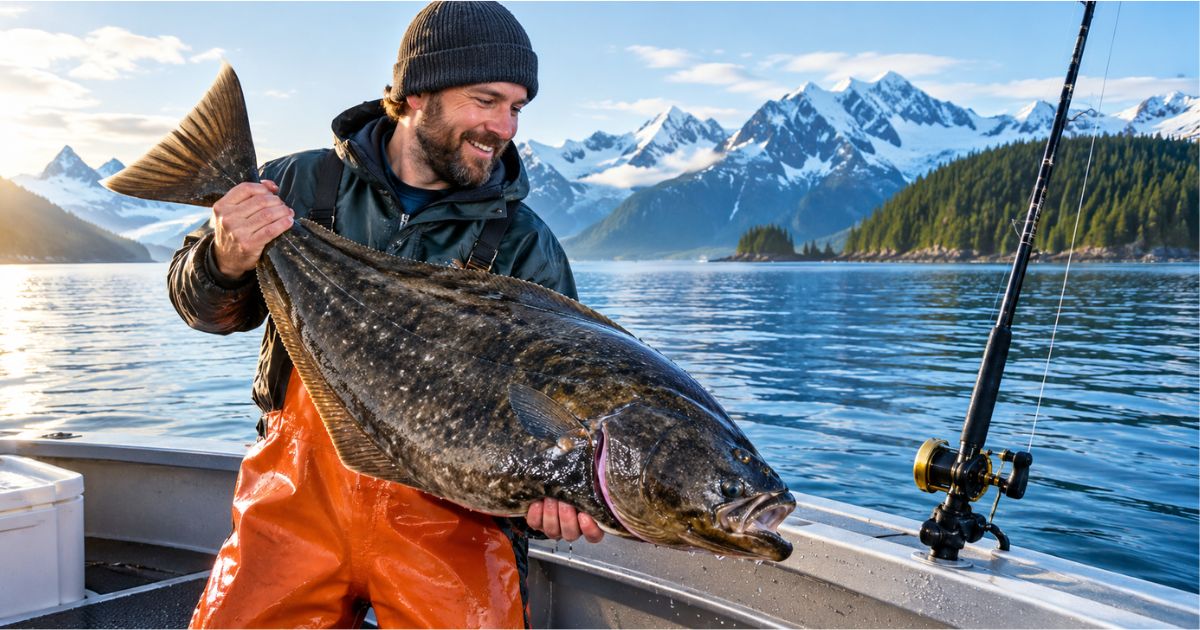
Alaska’s sport halibut season runs February 1 through December 31, 2026. But the Halibut Fshing Alaska Season you’ll actually fish is shorter: mid-May through September, with the peak from June through August. What you can keep depends on where you are. Southeast Alaska (Area 2C) allows one halibut per day on a charter, while Southcentral (Area 3A) allows two.
| Dates | What it means for you | |
| Legal sport season (2026) | Feb 1 – Dec 31 | You may fish. Almost nobody does it in winter. |
| Practical charter season | Mid-May – early October | Boats running daily, weather workable. |
| Peak season | June 1 – August 31 | Best conditions, best consistency, highest prices. |
Regulations current as of the NOAA Fisheries Alaska Region summary dated March 24, 2026. Halibut rules change every single year, always confirm before your trip.
When Is Alaska Halibut Season?
Alaska halibut season is the window when you’re legally allowed to catch and keep Pacific halibut in Alaska waters. For 2026, that window is February 1 through December 31.
January is the only month fully closed to sport halibut fishing. That closure lines up with the deep-water spawning period, when halibut are offshore and largely out of reach anyway.
But here’s the part most websites skip: the legal season and the real season are two different things. You can legally fish for halibut on February 3rd. You’ll struggle to find a captain who’ll take you.
Legal Season vs. Real Season: Why They’re Not the Same
Three separate calendars get tangled together online. Let’s untangle them.
The legal sport season is set by federal regulators: February 1 to December 31, 2026.
The commercial season is a completely different thing. The International Pacific Halibut Commission set the 2026 commercial fishery to open March 26 and close December 7. This governs the boats supplying your grocery store, not your charter trip. If you’ve read “halibut season opens in late March,” that’s what the article meant.
The practical season is the one you actually plan around. It’s set by weather, daylight, sea state, and where the fish are. In most of coastal Alaska that’s mid-May through early October.
Why the gap? Pacific halibut spend winter in deep offshore water along the continental shelf, where they spawn. As daylight returns in spring, they migrate shoreward into shallower feeding grounds the kind of water a six-hour charter can reach. That migration, not the regulation, is what creates the fishable halibut season.
Bottom line: the calendar says eleven months. Plan for five.
Alaska Halibut Season Month by Month
| Month | Halibut quality | Also biting | Weather | Crowds | Typical charter price |
| May (from ~15th) | Good, smaller average | King salmon, rockfish | Sunny, cool, often calm | Light | Lower shoulder rates |
| June | Very good | King salmon, rockfish, pinks (even years) | Reliable, long daylight | Building fast | Peak rates begin |
| July | Excellent | Kings, rockfish, lingcod opens July 1 | Best of the year | Heaviest | Peak |
| August | Excellent | Silver salmon, rockfish, lingcod | Good early, wetter late | Easing after mid-month | Peak, softening late |
| September | Good to very good | Silvers at their best | Windier, less predictable | Light | Shoulder rates |
| Oct–Apr | Limited access | Winter kings, rockfish | Rough, short days | None | Very few boats running |
May: the quiet opener
Most charter fleets start running around mid-May. Halibut have moved in from their deep winter water, king salmon are around, and the fleet hasn’t hit full stride yet.
The fish tend to run smaller this early. The trade-off is real: fewer boats, lower prices, and calm sunny days are common.
If you care more about being on the water than about a 100-pound fish, May is underrated.
June: the peak begins
June 1 is when Alaska’s halibut season shifts into gear. Daylight is enormous, weather is about as dependable as Alaska gets, and salmon runs are pushing into Cook Inlet and the Southeast passages.
That matters more than it sounds. Halibut follows the salmon. As kings and sockeye stage near river mouths, halibut move in behind them to feed which is exactly why June fishing improves week over week.
July: prime time
If you’re booking one week and want the highest odds, book July.
Weather is at its most predictable. The major salmon runs are in. And lingcod becomes legal to retain on July 1, which turns a halibut trip into a genuine multispecies day.
July is also the most crowded and most expensive month. Seats on good boats go months in advance.
August: halibut plus silvers
The first half of August fishes almost identically to July. Then two things change.
Silver salmon arrived. They’re aggressive, they fight hard, and in many ports they peak mid-August and stay strong into fall. A halibut-and-silver combo day in August is arguably the best single-day value of the Alaska season.
The second change is daylight and weather. Days shorten noticeably, rain picks up, and late August brings more wind. Crowds thin out at the same time.
September: the value window
September is the month experienced repeat visitors quietly prefer.
Fishing stays good. Silvers are excellent. Prices drop. Lodges have space. The catch is weather variability cancellations become a genuine planning factor rather than a rare event.
Fish September if you have flexible days. Don’t fish in September if you have exactly one shot.
October through April: the quiet months
Halibut are still legally open (except January), but the fleet is mostly hauled out. Deep water, short days, and rough seas make consistent access difficult.
Rockfish stay available year-round for those willing to make the trip, and some ports hold “winter king” salmon. Halibut, realistically, is a summer proposition.
What Is the Best Month for Halibut Fishing in Alaska?
July is the best month for halibut fishing in Alaska. It combines the most stable weather, the longest usable daylight, peak salmon activity that pulls halibut into feeding mode, and the widest choice of trips including lingcod, which opens for retention July 1.
If you want a close second with fewer people, choose late August. Halibut fishing is still excellent, silver salmon are running, and both crowds and prices start to ease.
And if budget drives the decision, mid-May or September deliver good fishing at shoulder-season rates. You’re trading price for weather risk.
2026 Alaska Halibut Rules: What You Can Actually Keep
This is where most season guides go silent and where trips get ruined.
Alaska halibut rules are not statewide. They depend on three things: which IPHC regulatory area you’re in, whether you’re on a guided charter or fishing unguided, and what day of the week it is.
All of the following comes from the NOAA Fisheries Alaska Region 2026 regulation summaries.
Area 2C Southeast Alaska (Ketchikan, Sitka, Juneau)
- One halibut per day for charter anglers.
- Reverse slot limit: the fish you keep must be 34 inches or shorter, or 80 inches or longer. Anything in between goes back.
- Thursday closures: charter anglers may not keep halibut on any Thursday from June 18 through September 10, 2026.
The reverse slot exists to protect mature spawning fish. It means a beautiful 50-inch halibut in Southeast is a photo, not a fillet.
Area 3A Southcentral Alaska (Homer, Seward, Ninilchik, Whittier)
- Two halibut per day for charter anglers.
- Size rule: one fish of any size, plus one fish no longer than 27 inches. That second fish works out to roughly 9 pounds round weight.
- Closure days: charter anglers may not keep halibut on all Wednesdays, and on Tuesdays from June 2 through August 25, 2026.
- One retention trip per day per charter vessel.
Area 2C vs. Area 3A at a glance
| Area 2C Southeast | Area 3A Southcentral | |
| Ports | Ketchikan, Sitka, Juneau | Homer, Seward, Ninilchik, Whittier |
| Charter daily bag | 1 halibut | 2 halibut |
| Size rule | ≤34″ or ≥80″ (reverse slot) | One any size + one ≤27″ |
| Closure days (2026) | Thursdays, Jun 18 – Sep 10 | All Wednesdays; Tuesdays Jun 2 – Aug 25 |
| Trophy fish legal to keep? | Only if ≥80″ | Yes, one of any size |
Planning takeaway: if your heart is set on bringing home a big fish, Area 3A gives you a legal path that Area 2C mostly doesn’t.
Why can’t you keep halibut on Wednesdays?
Weekly closures are a quota tool. Charter anglers in Areas 2C and 3A share a limited allocation of the halibut catch. Closing specific weekdays spreads that allocation across the whole summer instead of burning it out by July.
You can still go fishing on a closed day. You can still hook halibut. You just have to release them which is why many operators run salmon or rockfish trips on those days instead.
Check your charter’s schedule against the closure calendar before you book. A Wednesday “halibut trip” in Homer is a catch-and-release trip.
Guided vs. unguided: two different rulebooks
This surprises almost everyone.
For 2026, unguided sport anglers people fishing from their own or a rented boat with no guide aboard have a daily bag limit of two halibut of any size, with a possession limit of two daily bag limits. No slot limit. No 27-inch rule. No weekday closures.
That’s substantially more generous than charter rules, and it’s currently a live policy debate in Alaska. A proposal to cut the unguided limit to one fish was raised at the IPHC’s January 2026 meeting and referred to the North Pacific Fishery Management Council as a domestic allocation question so this could change in future seasons.
One important catch: if a boat comes back with a mix of guided and unguided fish, the stricter charter rules apply to everything on board.
Licenses and the $20 charter halibut stamp
Two documents, not one.
- An Alaska sport fishing license from ADF&G. Non-residents 16 and older need one. Buy it online before you fly.
- A charter halibut stamp required for charter anglers 18 and older in Area 2C or 3A for each trip on which they intend to keep halibut. Each stamp costs $20.
People get caught out by the stamp constantly because it doesn’t exist anywhere else in American sport fishing. Ask your operator whether they sell them at the dock or expect you to arrive with one.
GAF: the legal exception worth knowing
Some operators participate in the Guided Angler Fish (GAF) program, which lets them lease commercial quota for client use.
Two things GAF changes:
- Clients can keep up to two halibut of any size per day, no slot limit, no 27-inch rule.
- GAF fish can be retained on days that are otherwise closed to charter halibut retention.
GAF trips cost more and availability is limited. But if you want a trophy fish from Southeast Alaska, or you’re locked into a Wednesday in Homer, it’s the legitimate path.
A few rules that trip people up
- Gear: a single line with no more than two hooks, or a spear. Nothing else.
- Filleting: a halibut may be cut into no more than two ventral pieces, two dorsal pieces, and two cheek pieces, each with enough skin to identify light side from dark side. One dorsal or ventral fillet may be eaten aboard.
- Logbook: charter anglers must sign the vessel logbook at the end of the trip.
- Skipper and crew may not keep halibut during your charter. If a deckhand catches one, it goes to you or goes back.
Best Places to Fish Halibut by Season
| Port | Area | Best window | What defines it |
| Homer | 3A | Jun–Sep | The “Halibut Capital of the World.” Huge, experienced fleet. Kachemak Bay and outer Cook Inlet grounds. |
| Seward | 3A | Jun–Aug | Closest major port to Anchorage. Access to Resurrection Bay and Prince William Sound. Long runs, big fish potential. |
| Ninilchik / Anchor Point | 3A | Jun–Aug | Tractor-launched beach departures. Short runs, family-friendly, lower cost. |
| Ketchikan | 2C | Jun–Sep | Cruise-accessible, protected inside waters, reliable half-day options. One-fish slot rules apply. |
| Sitka | 2C | Jun–Aug | Outer-coast access, strong multispecies fishing. |
| Kodiak | 3A | Jun–Aug | Less pressure, remote feel. ADF&G reports Kodiak halibut average 30–35 pounds. |
A note on “which port has the biggest fish”: almost every operator claims theirs does. The honest version is that pressure matters as much as biology. Ports with fewer boats generally produce a higher average size and also cost more to reach.
From the Deck: What Captains Wish You Knew About Timing
Season charts tell you which month. They don’t tell you the things that actually decide whether your trip works.
1. Know what a normal fish looks like
ADF&G’s own Homer-area sport fishing report is refreshingly blunt. Most charters run 15 to 50 miles offshore and fish 100 to 300 feet of water, where anglers can expect halibut in the 10 to 60 pound range, with the occasional fish up to 200 pounds. Halibut caught closer to Homer tend to run 10 to 40 pounds.
Kodiak averages 30–35 pounds.
Read that again, because it’s the most useful sentence on this page. A 25-pound halibut is a normal, good Alaska halibut. Anyone selling you a season based on 300-pounders is selling you a lottery ticket.
Two mid-size halibut, filleted, will comfortably fill a cooler. That’s the realistic outcome, and it’s a genuinely great one.
2. Book your halibut day early in your trip
This is the single best piece of planning advice in Alaska fishing, and it costs nothing.
If you’re in Homer for five days, book your halibut charter on day one or day two. If the weather cancels it, there’s room to reschedule. Book it on your last morning and a bad forecast ends your trip with no fish and no second chance.
During June, July, and August, boats are often at capacity, rescheduling is hard or impossible. In September, when cancellations are more likely, buffer days matter even more.
3. Tide beats time of day
Halibut sit on the bottom and feed into the current. The strongest bite window is typically just before, during, and just after slack tide, when currents ease and your bait actually stays where you put it.
You usually can’t choose your tide on a scheduled charter. But if you’re booking a private or unguided day, ask about the tide table before you pick your departure time. It matters more than whether you leave at 6am or 1pm.
4. Dress for a different day than the forecast
Kachemak Bay at 7am in July is not the same weather as Homer at 7am in July. Wind chill on a moving boat routinely drops the felt temperature 15–20°F below what your phone shows.
Layers, waterproof outer shell, and a warm hat. Every single trip. Cotton is the wrong answer.
5. Take seasickness seriously before you leave the dock
Most medication needs to be in your system before you feel sick typically the night before and again the morning of. Once you’re green over the rail, it’s too late, and you’ve just lost a day you paid several hundred dollars for.
⚑ Brand note: this section is where your own data becomes your biggest competitive advantage. Add your captain’s name and years on the water, your fleet’s average catch size from last season, and one real trip story. First-hand specifics like these are what separate a page that ranks from a page people trust.
What Alaska’s Shrinking Halibut Quota Means for Your Trip
It’s worth being straight with you about the direction of this fishery.
- The IPHC set the 2026 coastwide catch limit at 29.33 million pounds the lowest total constant exploitation yield in the Commission’s 102-year history.
- That total is 1.3% below the 2025 coastwide quota. U.S. areas held flat at 24.27 million pounds; British Columbia was cut 7.2%.
- U.S. Commissioner Jon Kurland said commissioners remain concerned about a stock in a low productivity regime that began in 2006.
What this actually means for a visiting angler: not much, this year. The 2026 sport and charter limits stayed essentially the same as 2025. Alaska halibut fishing in 2026 remains genuinely good.
What it does mean is that rules will keep tightening over time, slot limits and closure days aren’t going away, and content you read from 2019 is worthless for planning a trip today.
It also means one more thing worth saying out loud: if you catch a genuine giant, consider releasing it. The largest halibut are almost all mature breeding females, and release survival is high. A photo and a measurement make a better story than 200 pounds of freezer burn.
When Should You Book Your Alaska Halibut Trip?
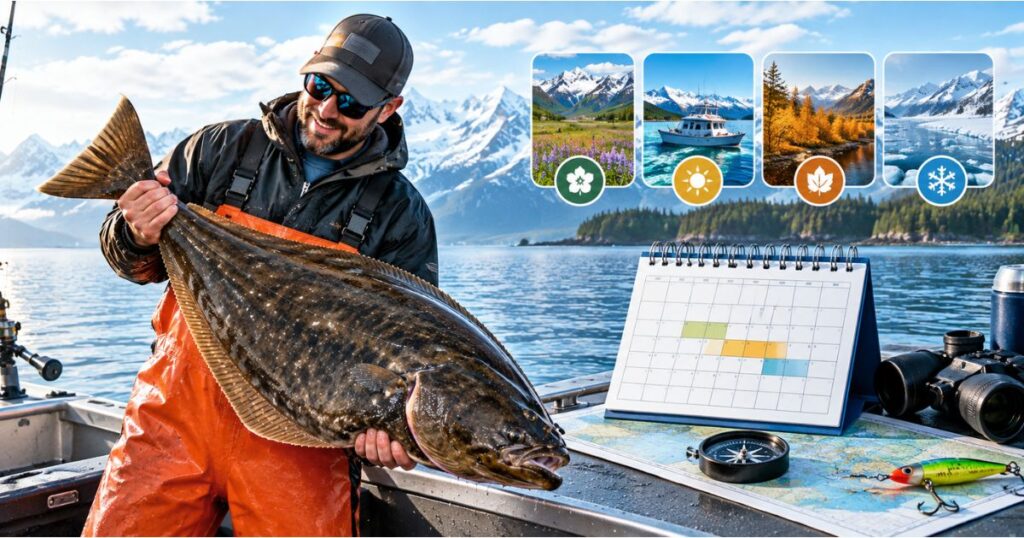
- Twelve to nine months ahead if you want peak July dates on a specific, well-reviewed boat. The best operators fill their summer by winter.
- Nine to six months ahead for most June and August dates. Still comfortable.
- Six to three months ahead workable for May and September. Peak dates will be picked over.
- Inside three months you’ll find something, but you’re choosing from leftovers, and holiday weeks will be gone.
- Whenever you book, confirm the closure days for your area and dates before you pay a deposit, and add a buffer day for weather.
Getting Your Halibut Home
Two halibut in the 20–40 pound range yields a serious amount of fillet.
Most ports have processors who will vacuum-seal, flash-freeze, box, and ship your catch. Budget roughly a few dollars per pound for processing and shipping combined, and confirm pricing before you commit it’s a real line item, not an afterthought.
Remember the filleting rule: no more than two ventral, two dorsal, and two cheek pieces per fish, each with skin left on to show which side it came from. Your processor knows this. Your cooler at home won’t care.
If you’re flying, ask your airline about frozen-fish box allowances before you book flights. Some Alaska routes treat fish boxes generously; connecting carriers may not.
FAQs
When will the halibut season open in Alaska in 2026?
The sport halibut season runs February 1 through December 31, 2026. The practical charter season starts around mid-May, when boats begin running daily.
What is the best month for halibut fishing in Alaska?
July. It offers the most stable weather, the longest daylight, peak salmon activity that draws halibut in to feed, and the widest choice of trips. Late August is a strong second with smaller crowds.
How many halibut can I keep per day?
On a charter in Southeast Alaska (Area 2C), one per day, either 34 inches or shorter or 80 inches or longer. On a charter in Southcentral (Area 3A), two per day one any size, one no more than 27 inches. Unguided anglers in 2026 may keep two of any size.
Is halibut fishing open year-round in Alaska?
No. January is closed to sport halibut fishing. The season runs February 1 through December 31, though most of the fleet only operates from about mid-May through early October.
Do I need a special stamp to keep halibut on a charter?
Yes. Charter anglers 18 and older in Areas 2C and 3A need a $20 charter halibut stamp for each trip on which they intend to keep halibut in addition to an Alaska sport fishing license.
What’s the average size of an Alaska halibut?
Charter-caught halibut commonly run 10 to 60 pounds, per ADF&G’s Homer-area reporting, with fish near port often 10 to 40 pounds. Kodiak averages 30 to 35 pounds. Fish over 200 pounds are rare.
Can I fish for halibut without a guide?
Yes. Unguided anglers follow different and generally more generous rules two halibut of any size per day in 2026, with no weekday closures. You still need an Alaska sport fishing license, and you’re responsible for your own safety, navigation, and weather judgment.
