

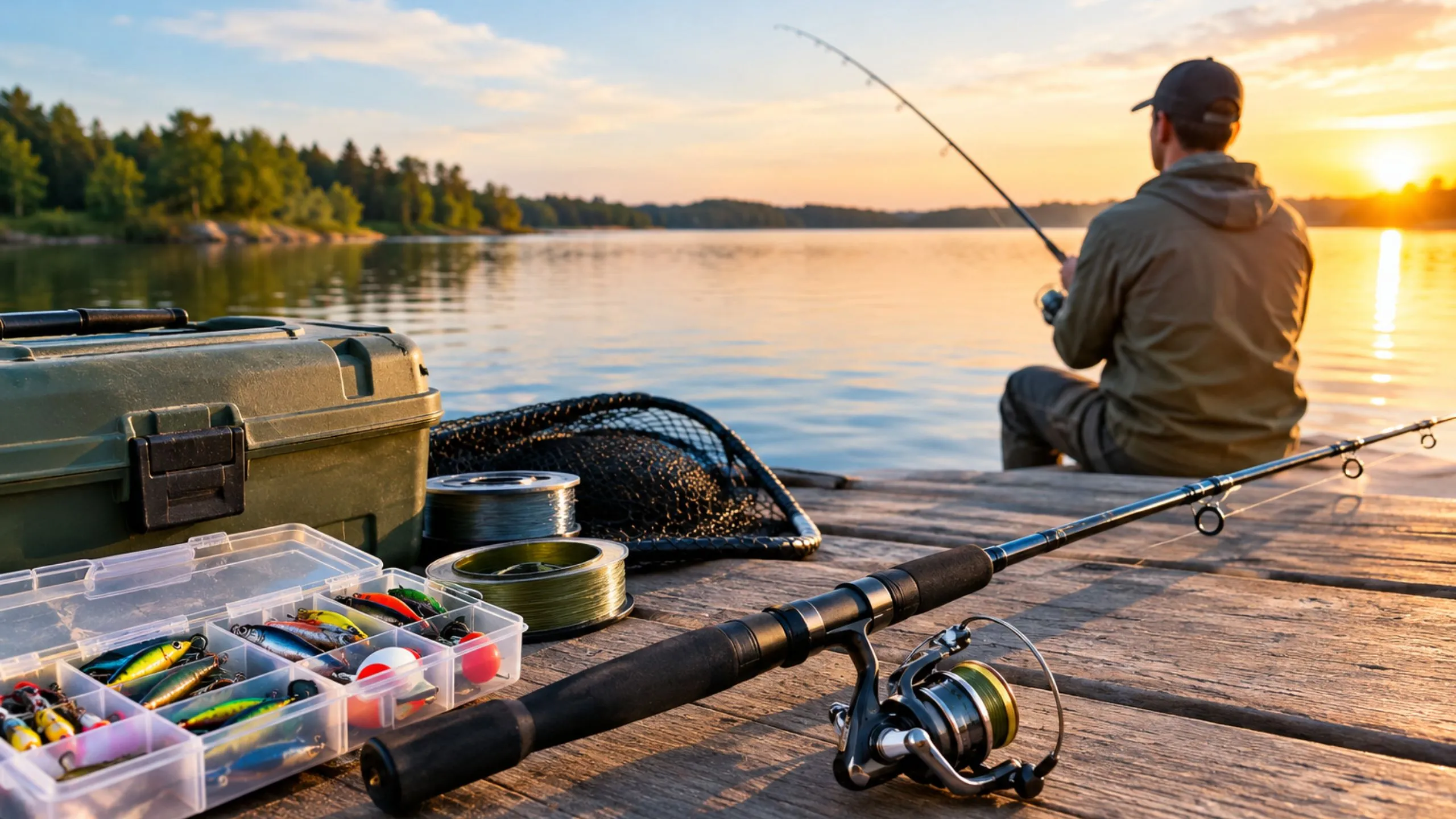
If you’ve never fished before, the amount of gear, knots, bait, rules, and techniques can make fishing seem harder than it really is. The good news is that you don’t need expensive equipment or years of experience to begin.
This guide walks you through 15 essential fishing tips for beginners, from checking your fishing license and choosing basic gear to finding fish, casting, handling your catch, and knowing what to change when nothing bites.
What Does a Beginner Need to Start Fishing?
To start fishing, you need a legal place to fish, the required license or permit, a simple rod-and-reel setup, basic tackle, suitable bait or a beginner-friendly lure, and a little practice. Your first goal should be learning how to fish safely and confidently not buying lots of equipment or catching a trophy fish.
15 Essential Fishing Tips for Beginners
1. Check Your Fishing License and Local Rules First
Before putting a line in the water, check the fishing regulations for the state and location where you plan to fish.
Fishing requirements vary across the United States. Depending on the state, your age, residency, location, species, and type of fishing, you may need a license or additional permit.
Rules can also cover:
- Minimum fish sizes
- Daily bag limits
- Fishing seasons
- Legal fishing locations
- Approved fishing methods
- Bait restrictions
- Species-specific regulations
The U.S. Fish & Wildlife Service recommends checking state fishing laws before fishing because regulations can specify which fish you may catch, minimum sizes, and how many you can keep.
Beginner rule: Don’t assume that a license from one state works in another. Check the official fish and wildlife agency for the state where you’ll fish.
2. Start With One Simple Rod-and-Reel Setup
One of the easiest ways to make fishing confusing is to buy too much equipment before you understand what you actually need.
For a first freshwater trip, a simple spinning or spincast setup is usually enough.
The U.S. Fish & Wildlife Service identifies closed spincast and open-bail spinning reels as common beginner options, with spincast reels being particularly easy for beginners to use.
A basic setup normally includes:
- Fishing rod
- Reel
- Fishing line
- Hooks
- Sinkers
- Bobber
- Bait or lure
You don’t need a boat, fish finder, specialized reel, or huge tackle collection for your first trip.
Start simple. Add equipment as your skills improve.
3. Build a Small Beginner Tackle Kit
Your tackle is the collection of smaller fishing equipment attached to or used with your rod and reel.
For a basic freshwater trip, consider:
| Item | Purpose | Beginner priority |
| Fishing hooks | Hold the bait | Essential |
| Sinkers | Help bait reach the desired depth | Essential |
| Bobber | Shows movement from a bite | Very useful |
| Fishing line | Connects your tackle to the reel | Essential |
| Bait or lure | Attracts fish | Essential |
| Pliers | Helps remove hooks | Useful |
| Small tackle box | Keeps equipment organized | Useful |
| Landing net | Helps land some fish | Useful |
The U.S. Fish & Wildlife Service’s beginner freshwater checklist includes monofilament line, fishing weights, hooks, a bobber, bait or lures, and a rubber fishing net and glove. Exact tackle should still be matched to your location and target species.
4. Learn One Reliable Fishing Knot
You don’t need to memorize ten fishing knots before your first trip.
Learn one dependable knot and practice it at home before you reach the water.
The improved clinch knot is one beginner option for attaching line to a hook or lure. The basic process involves passing the line through the hook eye, wrapping the tag end around the standing line several times, passing the end through the formed loops, wetting the line, and tightening it carefully.
Practice until you can tie it without constantly looking at instructions.
A strong, properly tied knot can prevent one of the most frustrating beginner experiences: losing your hook or fish because the connection failed.
5. Keep Your First Bait Simple
You don’t need a collection of dozens of artificial lures to catch your first fish.
For many beginner freshwater situations, simple natural bait or a straightforward lure can make learning easier.
Common beginner choices may include:
- Worms
- Other legal live bait
- Small soft plastics
- Small artificial lures
Your bait should match the species you’re targeting and the regulations where you’re fishing. Some waters restrict particular types of bait, so always check local rules first.
If you’re unsure what to use, ask a local tackle shop or check the fishing information provided by your state’s wildlife agency.
6. Pick an Easy Fishing Spot
Your first fishing location doesn’t need to be remote or difficult to reach.
A pond, lake shoreline, accessible riverbank, or public fishing pier can be a much easier starting point than a boat trip or complicated backcountry fishing location.
You also don’t necessarily need a boat. Beginner resources from Take Me Fishing note that anglers can fish from shorelines, bridges, and public piers.
When choosing a location, look for:
- Legal public or permitted access
- Safe shoreline access
- Areas with fish habitat
- Reasonable casting space
- Parking or easy transportation
- Local information about fish species
The best beginner fishing spot is often the one you can reach safely and fish comfortably.
7. Target Beginner-Friendly Fish
Don’t make your first goal catch the biggest fish in the lake.
Instead, learn about the common species in the water you’re visiting.
Depending on the region and water type, beginners may encounter species such as:
- Bluegill and other sunfish
- Largemouth bass
- Crappie
- Catfish
- Trout
- Perch
Take Me Fishing identifies bass, sunfish, crappie, catfish, trout, perch, and other species among common fish encountered in different freshwater environments.
Before choosing your bait or tackle, find out what species actually live in your fishing location.
8. Learn to Read Basic Water Structure
Fish don’t distribute themselves randomly.
As a beginner, you don’t need advanced electronics to start noticing places that may hold fish.
Look for:
- Weeds
- Rocks
- Fallen cover
- Changes in bottom type
- Drop-offs
- Shaded areas
- Places where shallow and deeper water meet
The U.S. Fish & Wildlife Service recommends looking for weedy or rocky areas, deeper water, and places where the bottom changes from one type to another. It also advises anglers to stay quiet and avoid unnecessarily disturbing the water.
Think of it this way:
Fish need food, shelter, and suitable conditions. Structure can provide some of those things.
9. Choose a Productive Time to Fish
There isn’t one universal hour when every fish in every American waterway will bite.
Fishing success depends on the species, season, weather, water conditions, location, and fishing method.
For a beginner, morning and evening can be useful periods to try, but don’t treat them as guaranteed “magic hours.”
Instead, pay attention to:
- Weather changes
- Water temperature
- Season
- Cloud cover
- Wind
- Local fishing reports
- Species behavior
Your goal is to learn how conditions affect fish rather than relying on one rigid rule.
10. Practice Casting Before You Fish
Casting accurately is more important than casting extremely far.
Before practicing with a real hook, remove the hook and use a casting plug or other safe practice weight. The U.S. Fish & Wildlife Service recommends practicing in an open area away from people.
Start by practicing:
- Grip the rod correctly.
- Face your target.
- Check behind and around you.
- Make a smooth casting motion.
- Release the line at the appropriate point.
- Focus on accuracy rather than distance.
A short, accurate cast is usually more useful to a beginner than a long cast that lands somewhere you didn’t intend.
11. Learn What a Bite Looks Like
Beginners often expect a fish bite to feel like a dramatic tug.
Sometimes it is. Sometimes it isn’t.
If you’re fishing with a bobber, watch for changes such as:
- The bobber moving unusually
- The bobber dipping below the surface
- The line moving sideways
- Repeated unusual movement
- Tension appearing in the line
A bobber is useful because it gives beginners a visual signal that something may be interacting with the bait.
Don’t immediately react to every tiny movement. Watch the behavior of your line or bobber and learn how your setup responds naturally to wind and water movement.
12. Set the Hook Smoothly
When you believe a fish has taken the bait, you need to set the hook.
For a basic bobber setup, a sustained or obvious movement can be the signal to respond. The U.S. Fish & Wildlife Service describes raising the rod tip quickly when a fish takes the bait and then reeling in the catch.
For beginners, the key is controlled movement rather than wild swinging.
Keep your movements deliberate. Too much force can pull the hook free, while too little response may allow the fish to escape.
13. Handle Fish Carefully
Catching a fish is only part of being a responsible angler.
If you’re releasing the fish, handle it as carefully and quickly as practical. Avoid unnecessarily keeping it out of the water for photographs or inspection.
Good habits include:
- Wet your hands before handling a fish when appropriate.
- Support the fish properly.
- Avoid squeezing it.
- Keep its time out of water short.
- Use appropriate tools to remove hooks.
- Follow local regulations for fish you keep or release.
The U.S. Fish & Wildlife Service recommends minimizing the fish’s time out of water and handling it carefully during catch-and-release fishing.
If a fish has swallowed a hook deeply, don’t automatically force it out. Follow responsible fish-handling guidance and local regulations.
14. Know What to Do When Fish Aren’t Biting
This may be the most important lesson for a new angler:
Not catching fish doesn’t automatically mean you’re doing everything wrong.
Fishing conditions change, and even experienced anglers have unsuccessful days.
Instead of changing everything at once, change one variable at a time.
Try this troubleshooting sequence:
- Change location.
- Try a different depth.
- Change the bait or lure.
- Adjust your presentation.
- Move closer to structure.
- Try a different time or return under different conditions.
For example, if you’ve been fishing the same open shoreline for an hour without a bite, moving toward a different area with cover may tell you more than simply buying another lure.
Treat each trip as practice and information gathering.
15. Practice Conservation From Day One
Good fishing isn’t only about catching fish.
It’s also about leaving the water in good condition for wildlife and other anglers.
Follow these basic habits:
- Take your trash home.
- Never leave the fishing line behind.
- Dispose of bait and packaging properly.
- Follow local catch limits.
- Don’t move fish or aquatic plants between water bodies.
- Don’t release unused live bait unless local guidance specifically allows it.
- Respect private property and posted restrictions.
The U.S. Fish & Wildlife Service warns that discarded fishing line can harm birds and wildlife and advises anglers not to move fish or plants between water bodies or release unused live bait into the water.
Leave the fishing spot cleaner than you found it.
What Should a Beginner Bring on a Fishing Trip?
Use this simple checklist before leaving home.
First Fishing Trip Checklist
- Fishing license or permit, if required
- Fishing rod and reel
- Fishing line
- Hooks
- Sinkers
- Bobber
- Legal bait or lures
- Pliers or hook-removal tool
- Small tackle box
- Landing net, when appropriate
- Drinking water
- Sunscreen
- Hat and sun protection
- Appropriate clothing
- First-aid supplies
- Phone or emergency communication method
- Life jacket/PFD when appropriate
The National Park Service recommends planning ahead and bringing appropriate safety equipment, food and water, sun protection, extra clothing, and a properly fitted U.S. Coast Guard-approved life jacket around water.
Your exact packing list should change based on the weather, location, fishing method, and length of the trip.
What Is the Easiest Fishing Setup for a Beginner?
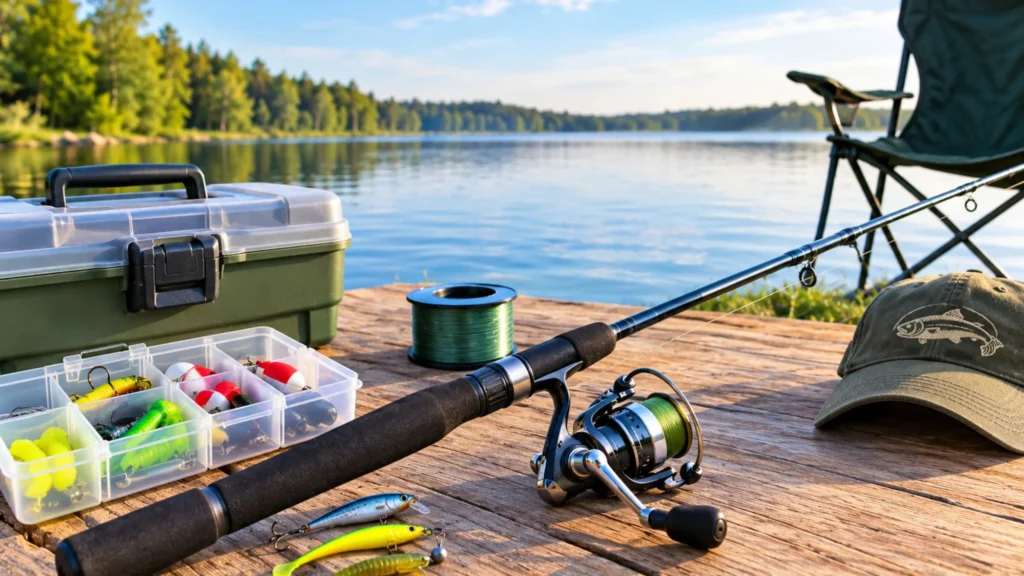
A simple freshwater rod-and-reel combination with basic line, a small hook, sinker, bobber, and legal bait is a practical starting point for many beginners.
A spincast setup can be particularly approachable because the reel uses a push-button release, while a spinning setup gives you a useful platform to continue developing your skills. The U.S. Fish & Wildlife Service identifies both as common beginner options.
Don’t worry about building a professional tackle collection.
Learn one setup first.
Where Should a Beginner Go Fishing?
Start somewhere legal, accessible, safe, and known to contain fish.
| Location | Beginner difficulty | Why it can work |
| Local pond | Low | Easy access and simple casting |
| Lake shoreline | Low to moderate | More habitat to explore |
| Riverbank | Moderate | Current can affect your presentation |
| Public pier | Low to moderate | Convenient access to deeper water |
| Boat | Moderate to high | More equipment and water-safety considerations |
The U.S. Fish & Wildlife Service reports fishing opportunities at hundreds of national wildlife refuges and national fish hatcheries, while Take Me Fishing also recommends accessible shorelines, bridges and public piers as options for beginners.
Always verify that fishing is permitted at the exact location and check the applicable regulations.
7 Beginner Fishing Mistakes to Avoid
1. Buying Too Much Gear
More tackle doesn’t automatically mean more fish.
Learn to use a simple setup before expanding your equipment.
2. Ignoring Fishing Regulations
A fishing spot can have specific rules about licenses, species, sizes, seasons, bait, and catch limits.
3. Using the Wrong Bait
Bait should make sense for the species, location, and fishing method.
4. Casting Without Looking Around
Hooks and lures can injure people. Always check your surroundings before casting. The U.S. Fish & Wildlife Service specifically advises anglers to look around before making a cast.
5. Staying in One Bad Location Too Long
If conditions provide little reason to expect fish in an area, changing location can be more productive than repeatedly casting to the same empty water.
6. Changing Everything at Once
If you change your bait, depth, location, lure, and technique simultaneously, you won’t know what actually made a difference.
7. Expecting Every Trip to Produce a Catch
Fishing involves changing environmental conditions and fish behavior.
A successful beginner trip can mean learning how to cast better, identifying new habitat, tying a better knot, or simply becoming more comfortable around the water.
Fishing Safety for Beginners
Fishing is an outdoor activity around potentially hazardous water, sharp hooks, slippery surfaces, changing weather, and sometimes strong currents.
Before you fish:
- Check the weather forecast.
- Tell someone where you’re going.
- Keep children closely supervised around water.
- Handle hooks carefully.
- Look around before casting.
- Avoid unsafe banks and slippery surfaces.
- Be cautious when wading.
- Wear a properly fitted life jacket/PFD when appropriate.
- Carry water, sun protection, and basic first-aid supplies.
The National Park Service warns that natural water can have sudden depth changes, currents, cold temperatures, underwater hazards, and other risks. It recommends wearing an appropriate U.S. Coast Guard-approved life jacket when on, in, or near the water.
If you are fishing in a river or stream, don’t assume calm-looking water is automatically safe. Water conditions can change quickly, and slippery rocks or strong currents can create serious hazards.
What Should You Do on Your First Fishing Trip?
Keep your first trip simple.
Your beginner game plan:
1. Check the rules.
Make sure you have the correct license and know the local regulations.
2. Choose accessible water.
A nearby pond, lake, shoreline, or legal public fishing area can be enough.
3. Bring simple gear.
Avoid turning your first trip into a shopping project.
4. Rig your line at home.
Practice your knot before you arrive.
5. Practice casting safely.
Accuracy matters more than distance.
6. Start with simple bait.
Use legal bait appropriate for your target fish.
7. Watch the water.
Look for structure, movement, depth changes, and signs of fish activity.
8. Change one thing when necessary.
If nothing happens, adjust your location, depth, bait, or presentation.
9. Stay safe.
Watch the weather and water conditions.
10. Learn something.
Even if you don’t catch a fish, leave knowing more than when you arrived.
Conclusion
You don’t need to be an expert to start fishing. Get the correct license, keep your equipment simple, choose an accessible and legal fishing spot, use appropriate bait, practice casting, and learn to recognize bites. Stay safe around the water, follow local regulations, and treat every trip as a chance to learn. Your first goal isn’t to catch the biggest fish—it’s to become a more confident angler.
FAQs
What do you need to start fishing?
Most beginners need a legal fishing location, the required license or permit, a rod and reel, fishing line, hooks, sinkers, a bobber, and suitable legal bait or lures. The exact setup depends on the type of fishing and location.
What is the easiest fishing setup for beginners?
A simple spincast or spinning rod-and-reel setup is a practical starting point. The U.S. Fish & Wildlife Service identifies both as common beginner options and describes the closed spincast reel as particularly easy for beginners.
What bait is best for beginners?
There isn’t one universally best bait. Choose bait based on the fish species, water, fishing method, and local regulations. Simple natural bait can be a straightforward starting point, but always check whether the bait is legal where you plan to fish.
Do you need a fishing license in the USA?
In many situations, yes, but requirements vary by state and location. License rules can depend on factors such as age, residency, species, and where you’re fishing. Check the official fish and wildlife agency for the state where you plan to fish before your trip.
What is the best place for a beginner to fish?
A nearby legal pond, lake shoreline, riverbank, or public pier can be a good starting point. Choose a location with safe access, known fish populations, and enough open space to practice casting.
What time of day is best for fishing?
There is no single best time for every species and location. Morning and evening can be useful periods to try, but weather, season, water temperature, species behavior, and local conditions also influence fishing activity.
What should you do if you don’t catch anything?
Don’t assume you failed. Change one variable at a time such as location, depth, bait, or presentation and observe what happens. Fishing is a skill that improves through repeated practice and learning how fish respond to different conditions.
Is fishing hard for beginners?
The basic mechanics are easier than they may first appear. You can begin with one simple setup, one reliable knot, basic bait, and an accessible fishing location. The more difficult part is learning how fish respond to changing conditions, which comes with experience.
