

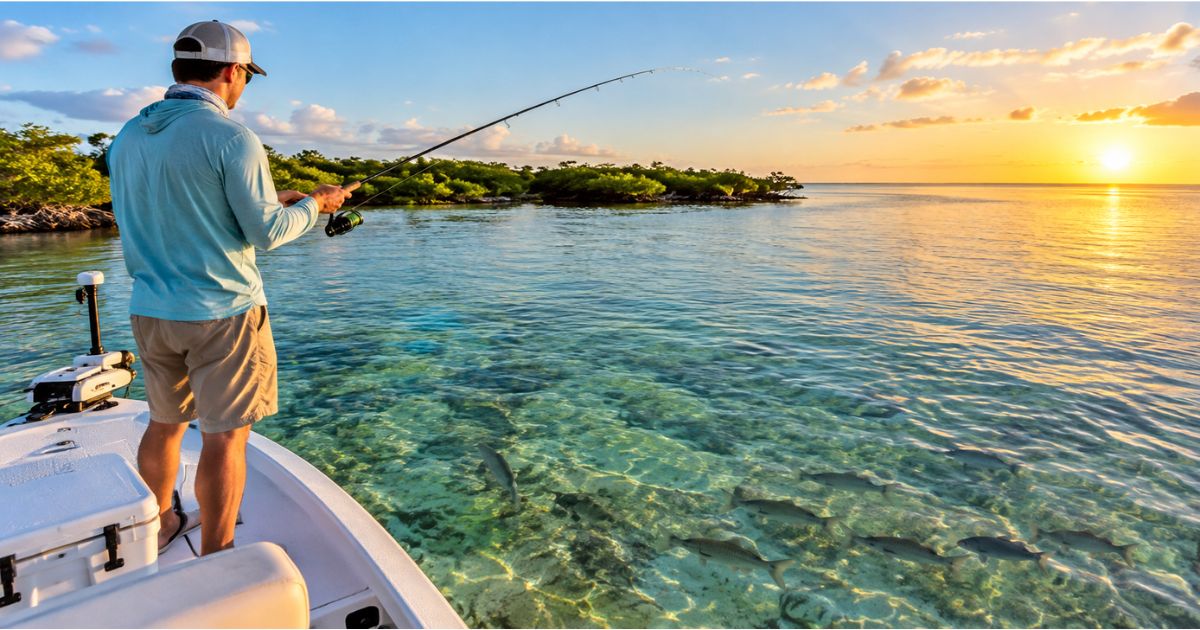
Inshore fishing is saltwater or brackish fishing in shallow, protected coastal water, such as bays, flats, estuaries, marshes, and mangrove shorelines. Anglers commonly put the limit at about 100 feet (30 meters) of depth. You can do it from shore, a pier, a kayak, or a small boat, and most trips are same-day outings.
You have probably heard guides and anglers say “we’re fishing inshore today.” Then someone else says “inshore” means a mile from the beach, and a third person says fifteen miles.
Nobody is wrong. “Inshore” is an angler’s word, not a legal one, and that is why the answers don’t match. This guide gives you one clear definition, shows you why the numbers differ, and covers the fish, gear, timing, and rules you need to get started.
What Is Inshore Fishing?
Inshore fishing is fishing in the shallow, sheltered saltwater (or brackish water) close to the coast. The water is calmer than the open ocean, the boats are smaller, and the tackle is lighter.
Four traits describe almost every inshore trip:
- Shallow water. Commonly about 100 feet (30 meters) deep or less, and often just a few feet.
- Protected habitat. Bays, flats, estuaries, tidal creeks, marshes, mangrove shorelines, oyster bars, jetties, and piers.
- Light gear and small boats. Spinning rods, light line, and skiffs or bay boats. Many people fish with no boat at all.
- Short trips. You launch, fish, and come home the same day, often within minutes of the ramp.
How Far Is “Inshore”? Why Every Source Gives a Different Answer
Here is how five popular guides define it. Notice that some use depth and some use distance, and the distance numbers don’t agree.
| Source | How it defines “inshore” |
| Scout Boats | About 30 meters deep or less. Depth matters more than distance from shore. |
| Toadfish | 30 meters or less in its intro, but a few inches to 15–20 feet deep and within a mile or two of shore later in the same article. |
| FishingBooker | Within roughly 10–15 miles of shore, and under 30 meters deep. |
| FishVerify | Within about 15–20 km (roughly 9–12 miles) and about 30 meters deep. |
| Captain Michael Fishing | Within a few miles of shore and under 30 meters (100 feet) deep. |
Three things explain the gap:
- Coastlines are different. Some shores drop to deep water quickly. Others have shallow flats that run for miles. Distance alone can’t capture that.
- Habitat matters more than miles. If you are fishing a protected bay or marsh in shallow water, you are inshore, whether you are 200 yards or 5 miles from the beach.
- There is no official standard. No agency defines “inshore” for anglers, so each writer picks a rule of thumb.
The practical rule: use depth and habitat first (about 100 feet or less, in protected coastal water), and treat distance as a rough guide. Under that rule, most people agree where inshore ends.
Inshore vs. Nearshore vs. Offshore
Most guides give you two choices. Real anglers use three. Nearshore is the in-between zone, and it is why “inshore or offshore?” can feel confusing.
| Inshore | Nearshore | Offshore | |
| Water | Shallow, protected: bays, flats, estuaries, marshes | Open coastal water just past the beach, jetties, and inlets | Deep open ocean |
| Boats | Skiffs, flats boats, bay boats, kayaks, or no boat | Center consoles and larger bay boats | Larger boats built for long runs and rough seas |
| Typical trip | A few hours, close to the ramp | Half-day trips | Long runs and long days |
| Gear | Light tackle | Light to medium | Heavy tackle |
| Example targets | Redfish, speckled trout, snook, flounder | Mixed: some inshore species plus pelagic visitors | Tuna, mahi-mahi, sailfish, marlin, wahoo |
There is no official line between nearshore and the other two, and species overlap. A tarpon or snook may be caught in an inlet that one angler calls inshore and another calls nearshore. When in doubt, ask your guide or marina how locals use the word.
Where Does Inshore Fishing Happen?
Inshore fish live where food, shelter, and moving water meet. Learn to read these places and you will find fish faster.
| Habitat | What it is | Common targets | How people fish it |
| Bays | Sheltered coastal water with grass, sand, and mud bottoms | Redfish, speckled trout, flounder | Casting lures or live bait near grass edges and drop-offs |
| Flats | Shallow sand or grass areas, often just inches to a few feet deep | Redfish, trout, snook, tarpon, bonefish (in the Florida Keys) | Quiet approach, sight casting, light tackle |
| Estuaries and tidal creeks | Where rivers meet the sea and salt mixes with fresh water | Redfish, trout, black drum, flounder | Fishing moving tide around creek mouths |
| Mangrove shorelines | Tangled roots that shelter shrimp, crabs, and small fish | Snook, redfish, mangrove snapper, tarpon | Tight casts along the edge |
| Oyster bars and docks | Hard structure that holds crabs and baitfish | Sheepshead, black drum, redfish | Bait fished close to structure |
| Bridges, piers, jetties | Man-made structure with current | Snook, snapper, drum, many others by region | Live bait or jigs, often from shore |
Because estuaries mix fresh and salt water, “inshore” water is often brackish, not purely saltwater.
What Fish Can You Catch Inshore?
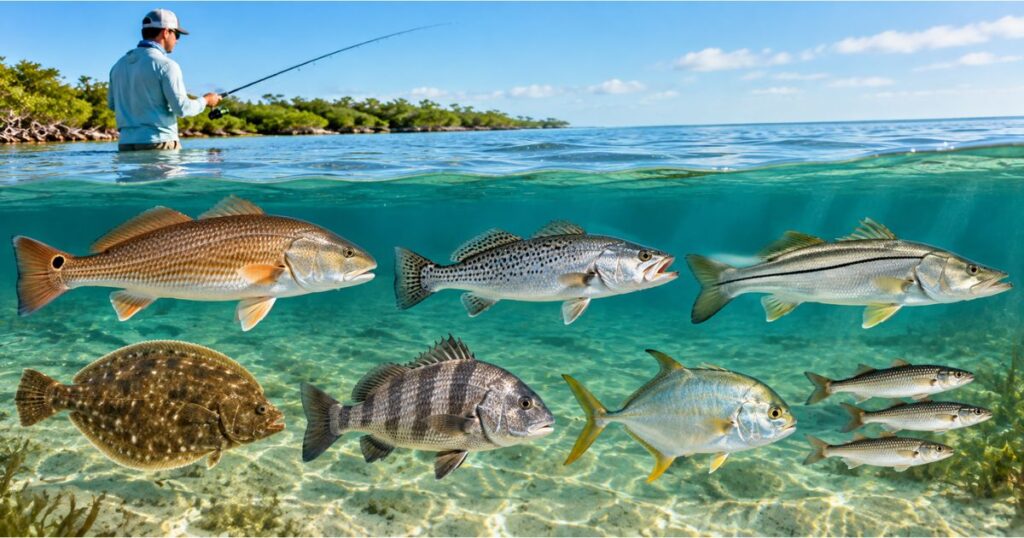
What bites depends on where in the U.S. you are fishing. Here is a starting map. Always confirm local species and seasons with your state wildlife agency.
| Region | Common inshore targets |
| Florida Keys and South Florida | Tarpon, bonefish, permit, snook, redfish, mangrove snapper |
| Florida Gulf Coast | Redfish, speckled trout, snook, flounder |
| Texas Gulf Coast | Redfish, speckled trout, black drum, flounder |
| Louisiana marshes | Redfish, speckled trout, black drum |
| Chesapeake Bay and Mid-Atlantic | Striped bass, bluefish, croaker, red drum |
| Northeast | Striped bass, bluefish, and summer flounder (fluke) are widely targeted. Verify with your state agency. |
| Pacific coast bays | Varies widely by bay and season. [Add region-specific species after expert or state-agency review.] |
A quick profile of four classics:
- Redfish (red drum). A hard-fighting favorite around grass flats, mangroves, and oyster bars. One of the most popular inshore fish in the U.S.
- Speckled trout. Abundant in many coastal waters, and they feed on shrimp and baitfish. Great for beginners.
- Snook. Known for powerful runs. They hang around docks, bridges, and mangroves.
- Flounder. Flat fish that hide along sandy bottoms and strike passing bait.
Inshore usually means smaller fish than offshore, but often more bites. You trade one giant fish for a day of steady action.
What Gear Do You Need for Inshore Fishing?
The good news: you don’t need much. Most inshore anglers carry just two setups, one light and one heavier.
Light setup. Good for trout, flounder, pompano, and smaller redfish. One tackle brand, Toadfish, describes a typical light rod as about 6’8″ to 7’2″, medium-light or medium power, with fast action, rated for roughly 6–12 lb line.
Heavy setup. Better for big redfish, cobia, tarpon, and sharks. The same brand describes typical heavy rods as about 7′ to 7′ 6″, rated for roughly 12–20 lb lines.
The building blocks:
- Rod and reel: a medium or medium-heavy spinning outfit is the beginner standard.
- Line: many anglers use braided main line with a fluorocarbon leader, which is harder for fish to see and resists rubbing on rocks and shells.
- Hooks: circle hooks are popular with live bait because they tend to hook fish in the corner of the mouth, which helps with safe release.
- Bait: live shrimp, pilchards, pinfish, mud minnows, and small crabs are common. Soft plastic shrimp, paddle-tail swimbaits, topwater plugs, spoons, and bucktail jigs are popular lures.
- Extras: pliers, a rubber-coated landing net, polarized sunglasses, sun protection, and a fishing license.
What Does Inshore Fishing Cost?
I can’t give you one price, because costs vary hugely. Here is what drives the total:
- How you fish. Shore, pier, and wade fishing cost the least. A guided charter costs more but usually includes boat, tackle, bait, and licensing. Owning a boat adds fuel, maintenance, and storage.
- Your tackle. One decent spinning combo is enough to start.
- Your license. Requirements and fees depend on your state.
- Your region. Charter rates differ by coast and season.
Do You Need a Boat?
No. This is one of the best things about inshore fishing. You have four main options.
- Fish from shore. Wade grassy flats, cast from a beach, or fish piers and bridges. The best choice depends on local access, so research your spot first.
- Use a kayak. Quiet, cheap to run, and able to reach shallow water.
- Take a small boat. A good inshore boat is often about 18 to 25 feet. Common types are skiffs, flats boats, bay boats, and center consoles. You need a casting platform, rod storage, and ideally a live bait well, not sleeping quarters or a bathroom.
- Book a charter. The easiest way to start. You get a captain who knows the water, and the trip usually covers equipment.
When Is the Best Time to Go Inshore Fishing?
Inshore fish follow tide, light, temperature, and season. Here is how to think about each.
- Time of day. Early morning and late afternoon are popular. Cooler temperatures and lower light often get fish feeding.
- Tide. Moving water is the key. Many anglers like an incoming tide because it pushes baitfish into shallow areas. Outgoing tides can also produce when bait washes through channels and creek mouths.
- Season. Fish move with water temperature. Warm months bring strong action for species like snook, tarpon, and redfish in the South. Many anglers rate fall highly because fish feed hard before winter. In cold months, some species slide into deeper channels while others hold in warmer pockets.
- Weather. Light wind is usually best. Clouds can keep fish feeding longer. Heavy storms can hurt visibility and water quality for a while.
Safety check: Inshore water is calmer than offshore, but it is not always calm. Wind can build quickly in open bays and make a small-boat ride bumpy. Check the marine forecast before you go, keep a properly fitting life jacket for everyone aboard, and tell someone where you are fishing.
Is Inshore Fishing Good for Beginners?
Yes. Inshore fishing is one of the easiest ways to start saltwater fishing. The water is usually calmer, trips are short, and you can learn with simple gear. You can even start from shore without a boat. A guided charter lets you learn the water with a local expert.
Why it works for newcomers:
- Calmer water means less seasickness
- Shorter runs mean more fishing time
- Basic gear is enough
- Fish are often plentiful
- It suits families and kids
Rules Before You Cast: Licenses, State vs. Federal Waters, Limits
This is the part most guides skip, and it is where “inshore” gets a real, legal meaning.
Who sets the rules depends on where you are standing, or floating. For most of the U.S., state waters extend 3 nautical miles from shore, but off Florida’s Gulf coast and Texas the boundary is 9 nautical miles.Inside that line, your state agency generally writes the fishing rules. Beyond it, federal rules usually apply.
Why that matters to you:
- Seasons, size limits, and bag limits can differ between state and federal waters, even for the same fish and the same stretch of coast.
- Most inshore fishing happens well inside state waters, so your state agency is usually the rulebook that matters most.
- A saltwater fishing license is commonly required, but rules vary by state, age, and where you fish.
Do this before every new trip:
- Look up your state wildlife or marine fisheries agency website.
- Check license requirements for saltwater.
- Check size limits, bag limits, and open seasons for each species you might catch.
- If you are fishing near a state boundary, check whether federal rules apply.
Fishing Responsibly
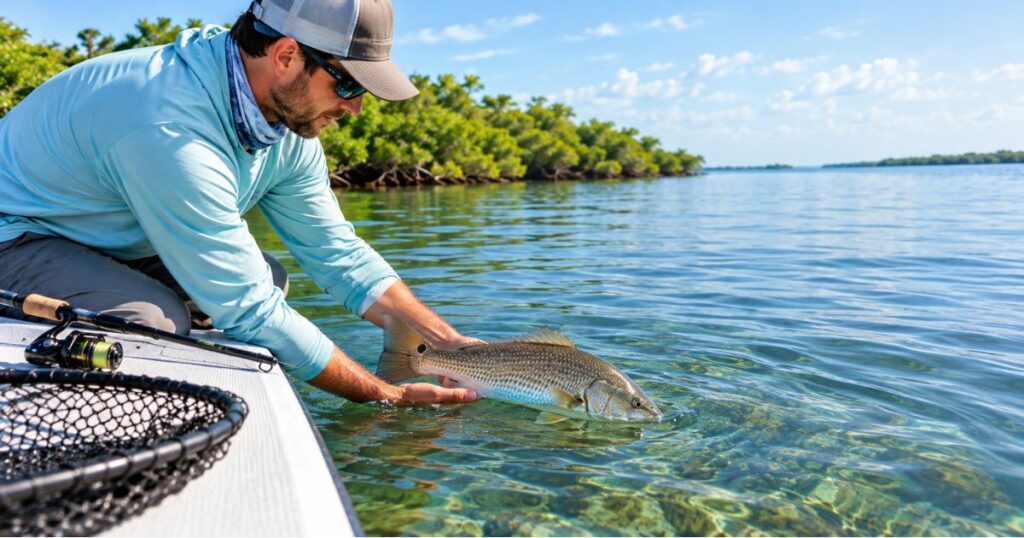
Healthy fisheries mean fish for your kids to catch. Simple habits go a long way:
- Know the rules and follow size and bag limits
- Use circle hooks with live bait where it fits
- Handle fish gently with wet hands and a rubber net
- Release fish quickly when required
- Avoid damaging seagrass and mangroves when you anchor or wade
- Take your used line and trash home
From the Field
[NEEDS YOUR INPUT: add a short first-hand story, guide quote, or observation here, for example a real example of a state or local boundary changing the rules, or what a first-time angler caught on a first guided trip. Real experience here is the strongest trust signal on the page. Include who it is from and their credentials.]
FAQ
What is considered inshore fishing?
Inshore fishing is fishing in shallow, protected coastal waters such as bays, estuaries, flats, and marshes. Most sources set the limit at about 30 meters (100 feet) of depth. There is no official definition, so habitat and depth matter more than distance.
How far from shore is inshore fishing?
Sources range from “within a mile or two” to 10–15 miles, because coastlines differ. Many guides use depth instead, about 100 feet or less. Think “shallow and sheltered,” not a fixed mileage.
What is the difference between inshore and offshore fishing?
Inshore fishing happens in shallow, sheltered water with small boats and light tackle. Offshore fishing happens in deep open water with larger boats and heavier gear, and often targets tuna, mahi-mahi, marlin, and wahoo. Trips offshore are usually longer.
Do I need a license for inshore fishing?
In most places, yes. A saltwater license is commonly required, but rules vary by state. Check your state wildlife or marine fisheries agency before you go. Guided charters often cover licensing as part of the trip.
What is the best bait for inshore fishing?
Live shrimp, pilchards, pinfish, and small crabs are popular, and soft plastic shrimp, paddle-tail swimbaits, and topwater plugs work as lures. The best choice depends on your region and target species, so ask at a local tackle shop.
Is inshore fishing good for beginners?
Yes. Calm water, short trips, and simple gear make it one of the easiest ways to start saltwater fishing. A guide or a shore spot with easy access can make your first trip even simpler.
