

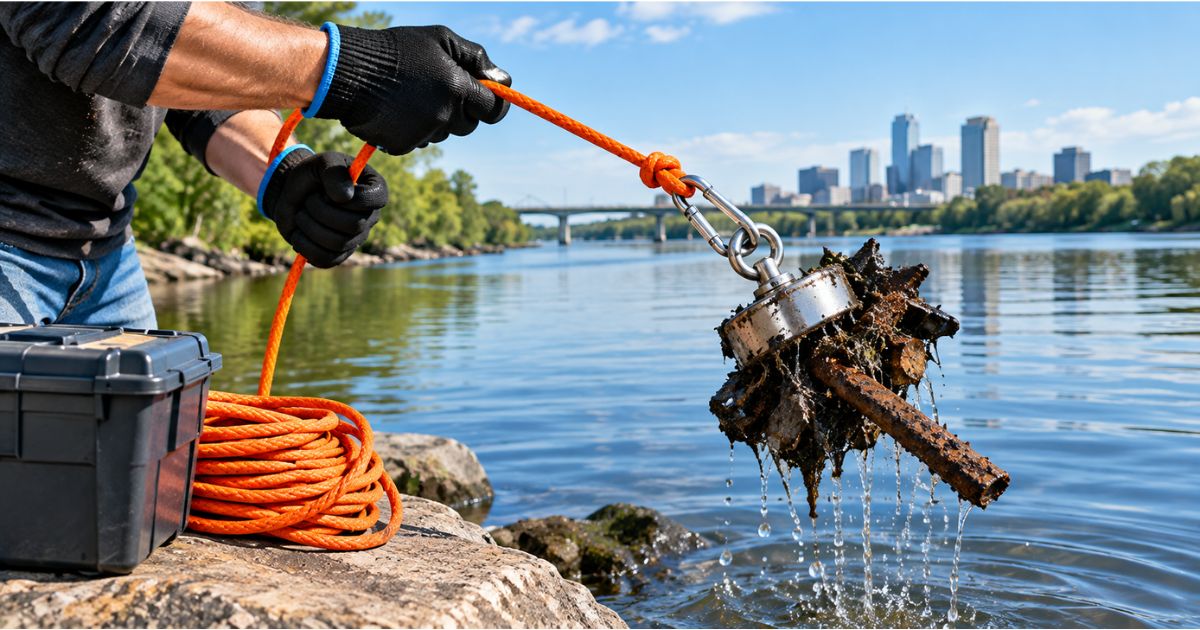
Magnet fishing is searching outdoor water for iron-containing (ferromagnetic) objects using a strong neodymium magnet on a rope. Most finds are scrap metal, though people also pull up bicycles, safes, and coins. Laws vary by state and city, and dangerous finds like firearms or explosives need to be reported to police right away.
Keep reading for how it works, what gear you need, what’s legal in the US, and how to stay safe on your first trip.
What Is Magnet Fishing?
Magnet fishing is the practice of using a powerful magnet on a rope to pull metal objects out of lakes, rivers, canals, and other water. It is also called magnetic fishing. People who do it are sometimes called magnetfishers.
Unlike traditional fishing, you aren’t after fish. You’re after anything that contains iron, from bolts and keys to old tools and bike frames.
How It Works
- Attach the magnet to a sturdy rope, usually with a knot or a carabiner.
- Toss it into the water from a bridge, dock, pier, or shore.
- Let it sink and drag it slowly along the bottom.
- Pull it back in and check whatever has stuck, wearing gloves.
How Did Magnet Fishing Start?
Magnet fishing likely started with boaters who used magnets to recover things they’d dropped in the water, like keys or tools. Over time, it grew into a hobby. It began gaining popularity in Europe in the early 2000s, and it has since spread to the US.
Today, many people combine it with environmental cleanup and treasure hunting, which is why it appeals to such a wide mix of people.
What Can You Actually Find?
Expect a lot of rusty junk. The fun is in the surprises.
- Common finds: Nuts, bolts, nails, keys, tools, and scrap metal
- Bigger finds: Bicycles, scooters, shopping carts, and car parts
- Historical finds: Old coins, jewelry, and occasionally antique items
- Dramatic finds: Safes, which are often empty, and occasionally a lockbox with something inside
- Dangerous finds: Firearms, grenades, and other explosives. These are rare but real, and they need an immediate police call. We cover this in the safety section below.
What Do You Need to Get Started?
You don’t need much. Most beginners start with a magnet fishing kit, which bundles the basics.
| Gear | What It Does | Tips |
| Neodymium magnet | Picks up the metal | Single-sided magnets hold strongest on one face. Double-sided magnets scan both sides. 360° magnets pull from every direction. |
| Rope | Lets you throw and retrieve the magnet | Nylon is common because it doesn’t rot. A rope of about 15 to 30 meters (50 to 100 feet) is typical. |
| Gloves | Protect your hands from sharp, rusty metal | Choose work gloves that aren’t too bulky, so you can still feel the magnet catch. |
| Carabiner and knot | Secure the rope to the magnet | Figure-8 follow-through and Palomar knots are both popular and hold well. |
| Grappling hook | Helps pull up heavy or awkward finds | Optional, but useful for bigger items. |
| Storage box | Keeps the magnet safe to transport | A polystyrene-lined tackle box helps reduce the magnet’s pull. |
Choosing Your Magnet Strength
Magnet strength is usually listed as pull force, measured in pounds or kilograms. This number is typically tested under ideal conditions, pulling straight off a flat sheet of steel. In real water, with mud, angles, and rust, you’ll get less.
Sellers differ on what a beginner should buy. One popular seller recommends about 300 kg (660 lb) for beginners. A major magnet fishing guide suggests at least 500 lb. Both agree that more pull force is better for heavier finds, and that a higher number doesn’t always mean a bigger magnet.
Cost
Entry-level kits can start around $50, according to one major fishing guide. Prices go up with stronger magnets and extra gear.
Is Magnet Fishing Legal in the USA?
There is no federal law in the US that restricts magnet fishing. Your state, county, and city rules are what matter. Some places have clear restrictions, and others are unclear, so check before you go.
States With Known Restrictions
| Location | What to Know |
| South Carolina | State law restricts magnet fishing in state waters without a license, under the Underwater Antiquities Act. |
| Indiana | Magnet fishing on public waters on Department of Natural Resources (DNR) properties requires a permit. The magnet must be something you can carry and retrieve by hand. |
| Everywhere else | Rules vary by state and locality. Check your state wildlife or fish and game agency’s website. |
Private Property and Permission
Always get permission before fishing on private land or private waterways. Trespassing can turn a fun afternoon into a legal problem.
Who Owns What You Find?
This depends on where you are. In some places, anything of value you find may belong to the local government, not to you. If you find something valuable or historical, check local rules before you keep it.
How to Check Your State
- Search for your state’s wildlife, fish, or DNR agency.
- Look for rules on submerged objects, permits, and water access.
- Call the local agency if the rules are unclear. Many magnet fishers report that local jurisdictions make the final call.
Is Magnet Fishing Dangerous?
It can be, mostly from the things you pull up and the places you fish. Most risks can be managed with a little care.
- Cuts and punctures: Rusty metal is sharp. Always wear gloves, especially for bigger finds.
- Tetanus: Get a tetanus booster if you haven’t had one recently. Rusty metal can carry infection risk.
- Crushed fingers: Neodymium magnets snap together hard. Keep your fingers clear when a magnet meets metal.
- Pacemakers and electronics: Strong magnets can interfere with pacemakers and damage phones, cards, and other electronics. If you have a pacemaker, don’t handle these magnets. Keep them away from your phone and car keys too.
- Steep banks and strong currents: Water can be deeper and faster than it looks. Fish from safe, stable footing and never lean too far out.
- Unexploded ordnance: WWII-era explosives still turn up in some waterways, including in Europe. Rare cases in the US are also documented.
What to Do If You Find a Gun or Explosive
If you pull up a firearm, grenade, or anything that could be an explosive, stop and call for help. Do not try to open, clean, or move it.
- Don’t touch or move the item. Leave it where it is and keep your rope tied off.
- Keep people away, especially children and pets.
- Note the exact location so you can tell officers where it is.
- Call 911 if there’s any immediate danger. Otherwise, call your local police non-emergency line.
- Let trained officers handle it. Don’t attempt to dispose of yourself.
Magnet Fishing vs. Metal Detecting
People often confuse the two hobbies, but they work differently.
| Magnet Fishing | Metal Detecting | |
| How it works | Uses a permanent magnet on a rope | Uses an electronic instrument that detects metal |
| Where it’s used | Water (rivers, lakes, canals) | Usually land, beaches, and parks |
| Common finds | Iron and steel objects from the bottom | Coins, jewelry, and metal items near the surface |
| Rules | Varies by state and waterway | Often has its own permit rules, especially on archaeological sites |
Some places treat magnet fishing under the same rules as metal detecting, so check both if you do either.
Where and How to Start Your First Trip
Choosing a Spot
Look for public water with plenty of foot traffic. People drop things near:
- Bridges
- Piers and docks
- Canals and harbors
- Historic riverside areas
Places that get a lot of attention may already be picked clean. Spots off the beaten path can be worth trying, but make sure you have permission and that the area is legal to fish.
Your First Trip, Step by Step
- Check local rules for your exact spot.
- Get permission if the water is private.
- Check your gear: magnet, rope, knot, gloves.
- Pick a safe spot with stable footing and clear access.
- Tie the rope securely and make sure it’s attached before you throw.
- Toss the magnet and let it sink to the bottom.
- Drag it slowly back and forth.
- Pull it in carefully and keep your fingers clear of the magnet.
- Inspect your finds with gloves on.
- Pack up junk properly. Don’t leave it on the bank. Take scrap metal to a scrap drop-off, and separate batteries and electronics, which may need special disposal.
If Your Magnet Gets Stuck
This is common for beginners. Try these in order:
- Slide the magnet off sideways. This works with much less force than pulling straight away.
- Give quick, sharp tugs from the side.
- Get help from a friend or a passerby for a steady pull.
FAQs
What is magnet fishing used for?
Magnet fishing is used for treasure hunting, cleaning up metal debris from waterways, and as an outdoor hobby. Many people enjoy it as a way to spend time outside while uncovering things they never expected to find.
Is magnet fishing legal in the US?
Yes, there is no federal law that restricts it. However, state and local rules apply, and some places require permits or ban it in certain waters. Check your state’s wildlife or DNR agency before you go.
Is magnet fishing dangerous?
It can be, mainly from sharp metal, crushed fingers, unexploded items, and unsafe banks or currents. Wear gloves, get a tetanus booster if needed, and never handle a suspected weapon or explosive.
What can you find magnet fishing?
Most finds are scrap metal like bolts, keys, and tools. Some people also find bicycles, safes, coins, and occasionally jewelry. Firearms and explosives are rare but possible, and they need to be reported to police.
How strong of a magnet do I need?
Many beginners start with a magnet rated around 500 lb or more, though sellers differ. Remember that the rated pull force is usually measured on a flat steel plate, so real-world pull is lower.
Do you need a permit for magnet fishing?
It depends on where you fish. Some states and waterways require a permit or license, and private property requires the owner’s permission. Always check local rules first.
