

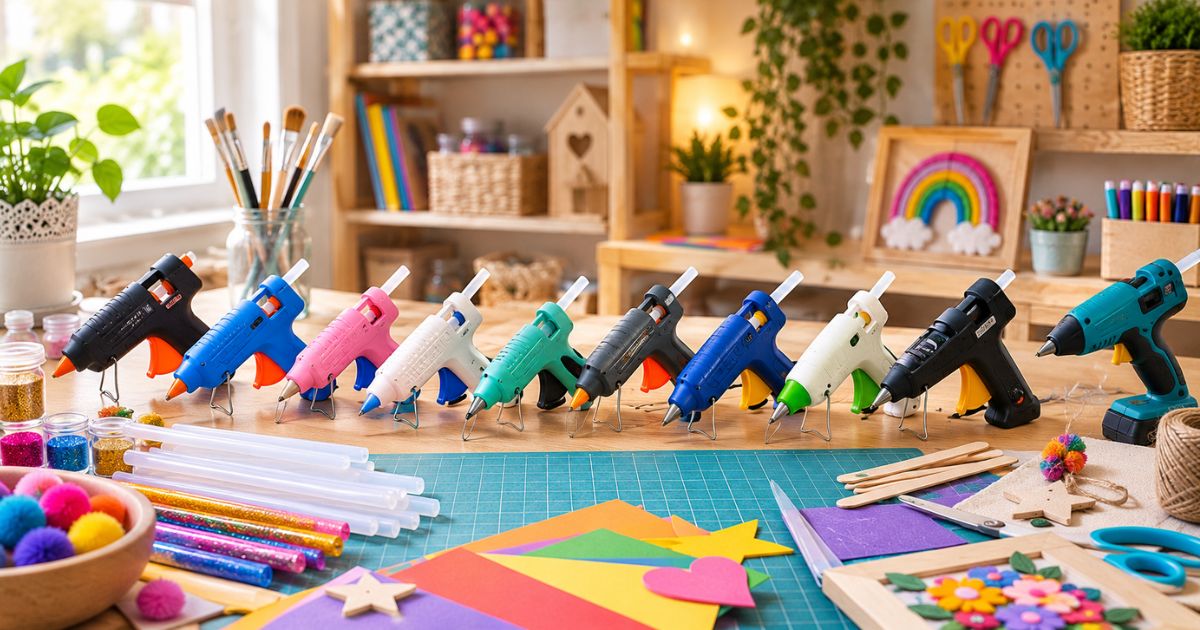
The Gorilla Dual-Temp Mini is our top overall pick for crafters. It’s versatile, affordable, heats in 45 seconds, and handles everything from fabric to wood. For cordless freedom, the Surebonder CL-800F offers mobility without sacrificing power. For beginners on a budget, the Elmer’s Mini is reliable and safe. Your best choice depends on your project type, the materials you’re bonding, and whether you prioritize precision over speed. Read on to find The Best Glue Guns for Crafts that matches your specific style.
How to Choose the Right Glue Gun
Before we jump into our top picks, let’s settle the most important question: What kind of glue gun do you actually need?
Most people buy the wrong gun on their first try. They grab whatever’s cheapest, or they assume “more watts = better,” or they don’t realize that fabric needs a different temperature than wood. Then they get frustrated when their craft doesn’t hold, or they burn the material they’re trying to bond.
Let’s fix that.
Mini vs. Full-Size: Size Does Matter
Here’s the difference: Mini glue guns use 7mm glue sticks (about the size of your pinky). Full-size guns use 11mm sticks (thicker, more like your thumb). These are not interchangeable; forcing the wrong size into a gun will jam it or leave the stick unmelted.
When to use a mini:
- Detail work (card making, scrapbooking, jewelry)
- Small or delicate projects (hair bows, model building, craft embellishments)
- If you have smaller hands or limited grip strength
- If you’re a casual crafter who doesn’t need high glue output
When to use full-size:
- Large projects (wreaths, lampshades, home décor)
- Heavy-duty bonding (wood, metal, ceramics)
- If you’re applying glue continuously (less reloading)
- If you want faster coverage on bigger surfaces
The honest truth: Full-size guns dispense glue faster and hold more, but minis give you finer control. Mini glue guns are ideal for detailed, delicate work like crafting and DIY décor, while full size glue guns dispense more glue, perfect for larger surfaces and heavy-duty projects.
Temperature: High, Low, or Dual?
This is where many crafters get burned literally and figuratively.
High-Temperature (~380°F): Creates a strong, permanent bond. Best for wood, metal, plastic, ceramics, and magnets. Gets very hot and can burn skin or melt heat-sensitive materials like fabric and foam.
Low-Temperature (~300°F): Safer and more forgiving. Best for fabric, paper, foam, and delicate materials. Creates a weaker bond than high-temp, so it’s not ideal for structural repairs.
Dual-Temperature: Switchable between high and low on the same gun. The high-temp setting is best for wood, plastic, and metals, while low temp works on Styrofoam, fabric, and paper. This is the most versatile option you get one gun that handles almost any project.
Cool Shot / Ultra-Low Temp (~250°F): Extremely safe for kids’ crafts and delicate projects. Bond is weaker, so not for structural work.
Quick material guide:
| Material | Safe Temp | Why |
| Fabric | Low only | High-temp melts or scars the fibers |
| Foam / Styrofoam | Low only | High-temp dissolves foam entirely |
| Paper / Card | Low or Dual | Low-temp is safer; dual gives control |
| Wood | High | Strong bond needed; low-temp won’t hold |
| Metal | High | Strongest bond required |
| Plastic | High | Low-temp won’t stick reliably |
| Leather | High or Dual | High for durability; test first |
Wattage vs. Temperature: The Confusion That Costs You Money
Here’s the single biggest mistake crafters make: they think wattage determines how hot the glue gets. It doesn’t.
Let me explain, because understanding this will save you money on a gun you don’t need.
Wattage is the electrical power the gun draws. It determines:
- How fast the gun heats up (20W takes 2–3 minutes; 60W takes 30–45 seconds)
- How well the gun recovers between squeezes (if you squeeze continuously for an hour, a 60W gun won’t cool down as much as a 20W gun)
- How consistently the heat stays on during heavy, continuous use
Temperature is the actual heat the glue reaches. It’s set by the glue gun design and the glue sticks you use. A 20W gun and a 60W gun can both reach 380°F if they’re both high-temp models. The 60W just gets there faster.
Real-world example: A 20W Gorilla Mini will reach 380°F and bond wood just as well as a 60W Surebonder. But if you’re gluing for 3 hours straight at a craft party, the 60W will maintain its heat better—the 20W might dip in temperature and weaken the bond mid-project.
When do you need 60W or higher?
- You’re crafting for 2+ hours without breaks
- You’re bonding heavy materials (thick wood, metal)
- You’re working at a workshop or production scale
- You want the fastest heat-up time possible
When is 20–40W plenty?
- You craft in sessions under 1–2 hours
- You do detail work or lightweight projects
- You’re casual about the whole thing
- You’re on a budget (lower wattage = cheaper)
Bottom line: Don’t overpay for 100W when 20W does the job. But if you’re serious about crafting, spending $10 extra for 40–60W is worth it for speed and consistency.
Cordless vs. Corded: Freedom vs. Power
Cordless (Battery-Powered):
- Pros: Freedom to move around, no cord tangles, great for craft parties or outdoor projects, no need to stay near an outlet
- Cons: Battery drains (usually 30–90 minutes per charge), takes time to recharge, often heavier, sometimes less consistent heat
Corded (Plug-In):
- Pros: Unlimited runtime, lighter, cheaper, more consistent heat
- Cons: Cord management, limited by outlet distance, can’t use in spaces without power
Hybrid (Surebonder-Style Base):
- Gun stays on a powered base while not in use (stays warm, ready to use)
- Remove from base for 3–5 minutes of cordless use
- Best of both: No cord during crafting, but the gun stays charged on the mat
Cordless models are our top choice for crafting because they allow for greater freedom of movement. There’s no need to worry about a cord getting tangled or caught on the edge of your table, or not being able to reach your workspace.
Which should you choose?
- Cordless: You move between rooms, craft at events, or hate cord management
- Corded: You have a dedicated craft space and want unlimited, consistent power
- Hybrid: You want flexibility without the high cost of a premium cordless gun
Our Top 10 Glue Guns Tested & Ranked
Best Overall: Gorilla Dual-Temp Mini Hot Glue Gun Kit
Price: $12–$18 | Heat-Up: 45 seconds | Power: 20W | Size: Mini (7mm sticks)
This is the gun that shows up in more craft rooms than any other model for good reason. It has nearly 20,000 reviews and a 4.7-star rating, and it’s easy to see why: even though it’s small for storage and convenience, it’s surprisingly powerful. Thanks to its two heat settings, it qualifies as both a high-temp and a low-temp gun, so it works on a huge range of materials.
What we love:
- Dual-temp switch means you can tackle fabric, foam, paper, and wood without buying two guns
- Fast heat-up (45 seconds) keeps you in the flow
- Comes with 30 glue sticks, so you can start immediately
- Built-in stand keeps the nozzle safe between uses
- Trigger is easy to squeeze, even for people with hand fatigue
- Price is unbeatable for the versatility you get
Trade-offs:
- 20W means if you’re gluing for hours, you might see a slight heat dip
- Mini size = more frequent stick reloading on large projects
- Nozzle is small (precise, but slower coverage)
Best for: Beginners, scrapbooking, card making, mixed-material projects, anyone who wants one gun that does everything.
Best Budget: Elmer’s Craft Bond High-Temp Mini Glue Gun
Price: $8–$12 | Heat-Up: 2–3 minutes | Power: 20W | Size: Mini (7mm sticks)
If the Gorilla is out of stock or you want something even cheaper, the Elmer’s Mini is rock-solid. It’s slower to heat up than the Gorilla, but the glue quality is consistent and the gun feels sturdy.
What we love:
- Affordable (often under $10)
- Reliable brand (Elmer’s has been making adhesives for 70+ years)
- High-temp only means stronger bonds than a low-temp gun
- Safe for kids (relative to other glue guns)
- Comes with glue sticks in most kits
Trade-offs:
- No dual-temp (if you need low-temp for fabric, this isn’t your gun)
- Slower heat-up (3 minutes vs. 45 seconds)
- Single-temp means less material versatility
Best for: Budget-conscious crafters, wood/paper/plastic bonding, beginners who want to test the waters.
Best Cordless: Surebonder CL-800F Semi-Cordless Hot Glue Gun
Price: $35–$50 | Heat-Up: 60 seconds (powered base) | Power: 60W | Size: Full-size (11mm sticks) | Cordless Runtime: 3–5 minutes
This is the gun that changed the game for serious crafters. It sits on a powered base that keeps the glue warm. When you’re ready to craft, you pick it up and it’s cordless for 3–5 minutes before you need to set it back on the base.
Many crafters swear by their Surebonder. It’s extremely affordable compared to some of the above options. It’s actually semi-cordless and so easy to use, giving you three minutes of cordless use but you can also use it corded a must-have for spontaneous crafters.
What we love:
- Cordless freedom without rechargeable batteries (no waiting for charging)
- Full-size power means fast coverage on big projects
- 60W means excellent heat recovery during continuous use
- Stand with glue-drip catcher (workspace stays clean)
- Affordable compared to premium cordless models
- Hybrid approach gives best of both worlds
Trade-offs:
- You have to go back to the base every few minutes (not practical for outdoor projects far from power)
- The stand takes up space on your craft table
- Full-size sticks mean less precision than mini
Best for: Serious home crafters, workshop users, anyone who crafts regularly in one space.
Best Heavy-Duty: Surebonder PRO2-220 220W Adjustable Hot Glue Gun
Price: $80–$120 | Heat-Up: Under 5 minutes | Power: 220W | Size: Full-size (11mm sticks) | Temperature: Adjustable (248–428°F)
This is the industrial-grade gun. It’s designed for high-volume and heavy-duty applications, boasts 220 watts of power and an adjustable temperature knob that ranges from 248 to 428 degrees Fahrenheit. It heats up in fewer than 5 minutes and features a toggle switch near the handle base that lights up bright red to indicate when it’s on.
What we love:
- Adjustable temperature means you can dial in exactly what you need
- 220W power is overkill for hobby crafting, but perfect for all-day professionals
- Industrial-strength bonding for serious DIY (floorboards, siding, ceramic tile)
- Durable construction built to last years of heavy use
- Includes storage case and extra nozzle
- Removable wire stand keeps it stable
Trade-offs:
- Overkill for hobby crafting (you’re paying for power you don’t need)
- Heavy and bulky
- Heat-up time is slow (better to leave it on between uses)
- Price is steep ($80+)
Best for: Contractors, professional DIY work, workshops, large-scale projects.
Best Precision Tip: Surebonder H-270 Precision High-Temp Gun
Price: $25–$35 | Heat-Up: 60 seconds | Power: 60W | Size: Full-size with fine nozzle | Temperature: High-temp only
When you need to lay down a thin, controlled bead of glue, precision-tip guns are your answer. This fine tip or precision tip glue gun from Surebonder is a beast. It’s 60 watts, which is a lot of power for a glue gun, with a rugged exterior that helps it withstand being dropped or roughly handled.
What we love:
- Fine nozzle lets you apply glue exactly where you need it
- 60W power means consistent heat even on detailed work
- Full-size capacity means less reloading
- High-temp only creates strong bonds (fine for most projects)
- Rugged casing resists drops and rough handling
Trade-offs:
- High-temp only (not for fabric or foam without risk)
- More expensive than basic full-size models
- Overkill if you mostly do large-area bonding
Best for: Jewelry making, model building, detailed card making, any project requiring fine control.
Best USB Rechargeable: Dremel 4V USB Cordless Glue Pen
Price: $45–$65 | Heat-Up: 30 seconds | Power: Rechargeable USB | Size: Pen-grip (smallest) | Runtime: ~45 minutes per charge
This is the most portable option. It’s shaped like a pen, charges via USB, and gives you maximum freedom of movement without ever plugging into a wall or base.
What we love:
- Pen-shaped for maximum control and comfort
- USB rechargeable (charges from laptop, power bank, wall adapter)
- Fast 30-second heat-up
- Lightweight and portable (fits in a craft bag)
- Cordless runtime is decent for crafting sessions
Trade-offs:
- Smallest capacity (frequent stick reloading)
- Battery does drain (45 min of use before needing a recharge)
- Premium price for the portability
- Lower glue output than full-size guns
Best for: Travel crafters, small detail work, anyone who values portability over coverage speed.
Best for Kids / Beginners: AdTech Ultra Low-Temp Cool Shot
Price: $6–$10 | Heat-Up: 2–3 minutes | Power: 10W | Size: Mini (7mm sticks) | Temperature: Ultra-Low (~250°F)
If you’re introducing kids to glue guns, this is it. The temperature is low enough that a quick accidental touch isn’t dangerous, and the gun is simple to use.
What we love:
- Ultra-safe temperature (minimal burn risk)
- Cheapest option on this list
- Perfect for kids’ crafts
- Reliable heating, even if slow
- Small size fits small hands
Trade-offs:
- Very weak bond (not for structural work)
- Slow heat-up (3 minutes)
- Low wattage means slow glue delivery
- Limited to lightweight projects
Best for: Kids’ craft parties, beginners learning the basics, delicate materials (balloons, tissue paper, thin vellum).
Best All-Purpose Standard Size: Chandler Tool CT60 Standard-Size Glue Gun
Price: $20–$30 | Heat-Up: 2 minutes | Power: 40W | Size: Full-size (11mm sticks) | Temperature: High-temp only
The Chandler Tool CT60 is rated as the best all-purpose option, with a focus on reliability for a wide range of uses. It’s the workhorse gun not fancy, but dependable.
What we love:
- Balanced power (40W gives you speed without overkill)
- Affordable for a full-size gun
- Comfortable grip for extended use
- Consistent bonding across materials
- Wide nozzle for coverage
Trade-offs:
- High-temp only (not for delicate materials)
- Heat-up time is average (2 minutes)
- No special features or innovations
- Nozzle is standard (not precision, not wide)
Best for: General-purpose crafting, home repairs, DIY projects where you need reliable performance without bells and whistles.
Best Fast Heating: GoGonova Quick Heat Cordless Glue Gun
Price: $30–$45 | Heat-Up: 15–30 seconds | Power: Rechargeable battery | Size: Mini (7mm sticks) | Runtime: 60+ minutes
If you hate waiting, this is your gun. Best for Quick Heating: GoGonova Quick Heating Glue Gun – Fast start-up for impatient creators think acrylic drying speeds.
What we love:
- Fastest heat-up on this list (15–30 seconds)
- Cordless with long battery life (60+ minutes)
- Lightweight and portable
- USB rechargeable
- Quiet operation
Trade-offs:
- Battery will eventually degrade (typical after 100+ charges)
- Mini size means more reloading
- Less powerful than corded or hybrid cordless models
- Price is mid-range
Best for: Impatient crafters, craft workshops/events, anyone who values speed over power.
10 Best for Scrapbooking: Cricut Smart EasyPress Glue Pen
Price: $25–$35 | Heat-Up: 60 seconds | Power: 20W | Size: Precision pen (smallest tip) | Temperature: Dual-temp
My favorite mini hot glue gun is Cricut’s new hot glue gun. It’s small, easy to use, but a mini powerhouse. It’s great for finer applications, such as making hair bows.
What we love:
- Designed by Cricut (integrates with Cricut cutting machines if you have them)
- Finest tip for scrapbooking precision
- Dual-temp flexibility (fabric and paper)
- Attractive design (looks good in your craft space)
- Fast heat-up (60 seconds)
Trade-offs:
- Premium price for what it is
- Works best with Cricut’s own glue sticks (they claim fewer drips/strings)
- Mini size = more reloading
- Integrated ecosystem can feel limiting if you use other brands
Best for: Scrapbookers, card makers, anyone already in the Cricut ecosystem, crafters who value aesthetics and precision.
Glue Guns by Use Case (Material & Project Matching)
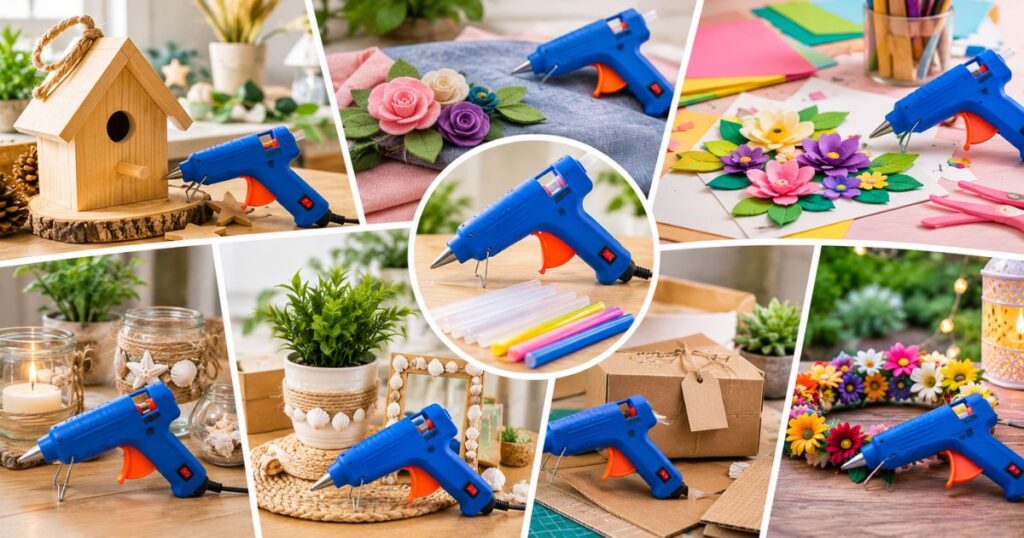
Best Glue Gun for Fabric & Delicate Crafts
Gun: Gorilla Dual-Temp Mini or Surebonder Cool Shot
Why: Fabric and delicate materials need low-temp glue. High-temp will melt or sear fibers, ruining your project. Dual-temp gives you the option to switch between low and high.
Pro tip: Always test on a hidden edge of your fabric first. Wait 2 minutes, tug it if it holds without the fabric showing scorch marks, you’re good.
Best Glue Gun for Scrapbooking & Card Making
Gun: Cricut Smart EasyPress or Dremel 4V Glue Pen
Why: These projects need precision, control, and low heat. The fine tips let you place glue exactly where you need it, and the low temperature is safe for delicate paper and vellum.
Best Glue Gun for Wood & Metal Bonding
Gun: Surebonder PRO2-220 (heavy use) or Chandler Tool CT60 (general use)
Why: Wood and metal need high-temp, strong bonds. Full-size guns deliver faster than minis. Higher wattage (40W+) gives better consistency if you’re working for hours.
Best Glue Gun for DIY Home Décor
Gun: Surebonder CL-800F or Gorilla Dual-Temp Mini
Why: Home décor projects (wreaths, lampshades, wall hangings) are mixed-material. Dual-temp lets you switch from low (fabric, foam) to high (wood, plastic). Cordless freedom means you can move around your project.
Best Glue Gun for Kids’ Crafts
Gun: AdTech Ultra Low-Temp or Elmer’s Mini
Why: Safety is the priority. Ultra-low-temp reduces burn risk. These guns are affordable enough to buy one per kid (no sharing, no waiting).
Key Features That Matter: Drips, Speed, Comfort & More
Heat-Up Time: How Fast Is Fast Enough?
Under 1 minute (30–60 seconds): Ideal. You can start crafting almost immediately. Models: Gorilla Mini, GoGonova, Dremel Pen.
2–3 minutes: Acceptable for casual crafting. Use the time to prep your materials. Models: Chandler Tool, Surebonder CL-800F (60-second warmup).
Over 3 minutes: Slow. Fine if you leave the gun on between uses, but not if you use it intermittently.
Real-world impact: On a 2-hour craft session, a 60-second gun saves you 5–10 minutes total vs. a 3-minute gun. Not life-changing, but worth it if you’re serious about crafting.
Trigger Comfort & Hand Fatigue
Craft for 3 hours straight and your trigger finger will ache. The Cricut and Surebonder are the best glue guns for ease of squeezing the trigger. If you have trouble with your hands, one of those would be suggested.
What to look for:
- Easy-squeeze mechanism (less force needed)
- Ergonomic handle (curved, not straight)
- Rubber or soft grip (doesn’t slip, feels better)
- Weight distribution that rests in your palm (not tiring)
Red flag: If the trigger takes real effort to squeeze, skip it. You’ll regret it after an hour.
Nozzle Design: Why Drips & Strings Happen (And How to Minimize Them)
Every glue gun drips and strings a little. The question is how much.
Why it happens:
- Gravity pulls excess glue down the nozzle after you release the trigger
- Glue cools slowly; hot glue can “thread” as you pull the gun away
- Nozzle shape affects how the glue flows and stops
What helps:
- Silicone or coated nozzles (glue doesn’t stick as much)
- Precision tips (finer control, easier to place glue cleanly)
- Nozzle design (some point down slightly to reduce drips; others are flat)
Honest truth: No gun eliminates drips entirely. The real control comes from technique:
- Squeeze gently (don’t flood the area)
- Lift the gun quickly (less time for drip)
- Place a silicone mat underneath (easy cleanup)
When using Cricut glue sticks there were fewer strings and fewer drips than using regular glue sticks. But there are still strings and drips. The brand of glue stick matters too.
Built-In Stand & Drip Catcher
A stand keeps the nozzle safe and prevents accidental burns to your table or project. A drip catcher is a bonus (saves cleanup).
Guns with stand: Gorilla Dual-Temp, Surebonder CL-800F, Gorilla standard full-size.
Guns without stand: Cordless USB models, some budget minis.
Glue Stick Compatibility & Availability
This matters more than you’d think. Some brands use proprietary sticks. Others use universal sticks.
Universal (most guns accept these): Surebonder sticks, Gorilla sticks, AdTech sticks, generic Amazon brands.
Proprietary: Cricut guns prefer Cricut sticks (claim fewer drips when used with their own sticks).
Compatibility check: Always confirm your gun’s stick size (7mm mini vs. 11mm full) and brand before buying bulk sticks. Using the wrong size jams the gun.
Common Mistakes & How to Avoid Them
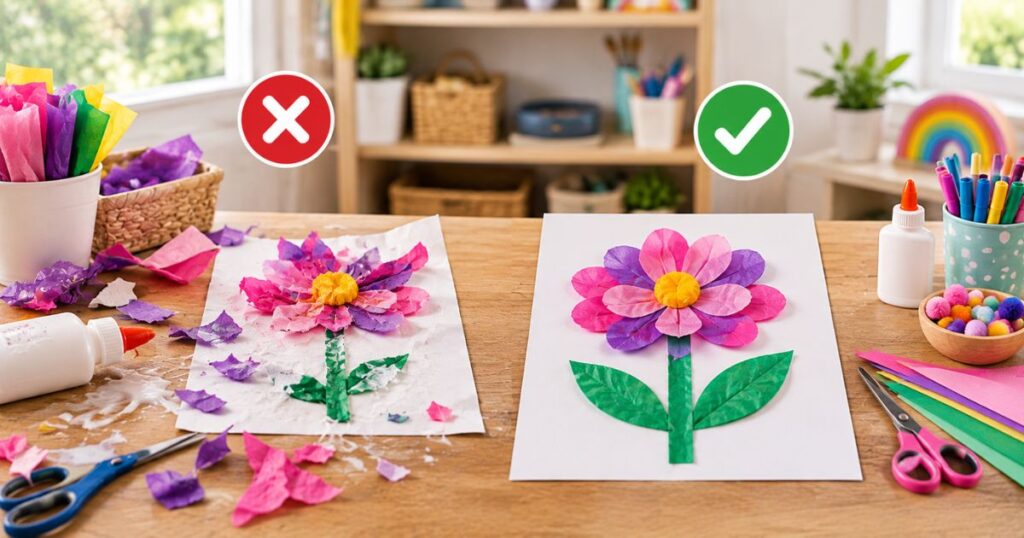
Mistake #1: Buying high-temp when you need low-temp
Result: Melted fabric, scorched paper, ruined foam.
How to avoid: Identify your primary material first. If it includes fabric, foam, or delicate paper → buy dual-temp or low-temp only.
Mistake #2: Confusing wattage with temperature
Result: Buying a 100W gun thinking it gets “hotter,” then realizing it’s the same temp as a 20W gun.
How to avoid: Read the spec sheet. Look for °F temperature rating, not wattage. Wattage is about speed, not heat.
Mistake #3: Choosing cordless without checking battery life
Result: Running out of battery mid-craft. Waiting for recharge. Frustration.
How to avoid: Check reviews for real-world battery time. Most cordless last 30–90 minutes. If your crafting sessions are 3+ hours, cordless might not be practical.
Mistake #4: Not testing on scrap first
Result: Gluing your finished piece, then realizing the bond is weak or the glue damaged the material.
How to avoid: Always test on a scrap of the same material. Wait 5 minutes for a full set. Tug it to check hold. Only then apply to your project.
Mistake #5: Overheating delicate materials
Result: Foam dissolves, fabric scars, paper curls.
How to avoid: Use the low-temp setting for anything delicate. If your gun is high-temp only, keep the nozzle 1–2 inches from the material and work quickly.
Mistake #6: Buying the cheapest gun at the dollar store
Result: Gun fails mid-project, glue oozes erratically, terrible ergonomics.
How to avoid: Spend at least $10–$15. The quality jump from $2 to $12 is massive. Read reviews before buying.
Maintenance & Longevity: Making Your Gun Last
Glue guns don’t last forever, but proper care adds years to their life.
Cleaning a Clogged Nozzle
Step 1: Unplug the gun and let it cool for 5+ minutes.
Step 2: Gently use a metal pick or small screwdriver to remove dried glue from the nozzle. (Don’t force it; you’ll damage the tip.)
Step 3: If the clog is severe, reheat the gun to temperature and push a fresh glue stick through with light pressure. This melts the blockage from inside.
Step 4: Use a damp cloth to wipe the nozzle clean. Wait 5 minutes before use.
Prevention: Store the gun upright (nozzle down) to prevent glue from backfeeding. Empty the chamber when done for the day.
Storage Best Practices
- Store upright (nozzle pointing down) to prevent backfeed and glue seeping into the heating chamber
- Keep in a cool, dry place (not a hot garage in summer; heat can damage the heating element)
- Cover the nozzle with a cap or heat-resistant cover to prevent dust buildup
- Unplug corded guns after use (saves electricity; extends cord life)
When to Replace vs. Repair
Replace if:
- Heating element dies (gun won’t heat at all)
- Trigger mechanism breaks (can’t squeeze or release)
- Cord is frayed or damaged (fire/shock hazard)
- Internal components visibly damaged
Repair or replace part if:
- Nozzle clogs (clean it)
- Stand is loose (tighten or replace)
- Handle cracks (still functional; cosmetic only)
- Glue leaks from the barrel (may be a thermostat issue; sometimes fixable)
Cost consideration: If the gun cost $15 and repair costs $8, repair. If repair costs $20, buy a new gun.
Real-World Scenarios: Which Gun for Your Project?
You’re making hand-sewn greeting cards and scrapbooking.
→ Gorilla Dual-Temp Mini or Cricut Glue Pen
Why: Precision, low-temp for paper, quick heat-up, portable. You’ll swap between glue and cutting, so compact is good.
You’re hosting a kids’ craft party (10 kids, 2 hours).
→ Two AdTech Ultra Low-Temp guns + one Gorilla backup
Why: Safety, affordability (buy multiple), easy to manage. No waiting in line for the gun.
You’re a serious hobbyist who crafts 5+ hours a week.
→ Surebonder CL-800F (cordless hybrid) + Gorilla Dual-Temp mini (backup)
Why: Cordless freedom, 60W power for consistency, full-size capacity. Mini for detailed work when needed.
You’re gluing wood for a furniture repair or DIY project.
→ Chandler Tool CT60 or Surebonder PRO2-220 (if you’re serious)
Why: Full-size, high-temp, strong bond. If it’s a one-off, CT60 is enough. If you DIY often, the extra power of the 220W is worth it.
You’re making wreaths, lampshades, and mixed-material home décor.
→ Surebonder CL-800F or Gorilla Dual-Temp full-size
Why: Dual-temp for switching between materials. Cordless freedom to move around your project. Full-size for faster coverage.
FAQs
Can I use a glue gun on fabric?
Yes, but only with a low-temp gun. High-temp will melt or sear fabric, ruining it. Even with low-temp, test on a hidden edge first. Wait 5 minutes and tug if it holds without scorching, you’re good.
How long does glue gun glue take to dry?
Hot glue sets fast (feels solid after 30–60 seconds), but full strength comes in 5–10 minutes. Handle carefully after 2–3 minutes, but wait at least 10 minutes before stress-testing the bond.
Are all glue sticks the same?
No. Different brands and even different types (universal vs. specialty) flow differently. Budget sticks often drip more. Premium sticks (Gorilla, Surebonder brand, Cricut brand) flow smoother and grip better. Test a few brands to find your favorite.
Is a cordless glue gun worth the extra cost?
Depends on your needs. If you craft in one spot, corded is fine. If you move between rooms, work at events, or hate cord management → yes, cordless is worth it. Expect to pay $30–$50 more.
What’s the difference between high temp and low temp glue guns?
High temperature reaches approximately 380 degrees Fahrenheit and can melt many different types of glue sticks for strong bonds on plastic, wood, and even metal. Low temp works on Styrofoam, fabric, and paper with reduced burn risk.
Can I use a glue gun to fix a broken ceramic vase?
Temporarily, yes. Hot glue isn’t permanent on ceramics and isn’t dishwasher-safe. For a long-term fix, use two-part epoxy. Hot glue is best for temporary holds or sealing cracks.
Do mini glue guns really work, or are they just toys?
Real tools, not toys. They’re slower and require more reloading than full-size, but they excel at detailed work and delicate projects. Perfect for scrapbooking, card making, jewelry. Not ideal for large projects.
What should I do if my glue gun burns my finger?
Run under cool (not cold) water for 5+ minutes. Don’t use ice (can cause more damage). Dry gently and apply burn cream. Seek medical care if the burn is severe (large blistering, deep). Always use glue guns carefully nozzles get hot.
