

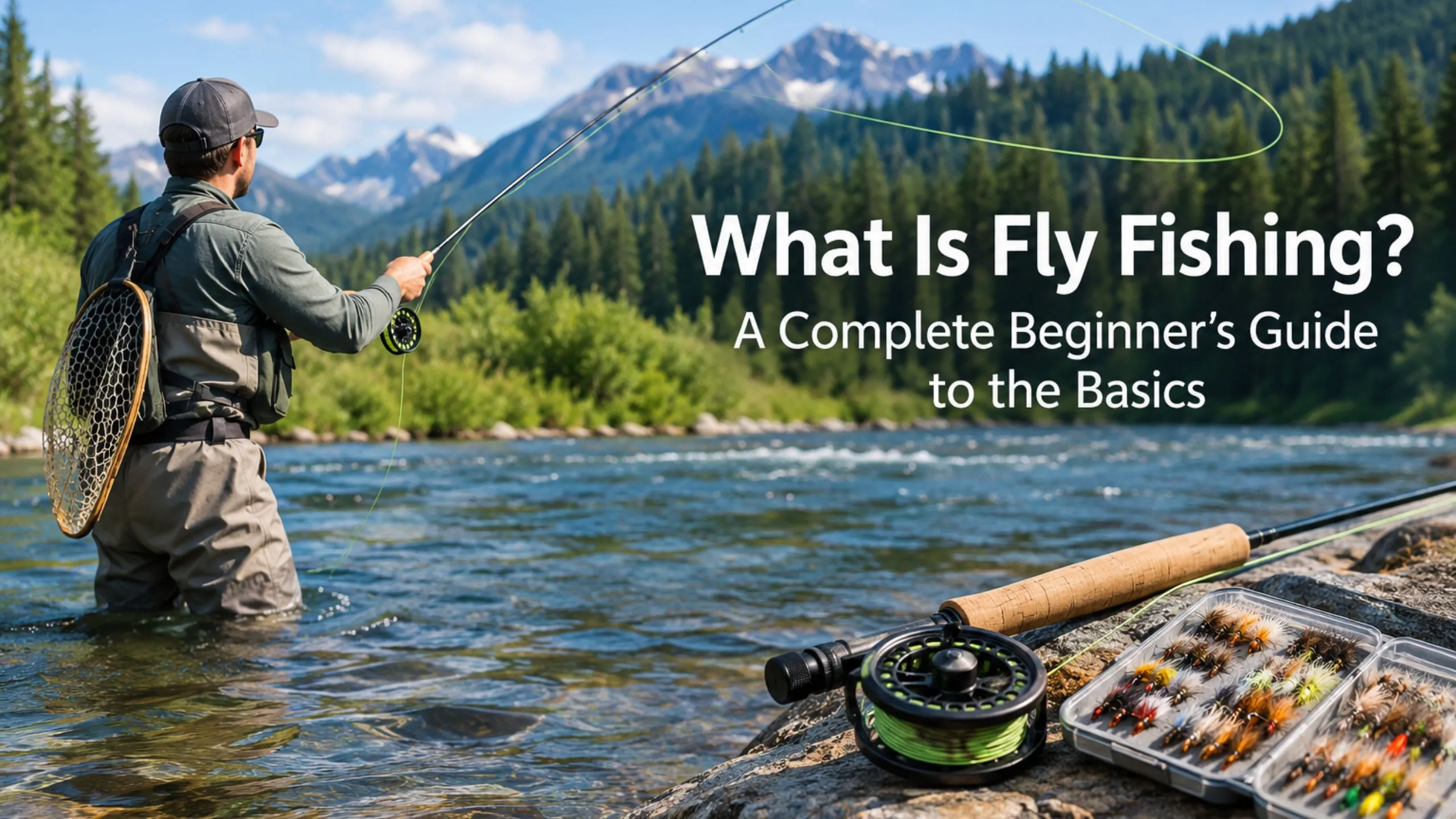
Fly fishing is an angling technique where you cast an ultra-lightweight artificial fly using a weighted fly line, rather than a heavy lure. The technique requires specialized equipment and a unique casting motion, but it’s rewarding for beginners and offers a more intimate, skill-based approach to catching fish. Instead of letting a heavy lure pull your line out, the line itself carries the weightless fly through the air.
What Is Fly Fishing?
Let’s start with the basics. Fly fishing uses a hand-tied artificial lure called a “fly” that imitates insects, small fish, or crustaceans. You cast this fly using a special rod, reel, and weighted line designed specifically for this technique.
The “fly” gets its name because the lures are made to look like small insects or flying prey. They’re tied from feathers, fur, thread, and synthetic materials—all wrapped around a tiny hook. When you cast a fly into the water, it floats or sinks depending on the pattern, and fish mistake it for real food.
That’s it. That’s the core of fly fishing: you’re fooling fish with a fake insect.
The beauty? Fly fishing connects you directly to the water. You’re not just casting and reeling mechanically. You’re reading the current, watching the surface for rises, and actively working the fly to look alive. It feels like puzzle-solving combined with art.
How Fly Fishing Differs from Spin Fishing
The most common question beginners ask: Isn’t fly fishing just regular fishing with a fancy rod?
No. The mechanics are fundamentally different.
The Core Difference: What Provides the Casting Weight
In spin fishing (conventional fishing), the lure is heavy. You cast the weight of the lure; the fishing line is just there for the ride. The reel uses centrifugal force to accelerate that heavy object out into the water.
In fly fishing, the line is heavy. The fly is nearly weightless. The line’s momentum carries the weightless fly through the air. Instead of the lure pulling the line out, you’re casting the rope itself.
Think of it this way: In spin fishing, you’re throwing a knot at the end of a string. In fly fishing, you’re throwing the string and the knot just rides along.
Side-by-Side Comparison
| Aspect | Fly Fishing | Spin Fishing |
| Casting weight | Line weight | Lure weight |
| Rod flexibility | Long, thin, flexible | Medium, stiffer |
| Reel function | Line storage, drag only | Casting mechanism |
| Learning curve | Steeper initially | More intuitive |
| Best for | Insect-feeding fish, precision | Broad fish variety, distance |
| Intimacy level | High (hands-on) | Moderate |
| Entry cost | $300–$500 | $150–$300 |
| Casting distance | 30–60 feet typical | 40–100+ feet |
When Each Method Shines
Fly fishing excels when:
- Fish are feeding on small insects or minnows
- You need precision and stealth
- You’re in rivers or shallow flats
- You want a more technical, meditative experience
Spin fishing excels when:
- You’re targeting larger predatory fish
- You need to cover a lot of water quickly
- You’re fishing in brushy areas (easy to re-cast)
- You want simplicity and instant gratification
Neither is “better” they’re tools for different situations.
What You’re Actually Casting: Flies Explained
This is where fly fishing gets fun: the flies themselves.
A fly is a hand-tied artificial lure designed to imitate whatever fish are actually eating. Tied on a tiny hook using feathers, fur, dubbing (fuzzy synthetic thread), and thread, a well-made fly looks remarkably like an insect or small baitfish.
Dry Flies vs. Wet Flies
Dry flies float on the surface. They imitate insects that have just emerged from the water (mayflies, caddisflies) or land-based bugs (grasshoppers, ants) that accidentally fall into the water. When a fish rises and takes a dry fly, you see it happen. It’s thrilling.
Wet flies and nymphs sink below the surface. Nymphs imitate the underwater larval stage of insects. They’re fished near the bottom or mid-water, where the majority of a fish’s diet actually lives. Many anglers catch more fish on nymphs than dry flies; they’re just less dramatic.
What Flies Look Like
A fly might be a 1-inch streamer with a silver body and white wings (imitating a minnow), or a tiny dry fly with a body the width of a pencil lead and a hackle collar that lets it float. Some have beads, others have rubber legs. Some are tied in gaudy colors to trigger strikes; others are tied to match local insects exactly.
Fish don’t have a sophisticated brain. They see something small, moving in a way that resembles food, and they eat it. Your fly doesn’t have to be perfect, it just has to be convincing enough.
The Equipment You’ll Need: A Beginner Breakdown
Before you can fly fish, you need gear. The good news: you don’t need to spend thousands. Here’s what actually matters.
The Fly Rod
Think of this as an extension of your arm and the most important tool you’ll buy. A fly rod is a long, flexible stick (typically 7–9 feet) that helps you cast the fly line and fight fish. It’s much longer and more flexible than a spin rod because it needs to load (bend) with the weight of the line.
For beginners fishing for trout in freshwater, a 9-foot rod rated for 4–6 weight line is ideal. It’s forgiving, affordable, and works in most situations.
The Fly Reel
This is simpler than a spin reel. A fly reel’s main job is to store line and provide drag (resistance when a fish pulls). The reel itself doesn’t cast; you use your hand to manage the line during casting. This is different from spin fishing, and it takes about 10 minutes to understand.
Entry-level reels run $60–$150. Spend the money here if you can, a smooth drag makes all the difference.
The Fly Line
This is where the magic happens. The fly line is a weighted, tapered line that makes fly fishing possible. It comes in different weights (3-weight, 5-weight, 8-weight, etc.). The line’s weight—not the fly’s weight is what you cast.
A typical fly line costs $60–$100. Match the line weight to your rod (a 5-weight rod uses a 5-weight line). The line floats, sinks, or sinks at various rates depending on the type.
Leader & Tippet
The leader is a tapered section of monofilament (clear fishing line) that connects the fly line to the fly. It’s usually 7.5–9 feet long. The tippet is the thin section at the end where the fly actually attaches. As you lose flies or trim knots, you replace the tippet.
Cost: $1–$3 per leader. Don’t skip this.
Waders (Optional but Common)
If you’re fishing in cold water or wade-able rivers, waders let you stand in the water without getting soaked. Chest waders go up to your chest; waist waders stop at your waist.
Waders aren’t essential if you fish from the bank or a boat, but they open up better fishing spots. $100–$300 for decent ones.
Cost Breakdown: What Should You Spend?
Entry-Level Setup (Start Here): $250–$400
- Rod: $100–$150
- Reel: $60–$100
- Line: $60–$80
- Leader & flies: $30–$40
- Accessories (line cleaner, leader wallet): $20–$40
Mid-Range Setup (Step Up After a Month): $500–$1,000
- Quality rod: $200–$300
- Better reel: $100–$200
- Premium line: $80–$120
- Full accessory kit: $100–$200
Premium Setup (Only If You’re Committed): $1,000+
Here’s the important part: Start with entry-level. A $100 rod will teach you everything. Upgrading to a $300 rod won’t make you better practice will. Don’t spend thousands before you know if you’ll actually enjoy fly fishing.
How Fly Casting Actually Works: Step-by-Step
This is the section most beginners wish existed. Fly casting looks complicated, but it’s really just repetitive motion with good timing.
The secret: you’re not using muscle. You’re using the rod’s flex and the line’s momentum. Most beginners try to force the cast. That’s the #1 mistake.
The Five-Part Cast (What’s Actually Happening)
1. The Setup Start with the rod at 2 o’clock (like on a clock face, behind and above you). Your grip should be relaxed. Stand with your feet shoulder-width apart, facing your target.
2. The Backcast Accelerates the rod smoothly backward to 1 o’clock (or higher), stopping abruptly. Don’t rush smooth acceleration is key. As you do this, line shoots behind you, and a loop of line unfolds in the air.
3. The Pause (This Is Critical) Stop and wait. Let the line fully extend behind you. This usually takes 0.5–1 second. Beginners rush this step. The pause lets the rod load (bend) with the line’s weight.
4. The Forward Cast Accelerates the rod forward smoothly, stopping at 10 o’clock. The line loop unfolds in front of you. Your hand follows through, extending forward naturally.
5. The Presentation As the line extends toward the water, ease off pressure on the rod (this is called “drift”). The fly lands gently on the water, followed by the line.
Why It Works: The Loop
When you execute these steps correctly, a loop of line forms in the air a beautiful, organized loop that unfolds like a ribbon. This loop carries the weightless fly along with it. The tighter the loop, the more distance and accuracy you get.
Beginner casting problems almost always trace back to loop issues:
- Tailing loop (line curls back on itself)? You’re accelerating too hard on the backcast.
- No distance? Your pause is too short, or your acceleration is too gentle.
- Fly lands in a heap? Your loop is too open; tighten it up.
The Most Important Truth About Casting
You don’t need 60 feet. Most fish are caught within 20–40 feet. Many are caught at 15 feet. Accuracy and presentation matter infinitely more than distance. A 30-foot cast placed perfectly beats a 70-foot cast by a mile.
Beginners obsess over distance. Veterans obsess over accuracy and drag-free drifts. Learn accuracy first.
What Fish Can You Catch on a Fly?
Fly fishing isn’t limited to trout though that’s where most people start.
Freshwater Stars
Trout (brown, rainbow, cutthroat) are the classic fly fishing target. They feed on small insects and are common in cold-water streams. Perfect for learning.
Salmon run rivers in spring and fall. They’re larger, more powerful, and require heavier equipment.
Bass (largemouth and smallmouth) love fly patterns that imitate baitfish. They’re aggressive and fun.
Pike and carp are emerging fly fishing targets. Sight-fishing for a 20-pound carp on a fly is intense.
Saltwater Stars
This is where fly fishing gets really exciting. The US Southeast and Florida Keys have world-class saltwater fly fishing.
Tarpon are the crown jewels. These silver giants migrate through the Gulf each spring (April–June). Hooking a 50-pound tarpon on a fly is a bucket-list moment.
Bonefish and permit are smaller but incredibly technical. Bonefish are speed demons; permits are finicky and require precise presentations. Catching all three in one day is called a “Grand Slam” the holy grail of saltwater fly fishing.
Redfish populate the Gulf Coast flats year-round. They’re aggressive, abundant, and perfect for intermediate fly fishers.
Striped bass live in coastal areas and estuaries. They’re powerful fighters.
The pattern: any fish that feeds on small prey or insects is fair game.
Is Fly Fishing Hard? The Honest Answer
People ask this constantly. Here’s the truth: Fly fishing has a steeper learning curve than spin fishing, but it’s not difficult.
The Real Timeline
- First hour: You’ll feel clumsy. Your casts will be short. You might tangle your line. That’s normal.
- First 5–10 hours: Your casting will click. You’ll start landing fish. It feels amazing.
- First month: You’ll be competent. Consistent casts, understanding basic reading of water, maybe 5–10 fish landed.
- First year: You’ll be intermediate. Comfortable in different conditions, experimenting with tactics, building judgment.
The Patience Factor
Fly fishing requires patience. You’ll miss fish. You’ll get skunked (catch nothing). You’ll lose flies to trees and snags. This is intentional. The challenge is part of why people love it.
If you want instant gratification, spin fishing with a bass lure is faster. If you want a challenge that engages your mind and your muscles, fly fishing delivers.
Beginner Frustrations (And Solutions)
Tangled line (“backlashes”): Happens because of poor timing on the backcast. Solution: practice the pause step.
Fly hitting you in the face: You didn’t backcast far enough behind you. Solution: backcast to 1 o’clock, not 12 o’clock.
Can’t cast far enough: You’re trying too hard. Solution: accelerate smoothly, then stop. The rod does the work.
Fish break off: Your drag is too tight, or you’re striking too hard. Solution: adjust drag so the line pulls slowly when you tug.
All of these are solved with practice usually within your first 10 hours.
Myth-Busting
“You have to be rich to fly fish.” False. $300 gets you started. Many legendary fly fishers began with cheap gear.
“You have to be young and athletic.” False. Fly fishing requires finesse, not athleticism. People fly fish into their 80s.
“You need perfect weather.” False. You can fly fish in the sun, rain, wind, and cold. Conditions change tactics, not feasibility.
“You have to live near great water.” False. Backyard ponds, small creeks, and urban parks hold fish. You don’t need pristine mountain streams.
Saltwater vs. Freshwater Fly Fishing
While the core technique is the same, saltwater and freshwater fly fishing feel different.
Freshwater Fly Fishing (Where Most People Start)
Environment: Rivers, streams, lakes, ponds. Usually cold water. Insect-based food chain.
Target fish: Trout, salmon, bass, pike, carp.
Equipment: 3–6 weight rod (lighter), smaller flies, floating line (usually).
The experience: Wading in creeks, reading hatches, matching insects, quiet mornings. Meditative and intimate.
Best locations in the USA: Rocky Mountain rivers (Colorado, Montana), Pacific Northwest, New England streams, Great Lakes tributaries.
Saltwater Fly Fishing (The Adventure)
Environment: Flats, lagoons, mangrove shorelines, channels, open ocean. Warm or mild water. Baitfish-based food chain.
Target fish: Tarpon, bonefish, permit, redfish, stripers, cobia.
Equipment: 8–12 weight rod (heavier), larger flies (2–4 inches), sinking or intermediate lines, saltwater-specific corrosion-resistant gear.
The experience: Sight-fishing on flats (watching the fish before you cast), higher adrenaline, sometimes guided. Explosive eats and powerful runs.
Why it’s booming: The US Southeast (Florida, Georgia, South Carolina) has world-class saltwater fly fishing. The tarpon migration in spring is legendary. Year-round redfish fishing along the Gulf Coast is accessible and abundant.
Key Difference: The Presentation
In freshwater, you’re often casting to a specific spot and letting the current do the work (a technique called a “drag-free drift”).
In saltwater, you’re often sight-casting to a fish you can see tailing or cruising. You spot the fish, place the fly in front of it, and strip the fly (pull it with your hand) to trigger a strike. The difference is huge.
A Brief History of Fly Fishing (And Why It Still Matters)
Fly fishing isn’t new. It’s ancient.
The earliest recorded fly fishing appears in a 2nd-century text from Macedonia, where anglers tied feathers to hooks and caught fish in rivers. The technique resurfaced in Japan in the 12th century and later in 15th-century England, where it became refined and popular among gentlemen anglers.
Why this history matters: Fly fishing carries tradition. When you fly fish, you’re participating in a 2,000-year-old practice. There’s something powerful in that continuity.
The sport evolved dramatically in the 20th century with synthetic fly lines (1950s), lighter rods (graphite), and modern fly-tying materials. Today, fly fishing is more accessible than ever cheaper gear, more educational content, more fishing communities.
Getting Started: Your First 30 Days
Here’s a realistic roadmap.
Day 1: Get Gear Visit a local fly shop or buy an entry-level combo online. Talk to the staff about local water and beginner-friendly spots. Pick up a few basic flies (dry flies and small nymphs).
Days 2–7: Practice (Yard, Not Water) Set up in your backyard or a park. Practice false casting (casting without a target) for 30 minutes daily. Focus on smooth acceleration and the pause. You don’t need water to learn casting.
Week 2: First Water Outing Find a beginner-friendly spot a small creek, trout pond, or local park water. Bring your gear and expect not to catch fish. That’s fine. Focus on casting accuracy, reading where fish might be, and staying patient.
Weeks 3–4: Regular Outings Fish 2–3 times per week if possible. Start paying attention to what the fish are eating (look for insects on the water). Experiment with different flies. Enjoy any fish you catch.
Month 2 & Beyond: Build Competency By now, you should be comfortable casting, reading water, and landing fish consistently. You’re ready to explore different waters, learn new techniques, or specialize (saltwater, larger fish, specific species).
Real Talk: If you can only fish once a month, you’ll progress slower. But you’ll still progress. Every outing teaches you something.
What Surprised Me About Fly Fishing
I started fly fishing expecting an adrenaline rush. What I found instead was something quieter and deeper.
First surprise: the meditation aspect. Fly fishing forces you into the present moment. You can’t think about work or your phone while you’re reading a current, timing a cast, and watching for a rise. It’s the closest thing to meditation I’ve found that also involves catching dinner.
Second surprise: how forgiving the learning curve actually is. I expected to be bad for months. Within 2 weeks of practice, I was catching fish. It’s steep but not impossible. The ceiling is high (you can spend a lifetime improving), but the floor is accessible.
Third surprise: gear doesn’t matter nearly as much as I thought. My first fly rod cost $120. I’ve since owned rods ten times that price. The cheap one taught me more because I wasn’t afraid to wear it out. Upgrade your gear after you know you love fly fishing, not before.
Fourth surprise: failure is actually the point. Fly fishing actively involves losing fish, getting skunked, and missing casts. Other angling methods feel like win-or-lose. Fly fishing feels like practice with occasional victories. The mindset shift is subtle but powerful you’re climbing a mountain, not running a sprint.
Last surprise: the community is genuinely generous. Fly fishers love sharing knowledge. Walk into a fly shop as a beginner, and you’ll get real advice, local intel, and encouragement. That culture of mentorship is rare in outdoor pursuits.
FAQ
Can I fly fish in saltwater?
Yes. Saltwater fly fishing is thriving, especially in the US Southeast (Florida, Georgia, South Carolina coast). You’ll need heavier equipment (8–10 weight rod), larger flies, and saltwater-specific gear (corrosion-resistant reel, specialized line). The technique is the same; the environment and species are different.
How much does fly fishing cost to start?
Entry-level: $250–$400. Mid-range: $500–$1,000. You don’t need to spend more to start. Many experts recommend buying used gear your first year and upgrading once you know you’re committed.
What’s the difference between fly fishing and spin fishing?
Fly fishing casts the line weight and uses a weightless fly. Spin fishing casts a heavy lure. Fly fishing requires more technique but allows more precision and intimacy. Spin fishing is simpler and covers distance faster.
How long does it take to learn fly fishing?
Basic competency (comfortable casting, catching fish occasionally) takes 5–10 hours of practice spread over 2–4 weeks. Intermediate skill takes 2–3 months of regular fishing. Mastery is a lifetime journey.
Is fly fishing just for trout?
No. You can fly fish for salmon, bass, pike, tarpon, bonefish, permit, redfish, stripers, and more. Trout is the classic entry point and the easiest to learn on, but fly fishing is versatile.
Do I need waders?
No, but they’re common for stream and river fishing. You can fly fish from the bank, a boat, or wading without waders in warm water.
Can beginners fly fish?
Absolutely. The learning curve is steep but short. You’ll be competent within weeks. Fly shops and local fly fishing communities actively welcome beginners.
What’s a “Grand Slam” in saltwater fly fishing?
Catching three specific fish species in a single day: a permit, tarpon, and bonefish. It’s exceedingly rare and considered a pinnacle achievement in saltwater fly fishing.
