

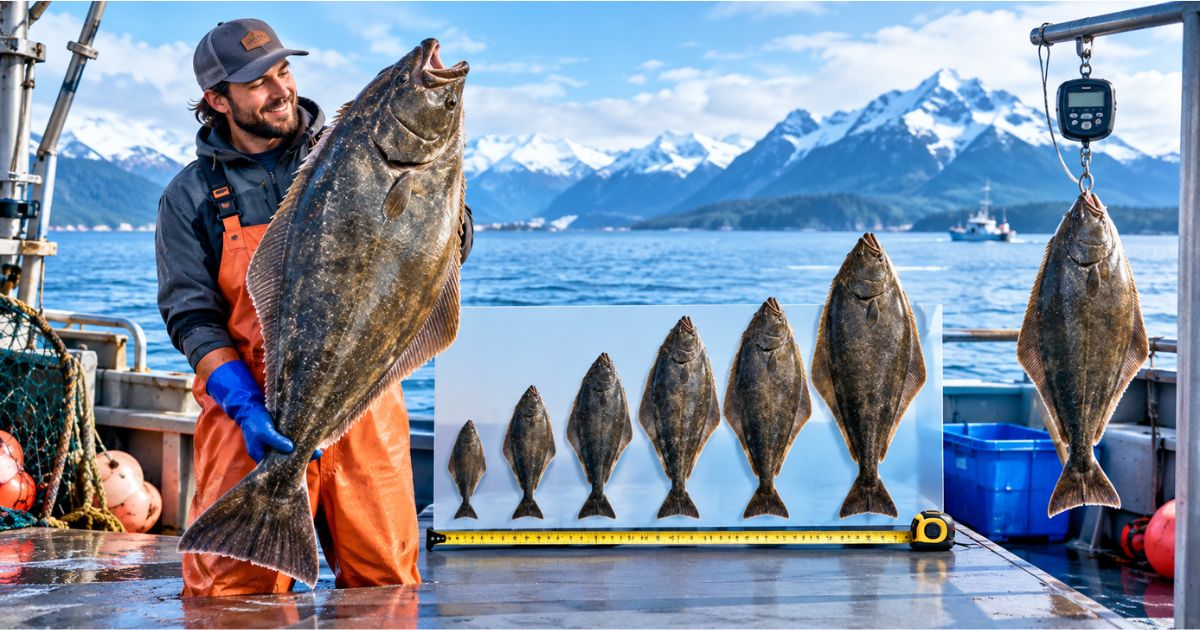
Alaska halibut Size can grow to more than 8 feet long and over 500 pounds, but most fish caught in the sport fishery weigh far less, usually 15 to 50 pounds. Weight jumps fast with length: a 40-inch halibut weighs about 30 pounds, while a 70-inch fish tips the scale at nearly 180 pounds. Females grow much larger than males, and Alaska’s biggest halibut ever caught weighed 459 pounds.
At a glance:
- Average sport-caught halibut: 15–50 lbs
- “Chicken” halibut (best eating): 10–30 lbs
- “Barn door” halibut: 100+ lbs
- Alaska state/world record: 459 lbs, caught near Dutch Harbor in 1996
How Big Do Alaska Halibut Get?
Pacific halibut are the largest flatfish in the world. A mature halibut can reach over 8 feet in length and exceed 500 pounds, though fish that size are rare. Growth depends heavily on sex: females routinely outgrow males by two to three times, and almost every fish over 100 pounds pulled from Alaska waters is female.
![Angler measuring a halibut on a charter boat deck] (alt text: measuring an Alaska halibut with a tape measure from jaw to tail)
Alaska Halibut Length-to-Weight Chart
Halibut weight can be estimated accurately from length alone, using growth relationships tracked by the International Pacific Halibut Commission (IPHC). Below is a reference chart showing live (round) weight and dressed (head-off, gutted) weight by length.
| Length (in) | Live Weight (lb) | Dressed Weight (lb) |
| 20 | 3 | 2 |
| 30 | 12 | 9 |
| 40 | 29 | 22 |
| 50 | 60 | 45 |
| 60 | 109 | 82 |
| 70 | 179 | 135 |
| 80 | 277 | 208 |
| 90 | 405 | 304 |
| 100 | 570 | 428 |
Figures are rounded from published length-weight relationships used by Alaska charter operators and derived from IPHC growth data. For a precise, regulatory-area-specific estimate, the IPHC’s official length-weight calculator lets you enter an exact fork length and area.
Why the jump is so steep: halibut are flat but not thin as they lengthen, they also gain girth and thickness, so weight increases roughly with the cube of length rather than in a straight line. That’s why a fish just 10 inches longer than another can weigh nearly twice as much.
How to Measure a Halibut Correctly
Getting an accurate length reading matters for both regulations and estimating table fare. Here’s the standard method used by Alaska charter crews:
- Lay the fish flat with its mouth closed on a flat surface or the boat deck.
- Start the tape at the tip of the lower jaw (with the mouth closed, not the snout).
- Run the tape in a straight line over the pectoral fin.
- Stop at the extreme end of the middle of the tail, not the longest tail lobe, the center point.
- Read the measurement in inches, rounding down if it falls between marks (this matters for legal size limits).
Male vs. Female Halibut: Why Size Differs So Much
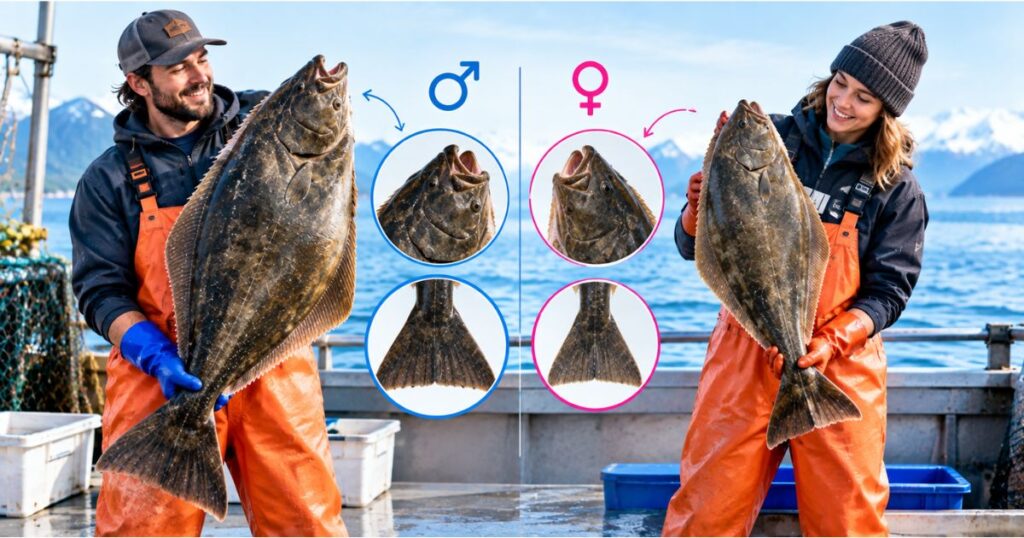
Female halibut grow faster and live longer than males, and the size gap becomes dramatic with age:
- Males rarely exceed 3 feet (36 inches) in length; a 36-inch male weighs around 15–20 pounds and is close to his maximum size.
- Females can grow past 8 feet and 500 pounds.
- Roughly half of male halibut reach sexual maturity by age 8, compared to age 11–12 for females males simply stop investing energy in growth sooner.
- Because of this, any halibut over roughly 100 pounds is almost certainly female.
This is also why Alaska’s conservation-minded anglers increasingly release the largest fish: a single 250-pound female can produce around 4 million eggs in one season, making her far more valuable alive as breeding stock than as fillets.
What Size Halibut Can You Keep in Alaska? (2026 Limits)
Halibut size and bag limits are set annually by NOAA Fisheries and the IPHC and can change from year to year, so always confirm current rules before you fish. For the 2026 season:
| Area | Daily Bag Limit | Size Rule |
| Area 2C (Southeast AK) charter | 1 fish | Reverse slot: must be under 34 in. or over 80 in.; retention closed Thursdays June 18–Sept 10 |
| Area 3A (Southcentral AK) charter | 2 fish | One fish any size, second fish 27 in. or smaller |
| Unguided/private boat, most areas | 2 fish | No size restriction |
A “reverse slot limit” protects the mid-size fish that make up the bulk of the breeding population, letting anglers keep only the smallest (best-eating) fish or the rare trophy-class giant.
What’s the Best Size Halibut to Eat?
Bigger isn’t better at the dinner table. Alaska anglers use informal size categories:
- “Chicken” halibut (10–30 lbs): Widely considered the best eating firm, moist flesh and easy to fillet.
- Mid-size (30–100 lbs): Still good eating, more freezer-friendly in smaller cuts.
- “Barn door” (100+ lbs): Tougher texture, and most experienced guides release these as breeding stock.
Fillet yield: Expect skin-on fillets to run 50–60% of the fish’s total weight so a 30-pound halibut yields roughly 15–18 pounds of fillets.
Is It Safe to Eat a Large Halibut? (Mercury by Size)
This is the part almost no other guide covers, and it matters if you’re bringing home a trophy fish. Like most large, long-lived predatory fish, halibut accumulate more mercury as they grow older and larger mercury builds up in fish tissue over a lifetime and doesn’t break down.
Based on Alaska state health guidance reported by public health officials:
- Halibut 40 lbs or less generally test low in mercury and are considered safe for regular consumption, including for pregnant women and children, in normal serving sizes.
- Very large halibut (roughly 220 lbs and up) may warrant just one serving per week for pregnant women, nursing mothers, and young children, due to higher mercury accumulation.
Source note: this reflects secondary reporting of Alaska Department of Health and Social Services fish-consumption guidance. If mercury exposure is a personal health concern, check the state’s current official fish advisory directly rather than relying on any single article including this one.
How Big Was the World Record Alaska Halibut?
Alaska holds every major halibut world record. The all-tackle record recognized by both Alaska and international game-fishing authorities stands at:
459 pounds, caught by Jack Tragis near Dutch Harbor, Alaska, on June 11, 1996, on a 130-pound test line.
For comparison, the largest documented Pacific halibut ever measured came in at over 8 feet long, roughly the height of a doorway, with a body nearly as wide as an adult is tall.
What Alaska Charter Guides Actually Look For
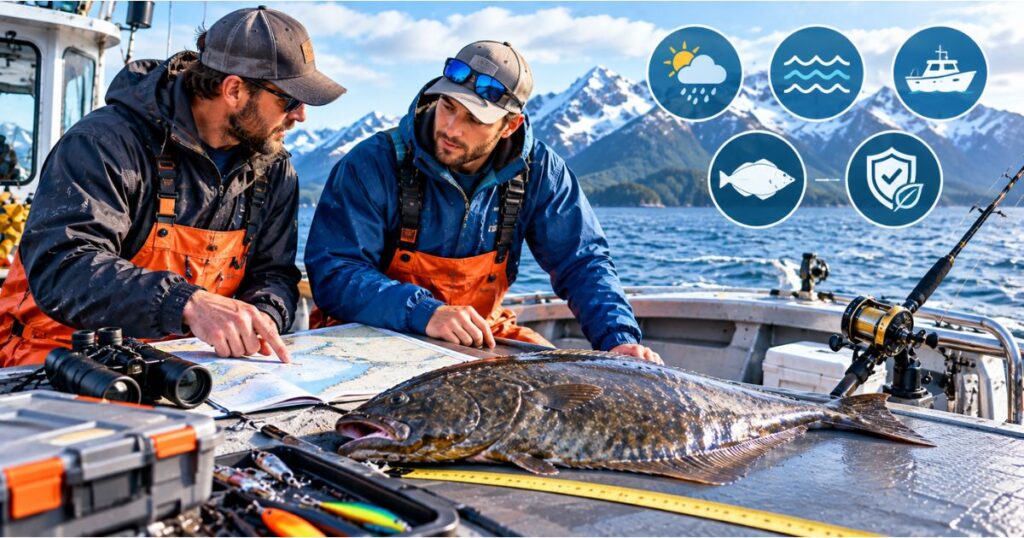
Flag for the brand: this section is strongest with a real first-hand quote or scenario from an actual captain or guide. Below is a placeholder framework; swap in real operator commentary for maximum E-E-A-T and originality.
Experienced Alaska charter captains rarely guess a halibut’s weight by eyeballing its length alone; they watch how it fights. A wide, slow, bulldogging pull near the bottom often signals a heavier, thicker-bodied fish than its visible length would suggest, because girth (not just length) drives most of the weight difference between two halibut of similar size.
FAQ
How big do halibut get in Alaska?
Alaska halibut can grow to over 8 feet long and more than 500 pounds, though the average sport-caught fish weighs 15–50 pounds. Females grow significantly larger than males.
What is the biggest halibut ever caught in Alaska?
The record is 459 pounds, caught by Jack Tragis near Dutch Harbor on June 11, 1996 recognized as both the Alaska state and IGFA all-tackle world record.
How do you measure a halibut’s length?
Measure in a straight line from the tip of the closed lower jaw, over the pectoral fin, to the center of the tail, not the longest tail lobe.
What is the size limit for halibut in Alaska?
Limits vary by year and regulatory area. In 2026, Southeast Alaska (Area 2C) charter anglers must keep fish under 34 inches or over 80 inches, while Southcentral Alaska (Area 3A) allows one fish of any size plus a second fish 27 inches or smaller. Always verify current-year rules before fishing.
What size halibut tastes best?
“Chicken” halibut in the 10–30-pound range is widely considered the best eating, with firmer, moister flesh than larger fish.
Is it safe to eat a really large halibut?
Yes, in moderation but very large halibut (roughly 220 lbs+) carry more mercury due to their age and size, so health guidance suggests limiting servings, especially for pregnant women and young children.
