

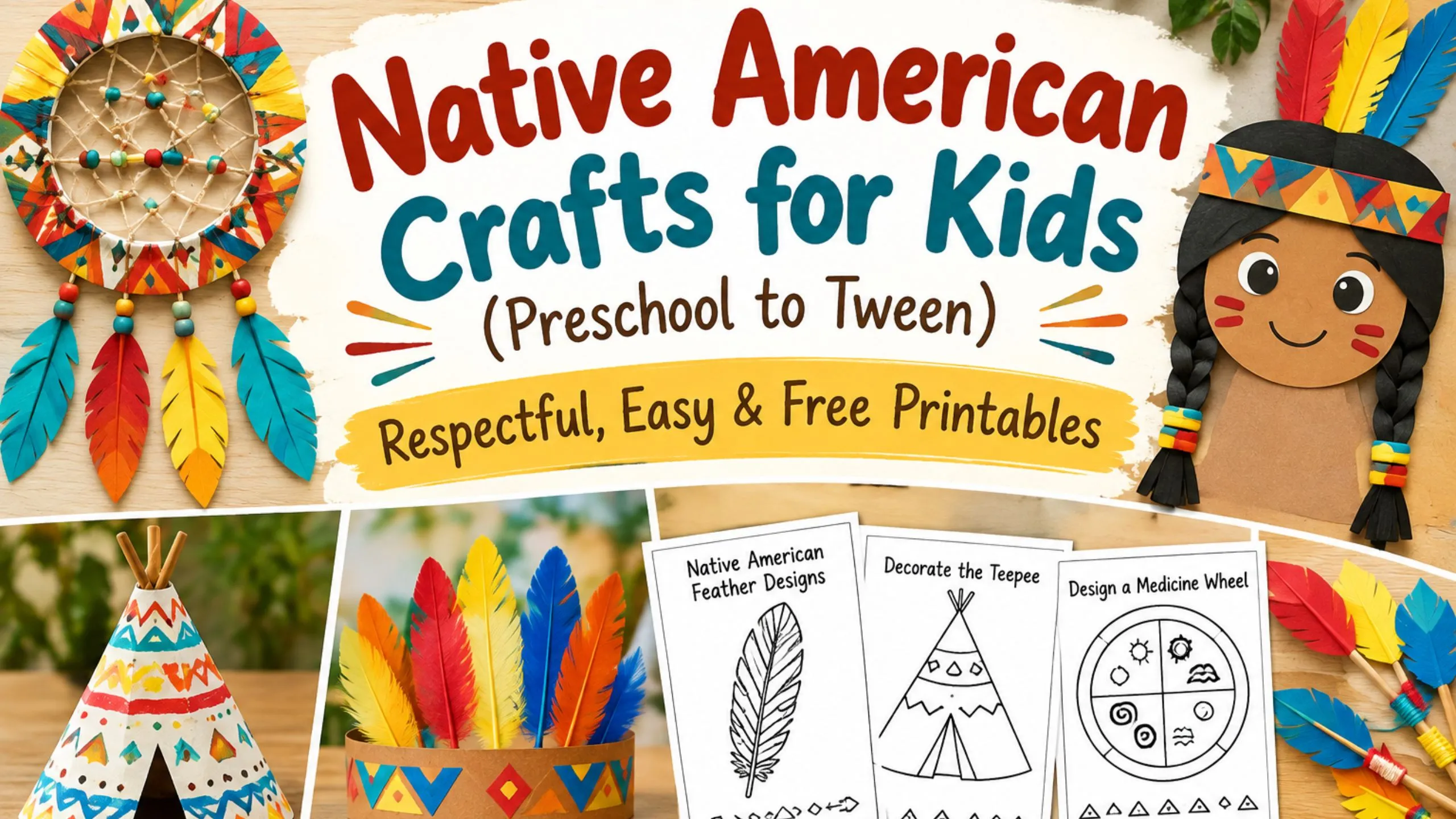
Start every project by naming the specific Native nation it comes from never “Native American Crafts for Kids” as one group. Skip sacred or ceremonial items (headdresses, medicine bags, pipes) as craft projects. Match the project to your child’s age: preschoolers do sensory work (clay, big beads), elementary kids handle multi-step builds (tipis, drums), and tweens can try real weaving or beadwork patterns. Pair every craft with a book by a Native author.
What “Respectful” Means Before You Start Crafting
Cultural appreciation means learning about a specific tradition, naming its origin, and understanding its meaning. Cultural appropriation means treating any Native tradition as generic dress-up material, stripped of context. The difference isn’t the craft itself, it’s whether a child learns whose tradition it is and why it mattered.
Three ground rules, before you touch a single supply:
| Do this | Skip this |
| Name the specific nation (e.g., “This weaving style comes from Navajo/Diné artists”) | Saying “Native Americans wore/made/did X” as if it’s one culture |
| Craft items that were everyday or decorative objects (pottery, weaving, dolls, rattles) | Recreating sacred or ceremonial objects (feather headdresses/warbonnets, pipes, medicine bags) as toys |
| Pair the project with a book or resource by a Native author | Using only non-Native-authored “fun fact” sheets |
| Call it a “headband” or “craft,” not a “costume” | Letting kids wear craft results as a Halloween or dress-up “Indian costume” |
Several ranking resources on this topic flag feather headdresses specifically: in many nations, war bonnets were earned symbols of honor reserved for respected leaders, not general decoration which is why most current teacher guidance steers away from headdress crafts entirely, or reframes them clearly as an art study rather than something to wear.
Native American Crafts for Preschoolers (Ages 3–5)
Preschoolers do best with sensory, low-choking-hazard, low-mess projects that need adult help for any small parts.
1. Big-Bead Corn Necklace (Haudenosaunee-inspired corn is one of the Three Sisters crops) String large wooden or plastic beads (never beads under 1.25 inches for this age) onto thick yarn to represent dried corn kernels. Talk about how corn was and still is grown, dried, and stored by many Native farming nations. Time: 15 minutes.
2. Fingerprint Corn Art Dip fingertips in yellow, orange, and red paint and press “kernels” onto a printed corn-cob outline. A gentle entry point to talking about the Three Sisters before kids are ready for scissors or small parts. Time: 15 minutes.
3. Clay Pinch Pot Give each child a golf-ball-sized piece of air-dry clay and let them pinch it into a small bowl shape. Many nations including Pueblo communities in the Southwest have long, celebrated pottery traditions; frame this as “we’re trying the pinch technique potters use,” not a replica of any specific sacred piece. Time: 20–30 minutes plus drying time.
4. Paper Plate Sun/Weather Symbol Painting Some nations use painted symbols to represent sun, rain, or weather in art. Let kids paint their own symbol on a paper plate after you show them a real example from a museum resource (see Trusted Resources below). Time: 15 minutes.
Safety note: avoid seed beads, pony beads under 6mm, feathers with quills, and any small natural items (acorns, dried corn kernels) with children who still mouth objects.
Native American Crafts for Elementary Students (Ages 6–10)
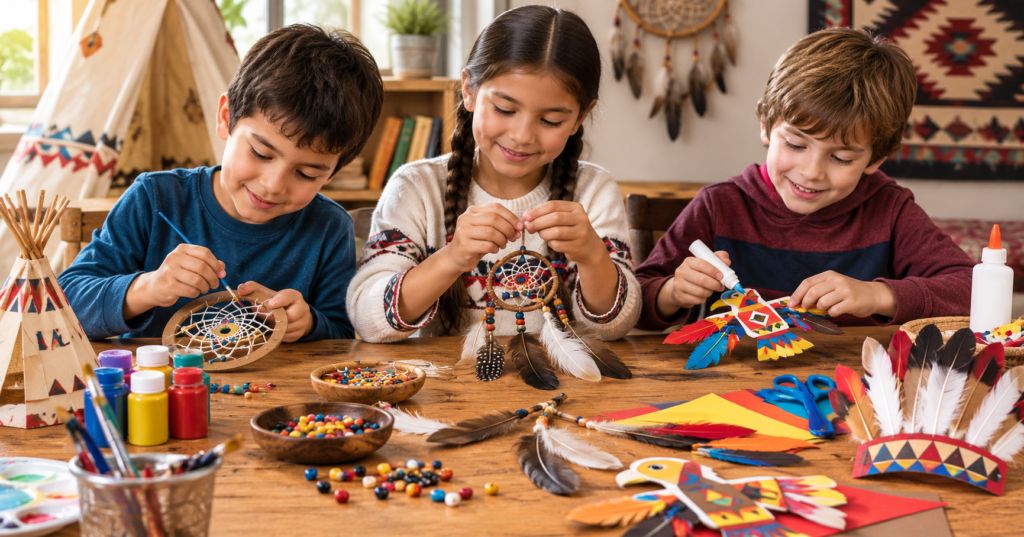
Elementary kids can manage multi-step builds, simple tools (blunt scissors, hole punches), and short research tie-ins.
5. Mini Paper Tipi Roll a semicircle of craft paper into a cone, tape the seam, and decorate with painted symbols. Explain that tipis were the portable homes of Plains nations (like the Lakota) whose seasonal travel followed buffalo herds and that not all Native peoples lived in tipis. Time: 30 minutes.
6. Woodland Wigwam Model Build a dome shape from bent pipe cleaners or thin branches, covered with brown paper “bark.” Compare it directly to the tipi above: wigwams are associated with Northeastern and Great Lakes nations (including Anishinaabe/Ojibwe communities), a different climate and lifestyle than the Plains. Time: 30–45 minutes.
7. Three Sisters Garden Planter Plant corn, bean, and squash seeds together in one pot, and explain how each plant supports the others corn gives beans a pole to climb, beans enrich the soil, squash leaves shade out weeds. This is a living STEM lesson as much as a craft. Time: 20 minutes, ongoing care after.
8. Corn Husk Doll Fold dried corn husks and tie with string to form a simple doll shape (no face many traditional corn husk dolls were made faceless on purpose, a detail worth explaining to kids). Time: 30 minutes.
9. Petroglyph-Style Rock Art Show kids photos of real petroglyphs (rock carvings found across many regions of the Americas) from a museum source, then have them “carve” symbols into clay tiles or draw them on stone-colored paper with charcoal. Emphasize that petroglyphs’ meanings are specific to the people, place, and time that made them not one universal symbol system. Time: 30 minutes.
10. Simple Hand Drum Stretch craft paper or fabric over an oatmeal canister and secure with string or a rubber band. Talk about how drum styles and roles vary widely; some nations use large group drums for ceremonies, others use small hand drums for personal or social music. Time: 30 minutes.
Native American Crafts for Tweens (Ages 10+)
Tweens can handle finer motor work, real research, and slightly more advanced technique.
11. Ojibwe-Inspired Beadwork Pattern Using a simple cardboard loom and seed beads, tweens recreate a geometric pattern after studying real Ojibwe (Anishinaabe) beadwork examples. This works well paired with a short lesson on pattern and symmetry. Time: 45–60 minutes.
12. Navajo/Diné-Inspired Weaving On a simple cardboard loom strung with yarn “warp” threads, tweens weave horizontal stripes with colored yarn. Introducing it by name Navajo (Diné) weaving is internationally recognized for its skill, and this project should be framed explicitly as inspired-by, not a replica of, that specific tradition. Time: 45–60 minutes.
13. Birchbark-Style Canoe Fold and glue brown paper (standing in for real birchbark) into a canoe shape. Canoes were essential transportation for many nations near rivers and lakes, the Shawnee among them, with styles varying widely by region and available materials. Time: 45 minutes.
14. Wampum Belt Weaving (Paper/Bead Version) Using purple and white pony beads or painted paper squares, tweens weave a simple pattern belt. This is a good moment for a real conversation: wampum belts among Eastern Woodlands nations recorded agreements, treaties, and history they were never purely decorative. Time: 45–60 minutes.
15. Arrowhead Model Study Compare photos of real stone points from different regions, then have tweens sculpt an arrowhead shape from air-dry clay or soap-carving material (no real cutting edges). Frame it as studying toolmaking skills passed down across generations, not a weapon-making project. Time: 30–45 minutes.
Materials & Safety Checklist
| Material | Safe from age | Watch for |
| Air-dry clay (non-toxic) | 3+ with supervision | Not for kids who still mouth objects |
| Large wooden/plastic beads (1.25″+) | 3+ | Standard preschool-safe size |
| Pony/seed beads | 6+ | Choking hazard for younger kids |
| Craft feathers (synthetic) | 4+ | Some kids have feather sensitivities; use paper alternatives if unsure |
| Yarn/twine | 3+ with supervision | Cut into pre-measured lengths to avoid tangling/wrapping hazards |
| Natural dyes (berries, turmeric) | 4+ | Check for food allergies before use |
| Blunt scissors | 4+ | Standard classroom safety scissors |
| Hole punches, small tools | 6+ | Adult supervision recommended |
Free Printable Templates
Look for free, ready-to-print templates for: tipi/wigwam fold-and-build models, corn cob coloring outlines, beadwork pattern grids, and petroglyph symbol reference sheets. Many state library and museum education sites (including tribal nation education departments) offer these at no cost to prioritize templates published by Native-run educational organizations where you can find them, since accuracy and context vary widely across generic printable sites.
When to Use These: Heritage Month, Indigenous Peoples’ Day & Beyond
Native American Heritage Month runs throughout November in the United States, recognizing the histories, cultures, and present-day contributions of American Indian and Alaska Native peoples. Indigenous Peoples’ Day, observed on the second Monday of October in many states and cities, is a separate observance honoring Indigenous history and resistance. Neither is primarily about Thanksgiving using these crafts only as a Thanksgiving-table activity flattens a year-round, living culture into a single autumn story. Where possible, tie a project to your own region: look up which nation’s traditional or present-day homeland you’re standing on, and start there.
Books by Native Authors to Pair With These Crafts
Reading a picture book or story written by a Native author alongside a craft turns a fun activity into real cultural learning. Look specifically for books about the Three Sisters, corn husk dolls, or drumming traditions written by authors from the nations connected to that craft. Your local library or a Native-owned bookstore is a strong starting source, and pairing is more effective than the craft alone.
A Teacher’s 5-Minute Respect Check
Before any Native American craft goes home or into a lesson plan, run it through this quick five-question check a simple framework any parent or teacher can use in under five minutes:
- Can I name the specific nation this comes from? If not, pause and look it up first.
- Is this object sacred or ceremonial in its original use? If yes, study it, don’t recreate it.
- Am I calling it a “craft” or “art study,” not a “costume”?
- Is there a book or resource by a Native author I can pair with it?
- Would I be comfortable explaining this project to someone from that nation?
If any answer is “no” or “I’m not sure,” swap the project or add the missing context before you start.
FAQ
What are respectful Native American activities for kids?
Respectful activities name the specific nation behind each craft, avoid recreating sacred or ceremonial objects, and pair the project with books or resources created by Native authors rather than presenting all Native cultures as one generic tradition.
What month is Native American Heritage Month?
Native American Heritage Month is observed every November in the United States, honoring the histories, cultures, and ongoing contributions of American Indian and Alaska Native peoples.
Is a dreamcatcher craft cultural appropriation?
It depends on context. Making a dreamcatcher while learning about its origin with the Ojibwe (Anishinaabe) people and its meaning is generally considered a respectful learning activity; making one with no context, or treating it as pure decoration, edges toward appropriation. Naming the source and the meaning is the key difference.
What’s the difference between a tipi and a wigwam?
Tipis are portable, cone-shaped dwellings historically associated with Plains nations whose lifeways included seasonal travel. Wigwams are dome-shaped dwellings associated with nations of the Northeast and Great Lakes regions. They come from different peoples, climates, and ways of life not interchangeable “Native American houses.”
What are the Three Sisters?
The Three Sisters are corn, beans, and squash, three crops traditionally grown together by many Native farming nations, especially in Haudenosaunee (Iroquois) agriculture, because each plant supports the others as they grow.
What age can kids start beading crafts?
Large beads (1.25 inches or bigger) are generally fine from around age 3 with supervision. Small pony or seed beads carry a choking risk and are better suited to children age 6 and up.
