

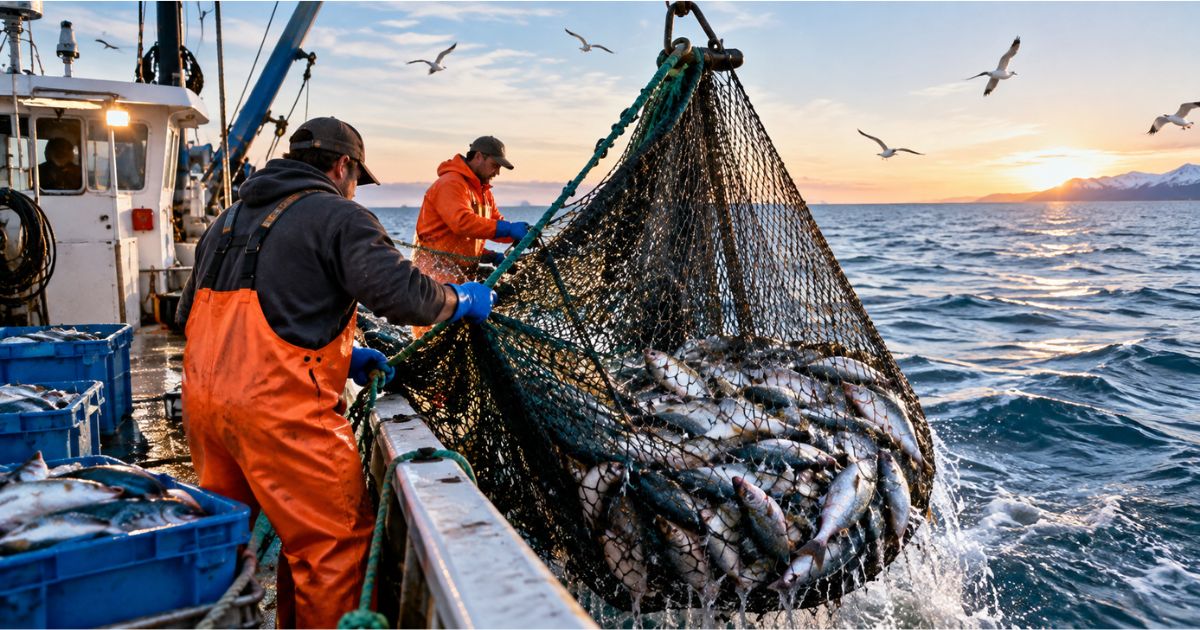
Commercial fishing is catching fish or other seafood to sell for profit, rather than to eat yourself or for fun. It happens in oceans, rivers, and lakes. It ranges from one person in a small boat to huge fleets of ships.
In the U.S., commercial fishermen landed 8.4 billion pounds of fish and shellfish worth $5.1 billion in 2023, according to NOAA Fisheries’ latest Fisheries of the United States report.
Quick Answer
- What it is: Catching seafood in order to sell it.
- How big: About 8.4 billion pounds landed in the U.S. in 2023 (NOAA).
- How it’s done: Nets, lines, traps, and dredges.
- Who regulates it (U.S.): NOAA Fisheries, plus state agencies.
- The big trade-off: It feeds millions of people, but badly managed fisheries can be overfished.
What Counts as Commercial Fishing?
Here’s a simple way to tell. Ask three questions:
- Is the catch being sold, traded, or bartered?
- Does the law require a commercial license for this fishing?
- Is it for profit, not just for dinner or sport?
If you answer “yes” to any of these, you’re almost certainly looking at commercial fishing.
That mirrors the way federal rules put it. One federal regulation says fishing is commercial if the person holds, or is legally required to hold, a commercial license, or if the fishing results in sale, barter, or trade of fish for anything other than personal consumption, per the definition in 50 CFR 660.702.
Commercial fishing is a type of fishing, but not all fishing is commercial. Here’s how the main kinds compare:
| Type | Why people do it | Sell the catch? | Example |
| Commercial | Profit | Yes | A crab boat selling to a processor |
| Recreational | Fun or sport | No | A weekend angler at a lake |
| Subsistence | Food or ceremony for self and family | No | A family that relies on fish as a main food source |
| For-hire (charter) | Selling trips, not fish | No (the trip is sold) | A guide taking paying clients out |
The for-hire row trips people up. A charter captain earns money, but the product is the fishing trip, not the fish. NOAA’s data keeps for-hire fishing separate from commercial landings, along with sport and subsistence fishing.
How Does Commercial Fishing Work, From Boat to Plate?
Think of it as a chain. Each link adds cost and value.
- Harvest. A crew catches fish with a boat and gear. Many trips last days, and large ships can stay out much longer.
- Landing. The boat comes to port and unloads. The pounds brought to shore are called landings.
- First sale. The fisherman sells to a dock buyer or processor. The price paid here is the ex-vessel value. NOAA describes it as what the fisherman is paid at the time of first sale.
- Processing. Fish get cleaned, filleted, frozen, canned, or packaged. Some big ships process the catch at sea.
- Distribution. Trucks, planes, and ships move seafood to stores, restaurants, and export markets.
- Retail. You buy it.
Why this matters: the dock price is just a slice of the final price. Michigan Sea Grant notes that in Canada, processed value is estimated at at least five times the landed value, because processing turns whole fish into fillets and packaged products.
So when you read “$5.1 billion in landings,” that’s the dockside number, not what shoppers pay.
What Are the Main Types of Commercial Fishing?
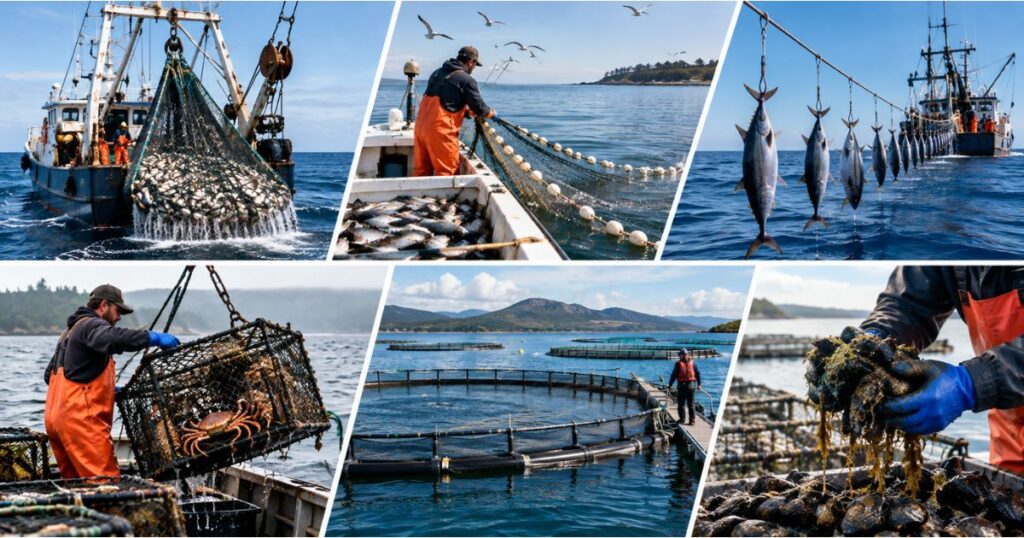
There are two ways to sort it: by gear (how fish are caught) and by scale (how big the operation is).
By gear
| Gear | How it works | Typical catch | Watch out for |
| Trawl nets | A cone-shaped net is dragged behind a boat | Pollock, cod, shrimp, flatfish | Seafloor damage (bottom trawls), bycatch |
| Purse seines | A net circles a school, then closes like a drawstring bag | Tuna, herring, sardines | Bycatch if the school is mixed |
| Gillnets | Netting hangs in the water; fish get caught by their gills | Salmon, whitefish | Entangling non-target animals |
| Longlines | One long line with hundreds or thousands of baited hooks | Tuna, swordfish, halibut | Hooking seabirds, turtles, sharks |
| Traps and pots | Baited cages that fish or shellfish crawl into | Crab, lobster | Lost gear that keeps trapping |
| Dredges | Heavy frames scrape shellfish off the bottom | Scallops, clams | Seafloor disturbance |
| Hook-and-line (handline, troll) | Individual lines, often by small boats | Salmon, tuna, snapper | Lower volume, usually more selective |
Bycatch means catching animals you weren’t trying to catch. Some gear, like longlines and certain nets, catches more of it than others. Gear designers and regulators keep working to reduce it.
On the Great Lakes, most commercial fishing uses gill nets or trap nets, with trawls in certain places. Trap nets funnel fish into a box where they swim freely until retrieved.
By scale
Small-scale (artisanal) fishing uses small boats, short trips, and little machinery boats selling to local markets.
Industrial fishing uses large vessels, advanced gear, and sometimes onboard processing. Factory ships can freeze and store the catch at sea, so fleets can work far from port. One EBSCO overview notes that in one hour, a factory ship can harvest more fish than a sixteenth-century boat could in a whole season.
Is fish farming “commercial fishing”?
It depends on who’s counting. Some sources lump fish farming (aquaculture) in with commercial fishing. NOAA’s commercial landings figures leave out aquaculture products, except clams, mussels, and oysters.
Why it matters: according to NOAA Fisheries, as summarized by EBSCO, fish farming supplied more than half of all fishery products for human consumption in the 2020s. So “wild-caught” and “farmed” are two big, separate supplies. Always check which one a statistic includes.
Commercial Fishing in the U.S.: The Numbers
Here are the headline facts, one per line:
- 2023 landings: 8.4 billion pounds, valued at $5.1 billion. (NOAA Fisheries, Fisheries of the United States)
- 2021 for comparison: 8.6 billion pounds, valued at $6.5 billion. (NOAA Fisheries) Weight stayed similar, but value dropped, a reminder that price swings matter as much as catch size.
- Global context: Commercial fishing is described as the most widespread human activity at sea, according to Global Fishing Watch.
Regions behave differently
NOAA tracks landings by region, and the 2019–2024 trends don’t match:
- Alaska: Landings were similar to historic levels, with no recent trend.
- Northeast: Landings were substantially below historic levels, with a decreasing trend.
- California Current and Gulf of America: Roughly in line with historic patterns, per the same NOAA pages.
- Great Lakes: A small but important freshwater fishery. U.S. commercial fishermen on the Great Lakes brought in nearly 14.7 million pounds worth $19.2 million in 2015. Those figures are older, so check Michigan Sea Grant for updates. Top catches include yellow perch, lake whitefish, and walleye.
On the Great Lakes, tribal fishing rights also matter. Treaties with sovereign tribal nations shape who can fish where, as described by Michigan Sea Grant.
Who Makes the Rules?
Commercial fishing is one of the more regulated industries around. In the U.S., the layers look like this:
- Federal waters: NOAA Fisheries manages fisheries under the Magnuson-Stevens Act, the main federal fisheries law. Federal waters generally run from state waters out to the edge of the U.S. Exclusive Economic Zone (EEZ), 200 nautical miles from shore.
- State waters: State agencies set licenses, seasons, and limits closer to shore.
- Tools managers use: Licenses and permits, catch limits (quotas), seasons, gear rules, and area closures.
Why so many rules? Fish are what economists call a shared resource. EBSCO explains that when fish are common property, any fisher who holds back to protect breeding stock risks losing the catch to a rival boat. That’s the “tragedy of the commons” idea, a core reason limits exist.
Managers also have to watch the data carefully. Fishing hard on a shrinking population can hide the decline: catch can stay high even as the stock dwindles.
Is Commercial Fishing Sustainable?
It depends on the fishery. Some are well managed and healthy. Others are overfished. Here’s the balanced picture.
The case for “it can work”
Wild fisheries can stay productive when catches stay at sustainable levels. EBSCO notes that even depleted fisheries may recover. NOAA’s own page describes U.S. fisheries as among the world’s largest and most sustainable.
The case for concern
- Overfishing: According to the UN’s FAO, as reported by EBSCO, 64.5 percent of assessed marine fish stocks were within biologically sustainable levels in 2021, and 35.5 percent were overfished.
- Illegal fishing (IUU): Global Fishing Watch says illegal, unreported, and unregulated fishing accounts for up to one in every five fish caught at sea.
- Bycatch: Non-target animals thrown back are often dead or dying by then.
- Habitat damage: Bottom trawling can scrape up seafloor habitat. EBSCO describes heavy trawls dragged across rough ocean floors, which destroys habitat and food for the young of many species.
- Subsidies: Governments worldwide pay tens of billions of dollars a year in subsidies, helping keep more boats afloat than the oceans can sustainably support.
A real-world warning
In 1992, commercial cod fishing near Canada’s Grand Banks was shut down after nations misjudged how many fish the area could support. EBSCO notes the cod population still hasn’t fully recovered, even after the moratorium ended in 2024.
Why the Numbers Don’t Match
If you’ve read other articles, you may have seen numbers that clash. Here’s why:
- “Overfished” figures vary. One source’s metadata even claims nearly 90% of stocks were overfished, while the same page’s body text gives 35.5%. Different years, different definitions, and different groups of stocks produce different totals. Look for the year and whether the figure covers assessed stocks only.
- Job counts vary. Global Fishing Watch cites nearly 60 million people directly employed in fisheries and aquaculture, while a Britannica snippet cites about 250 million. The two likely count different groups, such as direct vs. indirect workers or fishing vs. the full supply chain. Check the definition before quoting one.
- “Commercial fishing” itself varies. Some sources count fish farming; NOAA’s landings mostly don’t.
Rule of thumb: before trusting a number, ask: What year? What’s counted? Who measured it?
Technology That Changed the Industry
Tools make fishing more efficient, and sometimes harder on fish stocks:
- Sonar and aerial spotting help crews find fish.
- Nylon nets are stronger and last longer than older materials.
- Factory ships freeze and process the catch at sea.
- Vessel tracking is now a transparency tool. Global Fishing Watch uses satellites and machine learning to show where, when, and how vessels are fishing, and in 2018 it found commercial fishing across more than 55 percent of the ocean.
Tracking helps managers spot illegal activity. It’s one way technology can protect fish, not only catch them.
Jobs, Pay, and Safety
Commercial fishing can offer real jobs, but it isn’t a steady paycheck. Pay can vary a lot from boat to boat and season to season. Many fishermen are self-employed, so their income rises and falls with catch size and market prices.
It’s also one of the more dangerous jobs in America. One summary reports that 878 commercial fishermen died from traumatic injuries on the job from 2000 to 2019.
Buying Seafood You Can Feel Good About
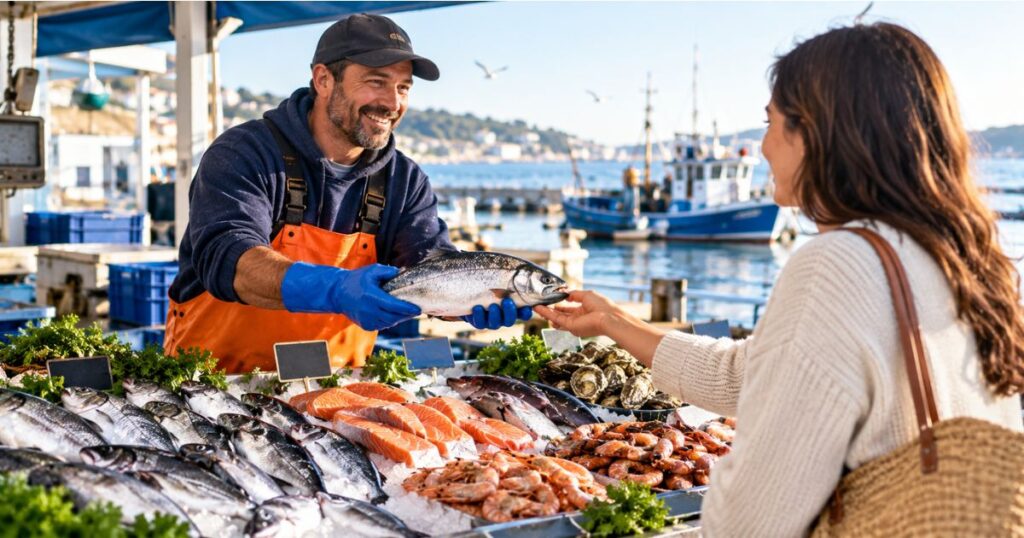
You don’t need to be an expert to shop smarter. Try these:
- Ask where and how it was caught. Good counters can tell you.
- Look for U.S.-managed wild fish when it fits your budget, since U.S. fisheries operate under federal management plans.
- Check third-party labels such as the Marine Stewardship Council (MSC) for wild-caught fish.
- Mix it up. Don’t rely on one popular species. Variety eases pressure on stocks.
Key Takeaway
Commercial fishing is catching seafood to sell. It’s different from recreational and subsistence fishing, and it’s built on a chain from boat to dock to processor to store. The U.S. landed about 8.4 billion pounds worth $5.1 billion in 2023, using nets, lines, traps, and dredges under federal and state rules. It feeds millions and supports coastal towns, but sustainability depends on how each fishery is managed. When you read a statistic, always check the year and what’s included.
FAQ
What is commercial fishing in simple terms?
It’s fishing done to sell the catch for profit. The seafood goes to processors, stores, and restaurants instead of being eaten by the person who caught it.
What is the difference between commercial and recreational fishing?
Commercial fishing is done to earn money from selling fish, and usually requires commercial licenses. Recreational fishing is for fun or personal use, and the catch isn’t sold.
What are the main types of commercial fishing?
By gear, the main types use nets (trawls, seines, gillnets), lines (longlines, hook-and-line), traps and pots, and dredges. By scale, operations range from small family boats to large industrial fleets.
How does commercial fishing work?
Crews catch fish, land them at port, and sell to a buyer or processor. The seafood is then processed, distributed, and sold at retail.
Is commercial fishing sustainable?
It depends on the fishery. Well-managed fisheries can stay productive, but overfishing, bycatch, and illegal fishing are real problems. FAO’s assessment found 35.5 percent of assessed marine stocks overfished in 2021.
Is fish farming commercial fishing?
Sources disagree. Some include it, but NOAA’s commercial landings figures mostly exclude aquaculture, apart from clams, mussels, and oysters.
Is commercial fishing dangerous?
Yes. It ranks among the riskier U.S. occupations, with rough weather, heavy gear, and long hours. Check NIOSH for current fatality statistics.
